

Welcome back to Ulta Beauty Strategies, Glossy’s series breaking down the latest strategies of the retailer and its most popular brands.
To reach Gen Alpha, you must understand Gen Alpha — that’s the backbone of Ulta Beauty’s strategy to acquire teen and tween consumers born between 2010 and 2024.
“We really made it our mission to want to understand who they are and what they’re motivated by,” Kelly Mahoney, chief marketing officer of Ulta Beauty, told Glossy. “Most importantly, [we want] to create an experience of the future that allows them to start off their journey in beauty and wellness in the most healthy way.”
To do so, Ulta Beauty partnered with consumer intelligence company NielsenIQ to conduct a custom survey of more than 500 U.S.-based children and teens ages 8 to 17, plus their parents, in April and May of this year. The goal was to learn about their preferences and motivations, as well as how they feel about and interact with AI tools. Participants were compensated with points toward gift cards or other offerings.
For Anna Mayo, vice president of beauty at NielsenIQ, the most surprising finding was the importance of parents in shaping what Gen Alpha wants to explore, buy and replenish. According to the survey, called Ulta Beauty’s Smart Beauty Study, 55% of respondents say they learn about beauty and personal care from their parents, while 52% learn from peers, and 51% learn from social media.
“Parents are the most important influence on their purchasing,” Mayo told Glossy. “We definitely see a lot of cross-influence, where kids are influencing the parents and parents are influencing the kids. They’re shopping together, and they’re trying to understand these categories together.”
Slightly lower in the ranking of how Gen Alpha learns about beauty is trying products in store, watching online tutorials, and conducting online searches, charting at 39%, 31% and 25%, respectively. But perhaps the most surprising stat is that less than 20% of Gen Alpha respondents say they learn about beauty and personal care from influencers, AI chat tools, brand and store websites and apps, or emails, coupons and store ads.
Another key finding is sky-high interest in beauty and personal care from boys who already like to buy fragrance and hair care. “This [Gen Alpha] group is incredibly passionate [about beauty], and it seems to transcend across genders,” said Mahoney. “Their feelings about beauty and wellness seem to be almost equal [between boys and girls], and that’s really unique. I haven’t seen that ever.”
Mahoney also told Glossy that Gen Alpha seems far more interested in beauty than past generations at this age. “We thought those beauty enthusiasts of 10 years ago were passionate about beauty and wellness, [but] this group is incredibly passionate,” she said.
As for AI tools, like Ulta Beauty’s recently launched AI chatbot, the team found boys are early adopters while girls are embracing AI tools at a slower rate.
“[Gen Alpha boys] are leading the way in terms of AI use, so not only are we seeing them explore the category, but they are really early adopters, more so than girls, in using AI to search and explore and become more informed on their choices,” Mahoney said.
According to the survey, 35% of Gen Alpha beauty consumers currently use AI-powered personalization tools while shopping to generate tailored product recommendations, while around 30% rely on AI-powered search results or interest-based content suggestions.
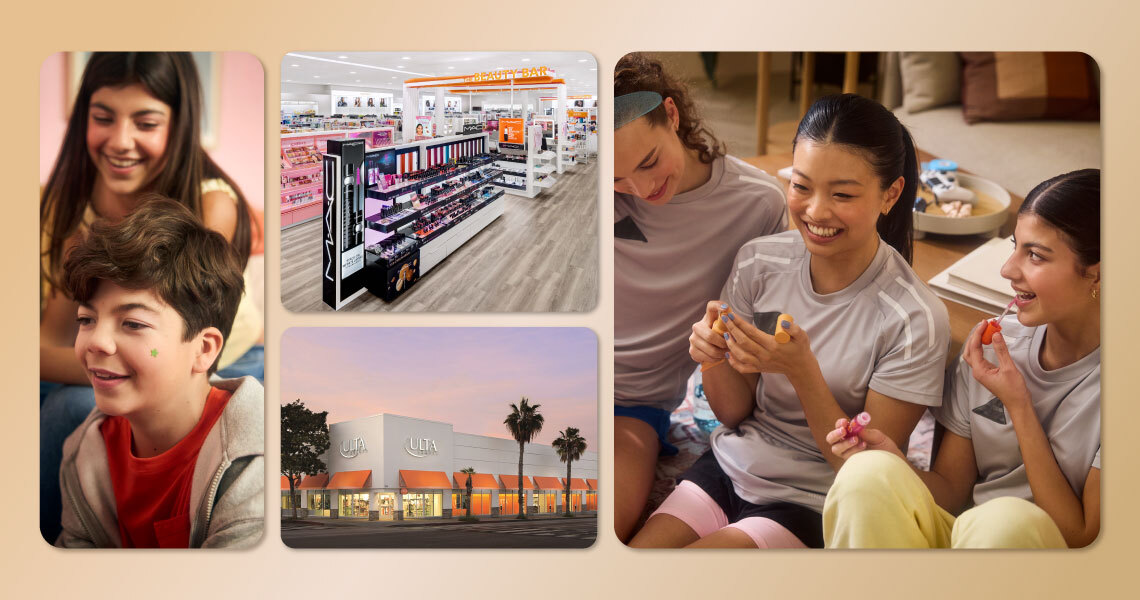
As for purchasing preferences, one may assume young people would prefer shopping online, but the Ulta team learned that, although digitally native, Gen Alpha shoppers are the first “hybrid shopping generation.” That is, Gen Alpha sees great value in utilizing digital and brick-and-mortar channels somewhat equally, Mahoney said. According to the survey, 78% of Gen Alpha consumers discover beauty products through at least one online source, while 77% also rely on real-world validation, including store visits, family and friend guidance, and peer conversations.
“Brands and retailers have a really big role that they can play here,” said NielsenIQ’s Mayo. “There was one quote in this study from a Gen Alpha parent that said they’re looking for an ‘age-appropriate section that we can explore together.’ This allows kids to stay within certain parameters, … [because] parents are also looking for products that are a little cleaner [than products made for adults].”
According to the survey, one-third of parents and guardians say the most important way retailers can build trust is by creating safe, welcoming environments for Gen Alpha, including age-appropriate assortments, clear ingredient labeling and knowledgeable in-store associate guidance.
Ulta Beauty will now utilize these findings to create new shopping experiences. “This particular cohort should be important to everybody,” Mahoney said. “What makes us so distinct in this is we have such a right to provide that trusted beauty and wellness authority. … I’m really optimistic about the future for us, and we take it on with great responsibility.”
