

Designers have a powerful role to play in reducing the apparel industry’s microplastic footprint—every material choice directly shapes environmental impact.
Over the past decade, research has consistently shown that natural fibers like cotton can biodegrade across a wide range of environments, including freshwater, saltwater, wastewater systems, soil, and compost. Unlike synthetic materials, which persist and fragment into microplastics, cotton garments can break down naturally over time—offering a fundamentally lower-impact alternative.
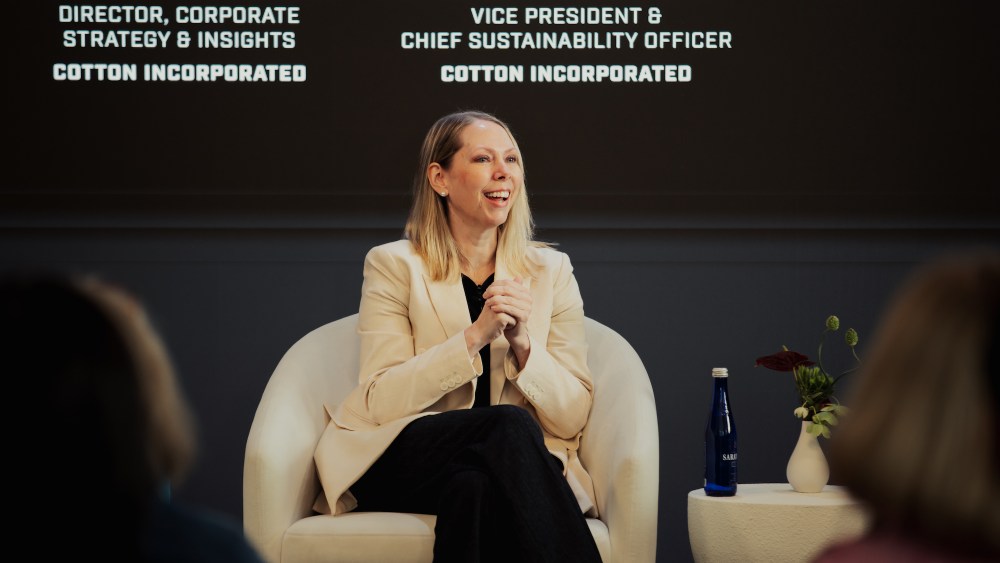
At Sourcing Journal’s “Road to 2030: Dealing with Detours” forum on Thursday in New York City, representatives from Cotton Incorporated explained how the organization has been studying this issue since 2010, building a strong scientific foundation with several published papers and nearly 1,000 citations.
The work has helped improve how the problem is measured and understood, particularly in relation to textiles and fibers. However, there was still a major data gap. While microplastics and packaging waste were recognized, Dr. Jesse Daystar, Cotton Incorporated VP and chief sustainability officer, said there was no clear estimate of how much plastic the apparel industry contributes to the environment.
To address this, Cotton Incorporated collaborated with leading global researchers to quantify plastic leakage across both cotton and synthetic value chains, spanning fast fashion and more traditional apparel categories. “We found that 14 percent of all plastic pollution comes from the apparel industry. That’s far higher than we originally anticipated,” he said.

Dr. Jesse Daystar, Cotton Incorporated VP and chief sustainability office
To put that into perspective, it’s about 20 times the weight of the Eiffel Tower or 23 times that of the Empire State Building, every single year.
The synthetic apparel value chain—from manufacturing pellets to the wash, dye and finishing—is a hot spot for microplastics, but it’s the end of life that really drives the overall impact. Though the United States has good waste infrastructure, Daystar emphasized that’s not how it is everywhere in the world.
“One of the problems that we contribute to, and other more developed economies, is that when we donate our clothing and think we’re doing what’s good for the environment, but it will get shipped to a country that doesn’t have proper waste infrastructure,” he said. “It’s more like shipping trash.” Donations often land in mountains of waste, contributing to plastic leakage in other countries.
Microplastics have the potential to become a greater headache for an apparel industry too dependent upon plastic fibers. Daystar pointed out how microplastics are now being considered for inclusion on a list of contaminants that could be regulated by the U.S. Environmental Protection Agency and U.S. Department of Health and Human Services.
“[Microplastics have] gone from something that maybe you’ve heard of to something that could be regulated in the future. So that really changes the conversation,” he said.
Additionally, consumer awareness of microplastic pollution is higher than brands realize, raising the stakes for fiber content disclosure, preferred fiber programs, and claims substantiation across the supply chain.
Industry professionals estimated that only about 28 percent of consumers are aware of microplastics. In contrast, Cotton Incorporated’s consumer research found that 41 percent of U.S. consumers say they’re aware of microplastics pollution—up from 17 percent in 2017—signaling a steadily growing issue shoppers recognize and discuss. Among consumers concerned about microplastics, 41 percent say they consider wearing clothing containing microplastics to be a major concern and 59 percent of consumers say they’re likely to look for clothing made with microplastic-free fibers.
Companies are taking steps to reduce their plastic consumption, according to Melissa Bastos, Cotton Incorporated director of corporate strategy and insights. A Cotton Incorporated survey of industry professionals found that 59 percent are reducing plastic packaging—an effort that consumers can easily see—and about 48 percent say they’re looking to switch from synthetics to natural materials.
Cotton rises to the top with 66 percent of industry professionals saying they consider cotton to be a great alternative to the synthetic fibers, Bastos said. Other natural fibers like hemp and wool are also on their radar.
Choosing bio-based fibers over synthetic materials is where brands and consumers can make the biggest impact. Daystar emphasized how sustainability is complex. Factors like greenhouse gas emissions, production methods, and energy sources are difficult even for industry professionals to fully assess—let alone everyday consumers. What consumers can do, though, is check garment labels and opt for materials that don’t introduce more plastic into the environment or their bodies.
“By choosing cotton, that’s a real choice they can make that has real impact on the environment,” he said.
