

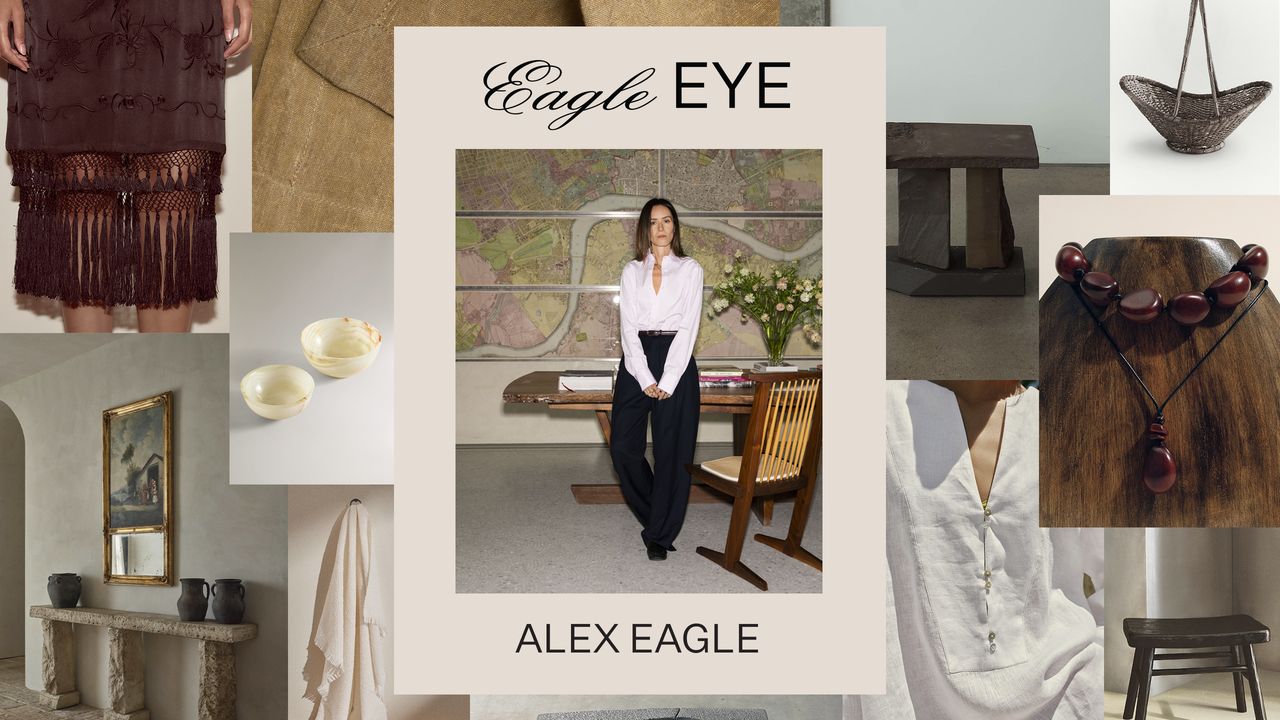
Eagle Eye exists to explain the gaps—between how we dress and how we live; between the spaces you’re drawn to and the coat you keep reaching for. Each month, London-based designer and creative director Alex Eagle will tap her roster of friends and experts to explore the “why” behind a certain theme—why we’re drawn to certain things, and how those instincts quietly form over years without us really noticing. It’s a column rooted in interior design, with many branches (and, of course, a curated edit of shoppable products to boot).
Lately, I’ve found myself buying peonies just as they’re beginning to drop their petals, reaching for vintage shirts softened by years of washing, choosing materials I know will look better in ten years than they do today; all things that carry evidence of time. There’s a Japanese philosophy for this feeling—wabi-sabi.
Rooted in Zen Buddhism, it has been quietly shaping aesthetics for quite some time. It emerged in the 15th century as a reaction against the ornate and the excessive, finding its fullest early expression in the tea ceremony, where rough-hewn bowls and uneven surfaces were considered more beautiful than lacquered perfection. Wabi, roughly translated, speaks to the beauty of simplicity and solitude. Sabi, to the grace that comes with age and wear. Together they describe something that Western taste has historically struggled to name: the appeal of the imperfect, the incomplete, the impermanent.
The chicest women I know aren’t constantly replacing their wardrobes; they’re repeating themselves. Not because they lack imagination, but because the object has moved beyond fashion and become something closer to identity. Ryota Iwai, founder of Auralee, sees the same quality in the things he reaches for himself. “I’m drawn to things that aren’t overly engineered or perfectly controlled,” says Iwai. “Things that feel a little worn, slightly imperfect, lived-in.” This way of thinking extends beyond fashion. For Imogen Kwok, a chef who works at the intersection of food and art, it’s her Japanese carbon steel knives, broken-in and aged, that best capture wabi-sabi: “The moment you accept that food is a living, changing medium,” she says, “you realize that perfection can only exist for a moment—if at all.”
As a designer, I find myself asking not how something will look when it’s finished, but how it will look in ten years’ time. Will the brass darken beautifully? Will the timber become richer? “You spend months obsessing over every detail,” says New York-based stylist and designer Colin King, “only to realize that time is going to become your collaborator.” Put that way, wabi-sabi can also be considered the decision not to intervene. You see it in the stone floor left unpolished, plaster walls that show their age, and brass handles worn bright in exactly the place a hand reaches every day. At Hôtel du Couvent, a 16th-century restored Provençal convent, this is very much the design directive. When the team behind the redesign found a monastery table at a flea market in northern Italy, worn smooth by decades of meals, they put it in the restaurant as the focal point, as-is.
“That table is the room. Not despite the patina; because of it,” explains Vanina Kovarski, head of brand for the hotel. “You can’t manufacture that. You can only have the good sense not to sand it down.”
At its center, wabi-sabi is about remembering that the objects we love most tend to share a quality with the people we love most: They become more themselves with time.
Imperfection
“True wabi-sabi is about discovering and embracing a flaw, or finding a quiet beauty within imperfection,” says Kwok. It’s a visible stitch, a glaze that pools differently on every piece in a set, a weave with slight irregularity. These are not flaws to be corrected but, rather, are the point entirely.
