

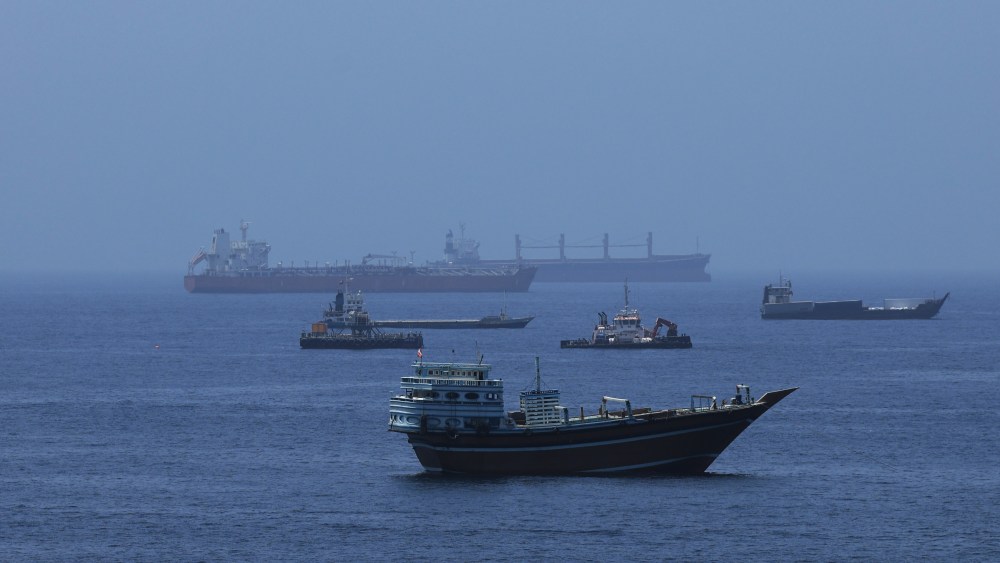
Iran is pressing the United Nations to recognize its authority over parts of the Strait of Hormuz, the waterway at the center of global attention since war broke out in the region in February.
“Parts of the Strait of Hormuz fall within the territorial waters of the Islamic Republic of Iran,” Iranian delegates said in a document submitted to the International Maritime Organization on Monday. “Under the international law of the sea, a coastal State exercises sovereignty, jurisdiction and sovereign authority over its territorial sea.”
The document didn’t identify which parts Iran claims control over, or state whether using alternative routes was acceptable to Tehran. The officials submitted the document as more ships sailing the vital oil channel face attacks from Iranian military forces despite Tehran and Washington agreeing to a framework deal aimed at ending their war.
Iran also claimed in the document that it is not a party to the United Nations Convention on the Law of the Sea (UNCLOS), which establishes that individual countries are legally obliged not to hamper or suspend transit passage throughout international waters under any circumstances. This would also apply to any potential tolls Iranian authorities impose on ships passing through the conflict-ridden conduit.
“Iran has persistently and explicitly challenged the characterization of this regime as customary international law, including at the time of the UNCLOS signature and through its ongoing legislative and diplomatic actions,” the delegates wrote.
The country has set up an oversight group, the Persian Gulf Strait Authority, in an effort to formalize its toll system and regulate the maritime traffic.
Indonesia and Singapore have taken the opposite stance regarding the state of their shared shipping corridor, the Strait of Malacca.
At a joint press conference Monday, Indonesian President Prabowo Subianto and Singaporean Prime Minister Lawrence Wong asserted that the countries were strategically aligned to keep the waterway safe, open and free for all vessels in accordance with UNCLOS.
“We must preserve peace and security in the strait, while also protecting it from pollution, accidents and piracy,” Prabowo said, adding that Singapore and Indonesia would continue coordinating closely with Malaysia and Thailand on the issue as a shared interest among countries surrounding the strait.
The strait, which also borders Malaysia, connects the Indian and Pacific Oceans.
The Malacca passage is pivotal to the apparel trade, as Asia-to-Europe or intra-Asia oceanic routes often pass through. Container ships that transport cargo from apparel manufacturing countries including China, Vietnam, Bangladesh, India, Pakistan and Myanmar are likely using the channel to move goods to other markets.
Some of the world’s busiest ports are positioned along the waterway, with the Ports of Singapore and Malaysia’s Tanjung Pelepas sitting at its southern entrance. Malaysia’s Port Klang is located near the midpoint of the 550-mile strait.
An estimated 22 percent of the world’s maritime trade passes through the strait, according to the Washington-based Center for Strategic and International Studies.
Three more vessels attacked in Strait of Hormuz
Although any concerns about the Strait of Malacca’s freedom of navigation appear to be quelled, the situation at the Hormuz escalated amid a new string of recorded attacks on vessels.
The United Kingdom Maritime Trade Operations Center (UKMTO) has tracked three separate incidents in a days’ span, starting Monday, all on tankers.
All three attacks occurred on the U.S.- and Oman-supported southern route, just miles off the coast of Oman. No casualties or environmental impact have been reported.
Both the UKMTO and local authorities have been investigating the incidents.
A U.S. official said Iran’s Islamic Revolutionary Guard Corps (IRGC) fired at least two missiles on two ships transiting the strait, inflicting severe damage.
As of Tuesday night, one of the ships, the Qatari liquefied natural gas (LNG) tanker Al Rekayyat, was at high risk of exploding due to a massive fire in its engine room, according to a recorded radio transmission reviewed by Reuters.
A Saudi-flagged crude oil tanker, Wedyan, was also damaged, the report said.
The third tanker has not since been identified.
Ahead of the attacks, the Joint Maritime Information Center said the threat level at the Strait of Hormuz remained substantial. The three attacks all occurred on the same southern route the center advised marines to transit through.
