

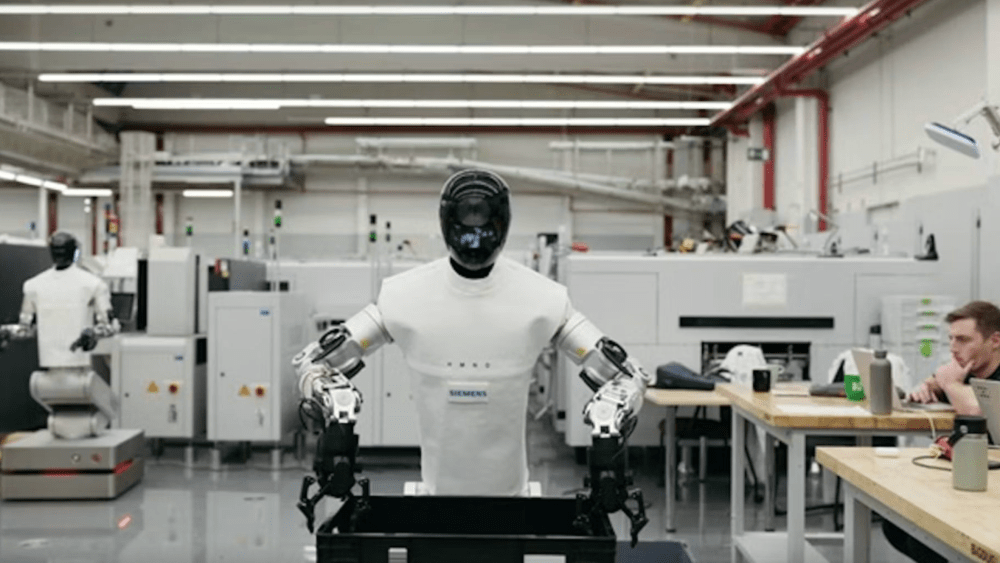
Here come the robots. While robotic arms have performed automotive welding for decades, sophisticated automation is now making a long-awaited leap into labor-intensive sectors such as apparel, logistics and industrial security.
Behind this shift is Jack Technology, which is a global manufacturer of industrial sewing machines that is leveraging AI and humanoid robotics to boost operational efficiency by at least 30 percent.
To achieve this, the company has teamed up with Siemens for software solutions spanning design and simulation, and even platform development. Jack Technology also ordered 2,000 humanoid robots tailored specifically for apparel manufacturing this year. The companies said this marks a landmark moment as it represents the sector’s first large-scale deployment of humanoid technology designed to operate in human-centric workspaces.
The fleet of robots is using existing tools without costly facility modifications.
Siemens said humanoid and quadrupeds are proving their worth across diverse, highly demanding operational environments. In a recent trial at Siemens’ electronics plant in Erlangen, a British startup’s wheeled humanoid robot successfully handled warehouse crates using physical AI technology.
The machine moved 60 crates per hour across eight-hour shifts. Tasks were completed autonomously. Meanwhile, robotics firm ANYbotics developed ANYmal, a four-legged robotic guard created to automate dangerous or difficult inspection tasks inside sprawling chemical and energy facilities. Navigating multi-story halls, stairs, and dark spaces, the quadruped uses infrared cameras and acoustic sensors to detect overheating equipment and subtle gas leaks. It relays critical real-time data back to human operators.
Siemens said a robot must continuously exchange data with production systems, synchronize workflows alongside human colleagues and adapt dynamically to shifting factory conditions. Isolated hardware is simply insufficient. To bridge this gap, Siemens provides the foundational digital backbone, supplying everything from digital twins and AI-enabled sensing to drive systems and fleet management software.
“The true value of a humanoid robot lies in its ability to become an integrated, collaborative tool within the manufacturing plant,” Siemens said in a corporate blog post. “This involves real-time data exchange with production systems and other autonomous guided vehicles (AGVs), the synchronization of workflows with other machines and human operators and adaptive operation that dynamically responds to changing conditions. Without deep integration, even the most sophisticated robot remains an isolated solution.”
