

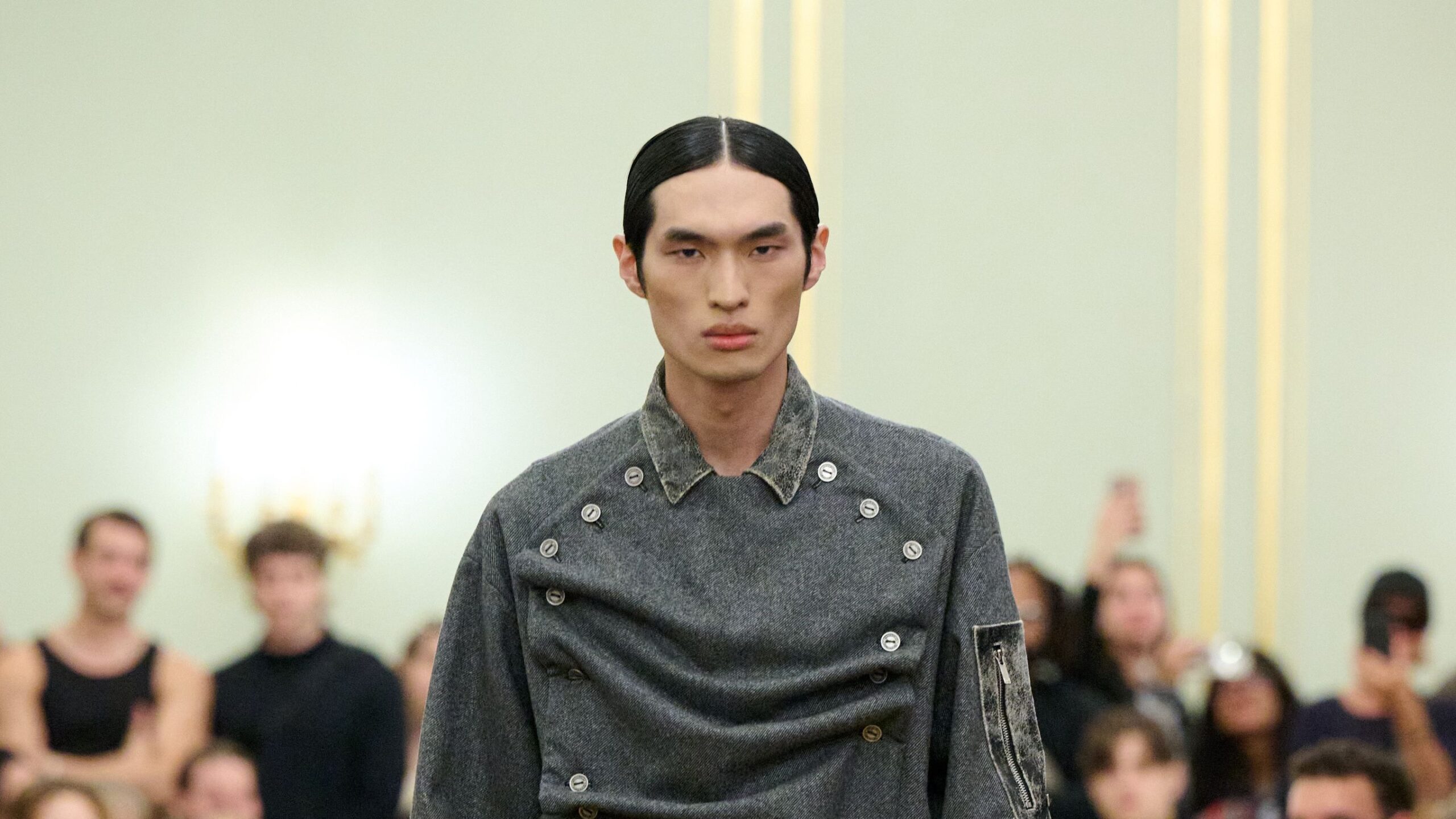
Little did Haderlump’s creative director Johann Ehrhardt know that when he was a waiter at a hotel, he’d one day end up a designer showing a collection in one. We’re at the Hotel Adlon, perhaps Berlin’s most storied hostelry, which lies in the shadow of the Brandenburg Tor, and sitting beneath 12 enormous chandeliers to see Ehrhardt’s spring 2027 Haderlump collection. Entitled Atrium, it began apparently, “in the hotel, as a memory…the stillness of off-season, the hierarchies of service, the strange intimacy of incompatible roles brought together by circumstance…to become the key architecture of the collection.” Backstage, Ehrhardt expanded on his thinking. “When we started looking to show in a hotel, the idea was to go somewhere very modern,” he said, “but then we came to the Adlon, the most historic one in the city, and it made so much sense to be here.”
Of course, you can see the parallels, between being in service as a designer, and that of a hotel employee: the notion of anticipating what someone wants and needs to feel cared for and comfortable; to create a sense that one’s every wish and hope is being catered to. In terms of the collection, which saw Ehrhardt continue to expand on his late 19th/early 20th century silhouettes—waisted, corseted, flowing, tailored—and bring them sharply into today with a cool, urban attitude and energy. There were the obvious hotel references—the room key as a decorative motif; metal fastenings that echoed cutlery; apron-like panels over the label’s signature super-wide pants; the graphic white lines on black that looked like an architectural façade rendering. Yet also the less obvious; of late, Ehrhardt has been pushing into evening looks more and more, so mid-show out came a strapless bias-draped faded denim dress, the idea being it’s like wrapping yourself in a hotel towel, and locked out of her room, a guest has had to walk through the lobby. (We’ve all been there, right?)
Yet the theme didn’t overpower Ehrhardt’s collection. He continues to fuse quotidian fabrics, materials we can all relate to—denim, leather, cotton for tees and sweats, with every one of them admirably coming from dead-stock, by the way—and use them for his dramatic, floor-sweeping looks, looks that speak to an ever-higher level of craft and accomplishment. Every look, he said, was meant to evoke a story, so aside from the poor unfortunate in her towel in the lobby, there was a crush of characters rushing around his square set, the chandeliers twinkling above, wearing the likes of a terrific patched black leather jacket, tightly belted over distressed jeans; a double-breasted great coat rippling with creases pressed into it; or a corset-laced, severe long dress, like something a governess would wear… if she was really into techno and liked to take herself off to Berghain of an evening.
