

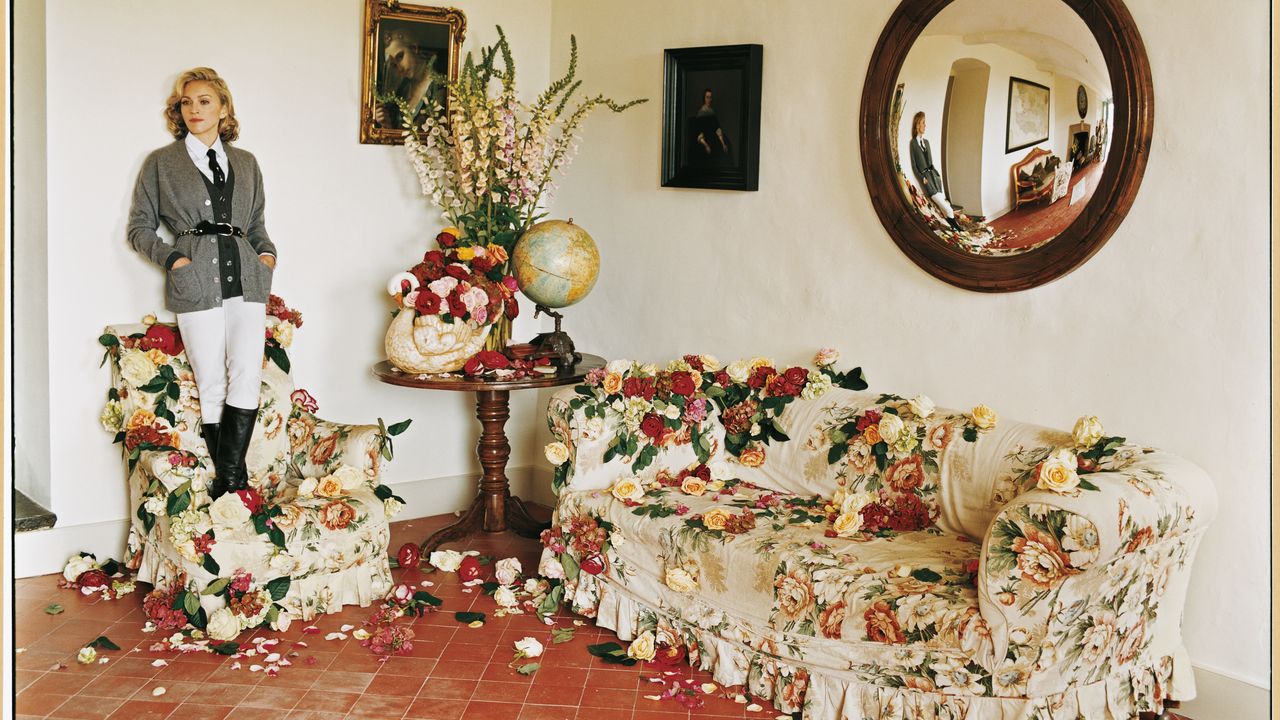
Cecil Beaton loved the place with “blind devotion.” When Beaton’s fifteen-year lease expired and he was evicted to make way for the landlord’s son, he wrote an elegiac book to assuage his great loss, a postwar requiem for the giddy, carefree thirties, the years of dressing-up, of masquerade and artifice. “We played; we laughed a lot; we fell in love,” he wrote. For Beaton, the place was “essentially an artist’s abode,” and he invited the great creative talents and stylemakers of the day to share his Eden: the writer H. G. Wells, and artists Salvador Dalí, Augustus John, Christian Bérard, and Graham Sutherland. They were joined by the period’s flamboyant style mavens, the Marchesa Casati, Lady Ottoline Morrell, Mona Harrison Williams, and Diana Vreeland among them.
When Madonna’s in residence she plays “lots of guitar; I go for lots of long walks, ride my bike. It’s a very physical place, a place for adventure. You can choose to go there to work in a very undistracted way and a very contemplative way, or you can go there and get lost in the environment. I always feel really melancholic when I’m driving away. I think if you’re a photographer, if you’re a painter, if you’re a writer it’s the perfect place to be,” says Madonna. “You feel protected because you’re sunk into that valley, and as far as the eye can see you can’t see another house. It’s a kind of buffer against the world.” Currently, Madonna is busy working on her new album (“basically all dance music”) with collaborator Stuart Price, which she hopes to release by the end of the year. She is also in the planning stages of a tour for summer 2006 and writing children’s morality tales. Her latest contribution to the world of children’s literature, Lotsa de Casha (Callaway), in which the richest man in the world loses everything but gains a friend (“There’s more to life than fame and fortune—something much more deep and profound,” says Madonna), follows The English Roses, her first foray into writing for children, itself the first of eight planned volumes; “The English Roses are going to take over the world!” Madonna says, laughing. Madonna’s own engaging children—Lourdes (Lola), eight, who has the preternatural grace and poise of a girl who takes her ballet lessons very seriously, and Rocco, four, a mischievous doppelgänger for his dad—have “never watched television,” says their mum crisply. “They’re fine. I don’t think they miss it. . . my daughter is a voracious reader, and I’m very pleased about that.”

