

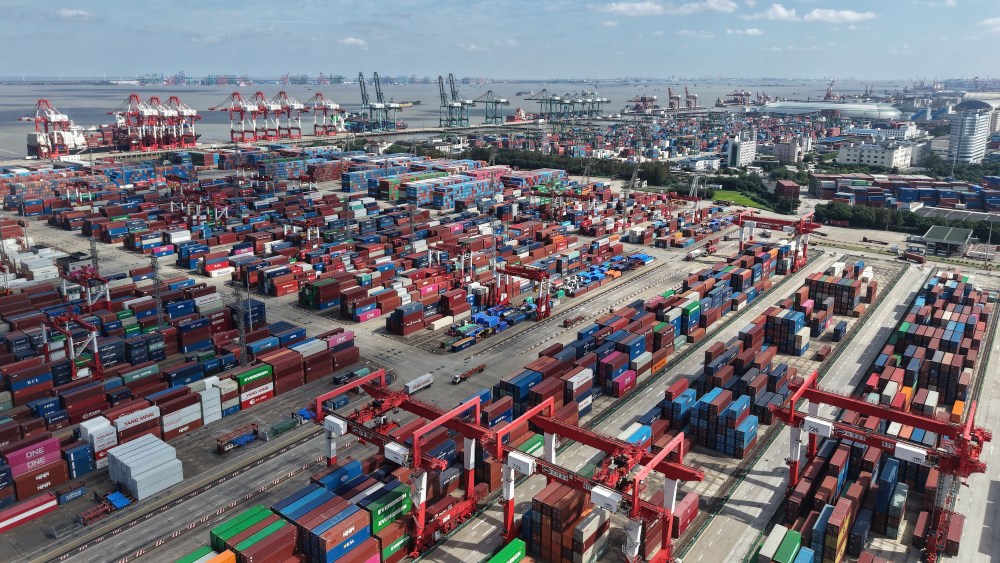
A “super typhoon” slated to hit eastern China and Taiwan on Friday could slow down port operations in impacted areas, compounding what has been heavier-than-usual congestion at major Chinese gateways in recent weeks.
As of Tuesday, forecasts indicate that the Category 5-strength Typhoon Bavi is expected to maintain super typhoon intensity of strong winds and torrential rain for two or three days before gradually weakening around Friday. But by then, gusts will remain at roughly 100 knots (115 miles per hour), which are conditions that are likely to disrupt operations and reduce capacity at ports, and disrupt the navigation of vessels crossing its path.
China’s Ministry of Transport maintained a “level-two” emergency response to heavy rainfall, the department said in a statement Tuesday, requiring all localities to strengthen maritime traffic safety initiatives ahead of the typhoon’s landfall.
“Strict enforcement of navigation restrictions during severe weather and flood seasons is required,” the alert read. “For vessels where safety cannot be guaranteed, the principle of ‘stopping all vessels that should be stopped, closing all vessels that should be closed, and evacuating all vessels that should be evacuated’ must be resolutely implemented to prevent risky navigation and illegal operations.”
Alongside the typhoon threat, China is currently experiencing severe weather in provinces like Hubei, Guangxi, Jiangsu and Shandong, with forecasts of heavy rainfall, thunderstorms and possible tornadoes in some areas.
In an update Tuesday, freight forwarding giant Kuehne+Nagel said Chinese ports including Shanghai, Ningbo and Yantian are “heavily disrupted,” noting that Bavi’s move toward the East China Sea will bring “significant disruption risk” expected from the end of this week.
Congestion has already forced ships to take longer to dock at these hubs, creating longer port stays for cargo ships. Data from container tracking solution platform Vizion indicated that as of June 29, it took a container vessel an average of 79 hours to berth at the Port of Shanghai after initially arriving at the gateway.
The average arrival-to-berth time is nearly double the 42 hours logged on May 18—when times started their escalation—and is the highest such number since Vizion tracked the figures in August 2024.
Vessel bunching at hubs like Shanghai and Ningbo has been the main culprit of the congestion. This occurs when multiple ships arrive in a short window at a port, overwhelming terminal capacity and often leading to severe bottlenecks.
Updates from Hapag-Lloyd have cited vessel bunching at both ports since June 8. The carrier said the average waiting time of Gemini Cooperation vessels docking at Shanghai jumped from an average of approximately 24 to 48 hours as of May 22, to a 60-hour waiting average by June 30.
Similarly, Gemini services sailing to Ningbo on the May date had a 24-hour waiting time on average, which had extended to a one-to-two-day average time to berth by the end of June.
According to data from container shipping market research firm Linerlytica, there were 156 ships waiting at anchorage at Shanghai and Ningbo on Tuesday, a significantly larger number than the 87 ships at berth.
The delays at the Chinese ports have exacerbated conditions worldwide that have been driven by strong cargo demand resulting in an earlier-than-normal peak shipping season.
Global port congestion worsened to its highest levels since 2022, the Linerlytica data said, with 10.9 percent of the fleet waiting at anchorages as of June 29. That amounted to 3.72 million 20-foot equivalent units (TEUs) that were in line to berth.
In the week since, the figures lightly cooled down to 3.61 million TEUs, or 10.6 percent of the fleet.
Linerlytica’s report said that 38 percent of the global congestion took place at north Asian ports, with northern Europe taking the second highest share at 13 percent.
Typhoon season impacts Chinese ports every year.
Almost two years ago, China’s east coast was smacked by one of the strongest storms in decades, which temporarily halted container operations at both Shanghai and Ningbo ports. With winds reaching 95 miles per hour, Typhoon Bebinca directly hit Shanghai and caused the city’s two international airports to cancel all flights for multiple days upon making landfall in September 2024.
A year later, Typhoon Ragasa forced multiple gateways including the Yantian terminal and the Ports of Nansha, Shekou and Hong Kong to shutter for multiple days, causing more shipping delays.
