

Material World is a weekly roundup of innovations and ideas that are reshaping the materials sector. It covers the latest developments in how fashion is designed, engineered, and scaled—from emerging biomaterials and next-generation leathers to engineered fibers and sustainable alternatives.
Carbios
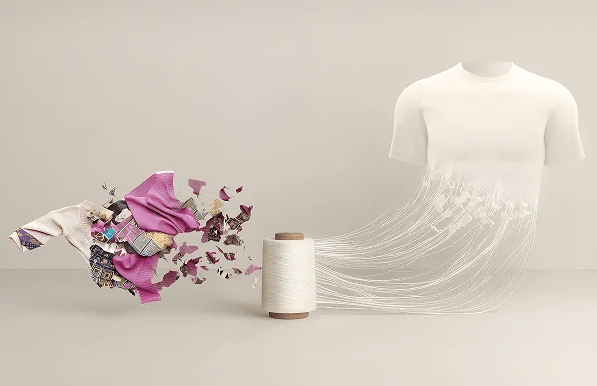
Biotechnology firm Carbios has successfully tested the use of its enzymatic biorecycling process for textile-to-textile recycling.
The company recycled complex, PET-rich textiles, simulating industrial-scale conditions, and it was able to convert more than 95 percent of the waste textiles in 24 hours. Carbios says the resulting virgin-quality monomers are equivalent to what it has achieved using PET from packaging. Following these results, the company is expanding its licensing to the textile market, which it notes is around twice the size of the PET packaging market.
Carbios’ demonstration plant in Clermont-Ferrand, France has now completed 100 batches spanning packaging and textile waste.
“Reaching the milestone of 100 batches confirms the robustness and industrial maturity of our technology,” said Benoît Grenot, CEO of Carbios. “Following the demonstration of our ability to process PET packaging waste and deploy this technology through licensing, we have now validated its application to complex textile waste streams. This achievement enables us to extend our licensing offering to the global textile market and meet the growing demand for scalable, circular recycling solutions.”
Tohoku University
Silk has plenty of inherent performance properties—including strength—but one issue has been the fibers’ reaction to moisture, which causes it to shrink and lose its shape.
Researchers at Tohoku University in Sendai, Japan have created a “super silk” that skirts this shrinking problem with a solution that begins with the silkworm’s diet. Plant-based cellulose nanofibers were sprinkled onto their food, which resulted in fibers that had a 50 percent greater tensile strength than non-treated silk. Additionally, compared to conventional silk, the worms with altered diets produced silk that shrank less than a quarter as much as conventional silk. The results were consistent even when the fibers were spun and made into textiles.
“Our goal was to improve silk while preserving its natural advantages,” said associate professor Hiroki Kurita. “We were excited to find that simply changing the silkworms’ diet produced silk that is both stronger and much more dimensionally stable in wet environments. We hope this sustainable approach will contribute to the development of next-generation functional textiles.”
Remade
The Remade Institute is investing $4.86 million in 10 research demonstration, verification and validation projects, two of which center on textile solutions.
Launched in 2017, Remade was founded in partnership with the U.S. Department of Energy, and it is a public-private organization that includes over 150 members across manufacturing, brands, education, trade organizations and more, such as Adidas, Nike, BASF and Milliken. The organization began with an initial investment of $140 million, and this is the seventh round of research it has funded. The projects will be co-funded by Remade and the chosen recipients.
Technology Readiness Levels (TRLs) is a one-to-eight scale that measures the progress of technology from research through to commercialization ready. In this scale, steps four through seven are often referred to as the “Valley of Death” since these phases are where technologies fail to advance from laboratory processes to pilots and commercialization. This round of research focuses on bringing solutions from step six to seven, which revolve around piloting.
Recipients MacroCycle Technologies and Eastman Kodak will be working on their project around SolvoGenesis, a process that chemically recycles textile waste into polyester resin. Another project with Rochester Institute of Technology and Goodwill of the Finger Lakes will center on a system for sorting and dismantling textile waste for recycling.
“By focusing Remade’s investment on these projects, we are getting closer and closer to fully commercializing these novel technology solutions, which once fully implemented are capable of achieving significant positive energy, manufacturing, environmental and economic impacts for us as a nation,” said Remade CEO Nabil Nasr.
ReFiber
On June 5, World Environment Day, ReFiber launched a demonstration project for used textile collection in Mumbai. Powered by doorstep laundry service OteRi, the campaign was able to collect 2.7 million tons of post-consumer textiles across 275 collections.
ReFiber is sharing the results and takeaways from the project in a whitepaper that launched at Bharat Tex. One of the key findings was that municipal services can effectively perform collection.
The paper also dives into some of the hurdles that remain for collection of used textiles. One challenge is that textiles get tossed alongside other waste, which reduces quality and prevents reuse. Other obstacles revolve around other missing levers, including incentives for individuals to participate, traceability, collection infrastructure and collection that connects to downstream uses.

From left, Anand Golecha; Naveen Sainani, Hon.Gen.Secretary, CMAI; Manoj Wanvari, COO, OterRi & ReFiber; Vrunda Manohar Desai, Textile Commissioner
“The Mumbai Textile Circular Economy Demonstration Project is a significant milestone in our journey to build a scalable textile circularity model through technology, data-led insights and ecosystem collaboration,” said Manoj Wanvari, chief operating officer of OterRi and ReFiber. “We plan to take this model forward by building city-wide, state-level and eventually national circular textile infrastructure powered by digital traceability, organized collection networks and inclusive stakeholder participation, a powerhouse solution and the need of the hour for India’s textile waste challenge.”
Brother
Equipment maker Brother International Corporation has launched the GTX300 Hybrid Garment Printer, which combines both direct-to-garment (DTG) and direct-to-film (DTF) applications. DTG is better suited for natural materials such as cotton, and DTF is a better fit for synthetics like polyester garments and performance apparel.

“The GTX300 is designed to help decorators say ‘Yes’ to more jobs without overhauling their production setup,” said Lawrence Davenport, vice president of the industrial products division at Brother International Corporation. “By combining DTG and DTF into one professional platform, we’re giving print businesses a practical way to expand what they offer, improve operational efficiency and grow with confidence.”
