

Nail art enthusiasts might be familiar with the terms stiletto, almond, square, and oval, all possible shapes available at your average manicure appointment. But the newest addition to that lineup might not be so well-known or as readily available. Meet the wolf claw or as it’s sometimes known, the cat claw. Like the name implies, the shape resembles an animal’s talons with its extremely curved line ending in a sharp point. Edgy and a bit eerie, for a subset of enthusiasts, it’s become a favorite for those seeking to push boundaries. Search the term on Instagram and you’ll find over 11,000 reels on the topic while TikTok videos on the style rack up millions of views. Though its origins are disputed, artists from across the world have adopted the aesthetic, offering creative takes that go from hyperrealistic to surreal to playful and bright.
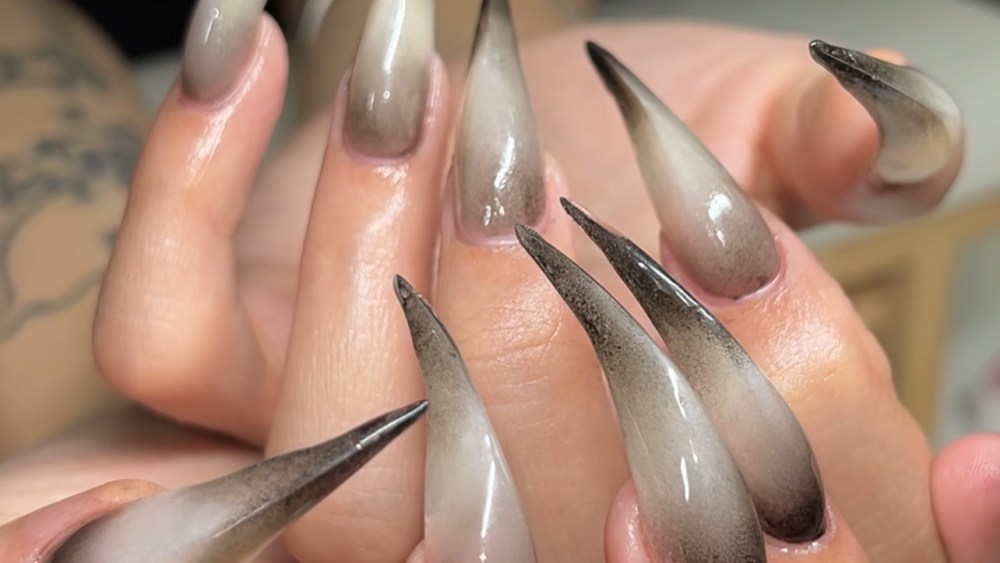
One such creator, Yanxin Chu, the founder of Little Kiss Ko, a nail salon in Sunset Park, Brooklyn, racked up over 3 million views for her design, which features an ombré set of wolf claws that looks as if they sprang straight out of the animal.
“This is an extremely curved stiletto shape, with a prominent apex. The curvature is up to the client’s preference and you can specify if you’d like them with or without the hook on the tips,” she said. Molded using gel or acrylic, they’re often time consuming to create, making it trickier to find someone who is familiar with the technique. “These nails are in demand and not many techs offer it yet in New York City,” explained Katie Nanami Kosharek, a Brooklyn-based artist who goes by Subversive Nails on Instagram, and offers the service by hand sculpting each extension in order to customize it to her client’s hands.

Courtesy of Katie Nanami Kosharek
Given their unusual shape, wolf claws come with pros and cons. “They make hands look long and slender but they’re also impractical. These are extremely difficult to handle in everyday life, be it washing your hair or putting in contacts,” said Chu.
In order to make it manageable she advises asking for a free edge that takes up half of your nail bed versus going extremely long. For Kosharek, she’s done shorter versions that hook just past the tips of fingers. Regardless of length, both emphasize that you’ll need a professional to remove them. “There’s just a lot of bulk and the material is not as easy to file through,” said Kosharek.
The joy and appeal of wolf claws comes in customizing the art that goes on top of the sculpted nails. Chu loves hyperrealism or using an ombré effect to mimic dirt, giving it a grungy feel. Others on social media lean into bold colors or animal stripes, to play up the wild quality of the shape. But the most clever way to take advantage of this trend? Both Chu and Kosharek advise a technique called encapsulation, where decorative elements are sealed between layers of clear gel, giving it a surreal, artistic effect. Whatever the artistic direction, should you be seeking a different take on your next manicure, perhaps the wolf claw is the answer.
