

At fashion’s flagship sustainability conference, the industry doubled down on circularity, recasting sustainability as a business problem and pushing workers to the margins of the conversation.
It was a repositioning that defined the recently concluded Global Fashion Summit in Copenhagen. Of 40 sessions held across five platforms—the main Concert Hall Stage, the side Action and Ignite Stages and the new Workshop and Community hubs—roughly a dozen centered on scaling textile recycling, grappling with EPR legislation and tackling resale or repair models. Just four addressed the climate crisis directly.
And workers—the people who keep the supply chain running—were the focus of only three.
The imbalance was hard to ignore. Even sessions that touched on labor often approached it through the lens of risk, reputation or economic impact rather than workers’ inherent rights. A panel on accountability in Italy’s luxury sector, for instance, centered on industry “ecosystems” and “costs on society” despite being prompted by court cases linking major brands to sweatshop labor.
The missing human element was stark enough that it was called out in real time. Speaking from the Community stage in the middle of the innovation showcase, Ruth Álvarez-DeGolia, founder and executive director of the artisan nonprofit Mercado Global, warned that it is “too easy to miss important perspectives” when sustainability is viewed only through an environmental—or Western—lens.
“In Guatemala and other parts of Latin America, women used to wear traditional clothing that would last for years because the quality was so incredible,” Álvarez-DeGolia said. “Now, the market is inundated with used clothing from Europe and the U.S. Brands might call this ‘upcycling’ or ‘circular economy,’ but it’s not necessarily good if low-quality used clothing is destroying traditional crafts and being quickly disposed of.”
But most of the summit’s speakers treated circularity—a nebulous concept at the best of times—largely as an engineering puzzle, constrained by immature infrastructure, policy gaps and weak economics. This reflected the wider pivot of the conference itself, which moved away from the loftier, values-driven rhetoric of previous years by reframing sustainability not so much as a moral imperative but rather as a core business competency.
“We do see a great commercial value to invest in the reverse supply chain,” Leyla Ertur, head of sustainability at H&M Group, told the summit. “It’s moving toward bringing waste to a high level of resources, not only as a great sustainability agenda but also a great business agenda: It lowers our vulnerability to raw materials, it prepares us to be ready for financial risk, it also creates great design opportunities for us.”

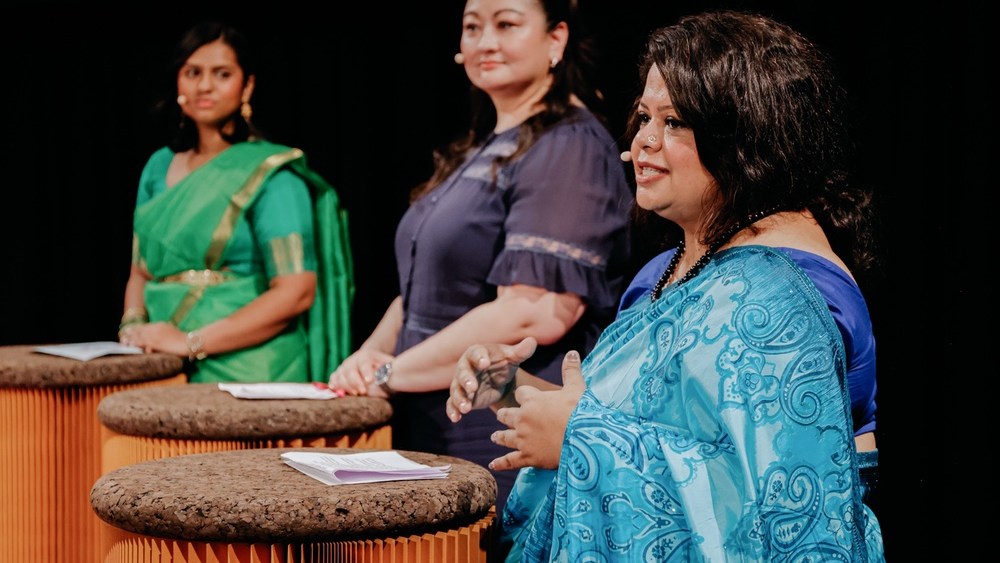
Anna Gedda of H&M Foundation and Aarti Mohan of Sattva speaking at “The Deepening Imperative to Decarbonize Fashion for People” panel on the Concert Hall Stage at the Global Fashion Summit in Copenhagen, Denmark, on May 6, 2026.
Courtesy
Paulo Cunha, a Member of the European Parliament, likewise framed circularity in the fashion and textile industries as a “strategic necessity” for a more competitive Europe that doesn’t rely on “external dependencies” like critical raw minerals and other important inputs.
“Circularity helps European companies innovate, improve resource efficiency and reduce production costs over time,” he said. “It strengthens our industrial resilience and allows our business to lead in higher-value, more sophisticated markets in the global environment where competitiveness increasingly depends on efficiency, feasibility and responsible production.”
Not everyone saw that as a problem. Several welcomed the shift toward execution. Muchaneta ten Napel, founder of policy consultancy Shape Innovate, wrote on LinkedIn that fashion had entered its “implementation era,” while Charlotte Brunnström, strategy lead at the H&M Foundation, observed that climate was increasingly being treated as both an operational and financial reality.
Still, some questioned whether the industry was avoiding harder conversations about human rights and overconsumption. For all the talk of circularity, waste workers—the plastic pickers in Brazil, secondhand retailers in Ghana, textile sorters in India, to name a few—were largely overlooked.
“Modern slavery and labor exploitation are not side issues,” said Grace Forrest, founder of anti-slavery nonprofit Walk Free, shortly after speaking on a panel about human rights due diligence on the Action Stage. “They are deeply connected to the systems driving global production and consumption. Yet at major global forums, the people speaking about frontline harm and workers’ rights are often pushed to the side stages rather than being at the center of the main conversation.”
The human cost of fashion wasn’t completely absent from the spotlight. On the coveted Concert Hall stage, Anna Gedda, CEO of H&M Foundation and Aarti Mohan, co-founder and partner of Sattva Consulting, spoke about how decarbonization will fail if people aren’t moving along with it.
“Decarbonization is going to solve for the climate imperative,” Mohan said. “It shouldn’t unlock another crisis in the form of people being left behind. So we have to do decarbonization with the worker transition in tandem.”
Mohan described workers manually lifting heavy fabrics at 50 degrees Celsius, or 122 degrees Fahrenheit. As cutting-edge machinery replaces these punishing jobs, she said, the industry must not abandon workers in less-skilled roles—women in particular.
Gedda conceded there was a “paradox” at play: “On the one hand, you need to go fast; on the other hand, you also need to be inclusive,” she said. “But I think that there can really be like a sweet spot. And that comes back to putting the worker perspective at the center from the start, to understand both the challenges and the opportunities.”
A question of representation
But one of the summit’s—and the industry’s—most urgent topics, heat stress and workers, was still pushed to a side stage session titled “Fashion, Climate & Women’s Health.”
Farhana Islam, a quality inspector at Tusuka Trousers in Bangladesh and the event’s sole garment worker, couldn’t attend because of visa issues. Hakan Karaosman, the Politecnico di Milano associate professor who moderated the session, used the moment to remind the audience of the privilege of being in the room and how those most affected by the industry’s decisions are often unable to access it.
Dr. Harshita Umesh, founder of Vaada Hope Foundation and a surgeon in training, described the patients she has treated on India’s hospital floors: workers who compare factory labor to being “trapped inside an oven,” who stop themselves from drinking water because it means asking permission to use the bathroom, who beg for medicines despite illnesses that require more extensive treatment because they must hurry back to their stations—or risk losing their jobs.
“Heat definitely becomes more dangerous when you’re underpaid, when you’re female, and especially when you come to India and you have the layered angle of caste, where there’s no legal protection,” she said. “I’m no longer treating an illness; I’m treating the consequences of a system that is based on inequity and is choosing to put a price on their lives.”
Tiffany Rogers, vice president of research and development at the Fair Labor Association, saw a missed opportunity in the lack of emphasis on wages. Speaking on the same panel, she noted that there remains an average 45 percent living wage gap in Bangladesh, meaning workers are earning barely half of what they need to survive.
“I’m grateful to represent the Fair Labor Association’s work on living wages as part of our impact partnership with Global Fashion Agenda,” she said later. “However, any brand speaking on that stage should be committed to wage transparency for workers in fashion supply chains. In addition, we are missing the voice and leadership of unions and worker representatives.”
And if it were up to Rawnak Jahan, director of CARE Bangladesh’s women and youth program—who rounded out the session by speaking about H&M Foundation’s Oporajita collective impact initiative—the summit would have focused more on brand investments in women.
“She built the industry, but today she is being left behind,” she said of the average garment worker in Bangladesh. “When the industry began, women made up 80 percent of the workforce. Today, that figure has dropped to 53 percent and it is still falling. Nearly 27 percent leave the sector entirely, not by choice, but because they are forced to care for children, to comply with husbands and male relatives who control their participation, and to escape a system that was never designed for them to rise.”

Vidhura Ralapanawe of Epic Group speaking at “The Decarbonisation Pathway: Transitions and Turning Points” panel on the Concert Hall Stage at the Global Fashion Summit in Copenhagen, Denmark, on May 6, 2026.
Courtesy
Vidhura Ralapanawe, executive vice president at Epic Group, subjects the conferences he attends to what he calls the “Martian test.” The Global Fashion Summit didn’t pass.
“A Martian crash-lands in Copenhagen and listens to us talk about sustainable fashion for three days,” he said. “What is the Martian going to think? It’ll say there are some issues here and there, but overall, we are on a good track.”
But Ralapanawe saw a “really big gap” between what gets said in closed-door roundtables and what is said onstage. As a supplier, he understands some of the reticence: after all, these are public companies. At the same time, “you can’t come out and say everything is hunky dory on the main stage and then, in a private setting, say that things are not so good,” he said.
He also had a gripe about representation that was barely better than that of workers: he was only one of two manufacturers in the financing roundtable and among a handful who spoke onstage.
“Aside from the recyclers and those with novel materials, there’s hardly anybody; it’s so expensive that only those who are invited to speak come,” Ralapanawe said. “It’s called Global Fashion Summit, but it’s not global.”
Accessibility is indeed a hurdle: At 450 euros ($524), an online-only ticket costs more than five months of a Bangladeshi garment worker’s wages. H&M Foundation sponsored both Umesh and Jahan—and would have done the same for Islam.
When voices reached the main stage, some of the direction missed the mark. Ralapanawe, speaking on a Concert Hall panel regarding financing for decarbonization, found he had to insist on integrating the realities of heat stress and climate adaptation into the financial models being discussed.
“You cannot talk about decarbonization without integrating the heat stress adaptation, because air conditioning changes your emissions profile,” he said. “But what was unique about our session was there were two manufacturers and two financiers and not a single brand. It’s almost as if we’ve concluded that financing decarbonization is a manufacturer issue and that the problem with manufacturers is they don’t have access to finance.”
At the start of the Global Fashion Summit, Federica Marchionni, CEO of Global Fashion Agenda, acknowledged the instability roiling the industry.
“We are living in a moment that is unstable, and your presence is critical in this defining time of transition,” she said. “What happens in this room doesn’t stay in this room. It travels into climate change, into communities, into closets and into the lives of millions of people that this industry employs.”
Interrogating the summit’s theme, “Building Resilient Futures,” she talked about how global trade routes are being disrupted in ways no one could have anticipated years ago, inflation is squeezing consumers, and climate remains the “silent co-author continuing to write his own terms.”
“The question is, where do we respond in time?” she asked. “Do we shape the future or wait for it to shape us? Fashion has a genuine, real opportunity to demonstrate that an industry can embrace new intelligence while becoming more human, not less.”
It was at an Action Stage session, not the agenda-setting Concert Hall, that Shannen-Kaylia Henry, founder of biomaterials firm CocoaFiber and a 2026 member of the GFA Next Gen Assembly, delivered what she called an “uncomfortable truth”: fashion operates from a “place of speed and profit, as opposed to a place of an internal understanding of its own system.”
Ziyander Mute, founder of township-based circular initiative ECOnnect Labs, took that idea further, noting that access to fashion education is often limited by cost, geography or language. By gatekeeping who can participate in fashion’s future, the industry is effectively stifling its own ability to survive.
“If it remains inaccessible in this way, then fashion adaptation may not be as effective because the people who are most capable of driving the resilience are systematically excluded,” Mute said.
