

Simplifyber is positioning itself as a next-generation materials platform with the potential to reshape a $2 trillion industry.
The Raleigh, N.C.-based materials innovation start-up, founded by Phil Cohen and Maria Intscher-Owrang, has developed a liquid-based, FSC-certified cellulose material that can be injected into molds to create soft goods. This allows manufacturers to bypass spinning, weaving, cutting or sewing — the multistage process that has defined apparel manufacturing for centuries.
Intscher-Owrang said the “one step, in one location” process has the potential to eliminate up to 60 percent of the production steps in traditional textile production. “In conventional soft goods manufacturing, you often start with fibers, then spin yarn, make rolls of flat fabric, cut the fabric into pieces and sew it back together to make a shape. Often, there is transport between steps. With Simplifyber you can go from fibers directly to a shaped panel in 100 seconds,” she told Sourcing Journal.
Additionally, the platform is unique in that it isn’t tied to a single fiber source. Simplifyber has worked with a range of natural and regenerated fibers, including wood pulp, recycled paper, Tencel, recycled textile inputs such as Circulose and hemp. The platform can also work with blended fiber systems depending on the performance requirements of the application.
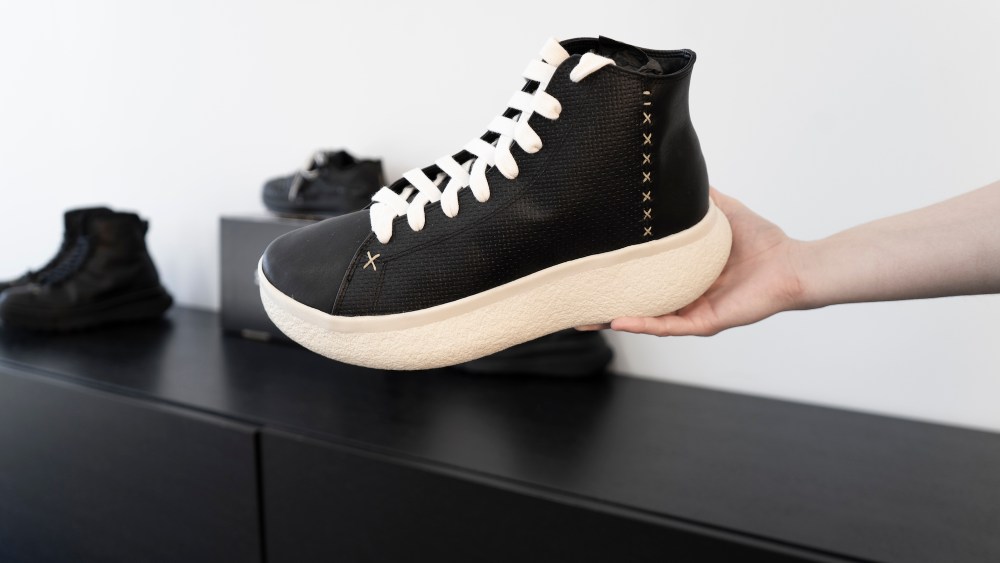
Though most of Simplifyber’s customer work since launching in 2020 remains confidential, the company has already been tapped by cool-girl brand Ganni for footwear and Kia for automotive materials.
“What’s been interesting is that, despite operating in very different industries, the conversations often converge around the same themes: reducing complexity, reducing waste and creating products in fundamentally new ways,” Intscher-Owrang said. “One thing I’ve learned through these collaborations is that the most successful partnerships don’t start with the question, ‘What material can replace the one I’m using today?’ They start with the question, ‘What becomes possible if products can be made differently?’”
Here, Intscher-Owrang shares how Simplifyber is tackling fashion’s waste crisis and, in the process, challenging industry norms.
Sourcing Journal: What is Simplifyber?
Maria Intscher-Owrang: At its core, Simplifyber is a way of forming fibers directly into shape. The exact fiber recipe can vary depending on what we’re trying to achieve, whether that’s softness, structure, durability, aesthetics or sustainability performance.
What’s exciting is that we’re not locked into any single feedstock. As new recycled and waste-derived fiber streams become available, they can potentially be incorporated into the platform, allowing us to continually evolve the materials we use without fundamentally changing the manufacturing process. In addition to fibers, we can also use ground-up particles.
SJ: What can Simplifyber material replace?
M.I.-O.: For fashion, Simplifyber can replace cut-and-sew textiles, plastic and leather in shoe uppers, bags and outerwear. The best part is that it’s not just a 1-to-1 replacement. We can reduce the need for parts of the assembly process by supplying a custom-shaped part or panel, depending on the application. It doesn’t replace every textile, but it does offer designers a seamless way to add 3D elements, and even textural decorations within a single piece. It’s a new way to build products, so it opens a whole new design space in addition to streamlining the supply chain. Designers can work in 3D, in much the same way people work with plastic, but the materials are bio-based and feel more natural.
SJ: How much material waste reduction have you measured compared to cut-and-sew manufacturing?
M.I.-O.: The process is designed to eliminate pattern-cutting off-cut waste because we are not cutting shapes out of flat yardage in the same way. The fiber is deposited into a mold in the geometry of the part. That said, I would describe the impact as significant waste reduction rather than claiming zero waste across the entire system. There can still be process losses, rejected parts or trimming depending on the product, but the off-cut waste associated with cut-and-sew manufacturing is largely removed. In many cases, it is also possible to grind and re-use the trim and reject waste.
SJ: Is the final material biodegradable, compostable, recyclable or circular?
M.I.-O.: Our products can be made to be up to 100 percent bio-based, although the exact formulation depends on the requirements of the application. Different products may require different types of fibers, binders, coatings or additives to achieve specific performance characteristics. For example, when we make car interior panels (doors, seat backs, center console, etc.), to make something that can last for 25 years in a hot car, we need to add conventional coatings. For footwear, it’s much easier to keep the panels 100 percent bio-based.
Because of that, I would be careful about making a blanket claim that every Simplifyber material is biodegradable or compostable. End-of-life characteristics depend on the specific formulation and intended use of the product. What we can say is that most of the materials we use for fashion applications can be mechanically recycled, and our platform also makes it relatively easy to incorporate recycled inputs back into the manufacturing process.
SJ: And you’re not limited to traditional raw materials.
M.I.-O.: We can incorporate recycled materials and, in some cases, materials that would otherwise be considered waste streams like mixed fibers, nonuniform or short fibers and ground particles. Because of that, we view Simplifyber not only as a material platform, but as an enabler of circularity.
For me, circularity is ultimately about keeping materials in use at their highest value for as long as possible. By simplifying product construction, reducing material complexity and making it easier to incorporate recycled inputs, we believe Simplifyber can play an important role in creating more circular manufacturing systems.

A Simplifyber mold.
SJ: Have you conducted a LCA onSimplifyber material?
M.I.-O.: Yes. We have completed a preliminary cradle-to-gate life-cycle assessment with North Carolina State University. The assessment found a carbon footprint of 1.41 kg CO₂e/kg for a fully bio-based molded material produced using renewable electricity.
For comparison, polypropylene is typically around 1.8-2.5 kg CO₂e/kg, ABS around 3.6-3.9 kg CO₂e/kg. Polyester fabric can be as high as 9.6 kg CO₂e/kg and leather can range from approximately 12-15 kg CO₂e/kg.
The LCA is preliminary, which means it has not yet been peer-reviewed or publicly published, but it provides an important early indication of the environmental potential of the platform. What I find particularly encouraging is that the benefits are not coming only from the material itself. A significant part of the opportunity comes from reducing manufacturing complexity. When you eliminate steps, reduce waste and simplify assembly, you can reduce environmental impacts across the system rather than optimize a single material in isolation.
SJ: What type of products can the material be applied to?
M.I.-O.: One of the things I find most exciting about the platform is its versatility. Because we’re creating material and shape simultaneously, the technology can be applied across a wide range of products, from apparel and footwear to accessories, automotive interiors, consumer electronics and home goods.
In fashion, that could include sneaker uppers, boot uppers, dress shoes, slippers, outerwear, hats, shaped handbags, structured clutch bags, luggage and molded design elements integrated directly into garments, such as tailoring, bodices or corsetry.
Beyond fashion, we’re exploring applications ranging from automotive interior components to consumer electronics accessories and wearable devices. Rather than thinking of Simplifyber as a replacement for a particular material category, I think it’s more useful to think about it as a new way of making shaped products. Once you’re able to create material and form at the same time, entirely new product architectures become possible.
SJ: Can Simplifyber enable more localized manufacturing?
M.I.-O.: I believe it can. One of the advantages of the platform is its flexibility. Because we’re not dependent on a single feedstock, there is the potential to incorporate locally available fibers, recycled materials and even certain waste streams into the manufacturing process. That opens interesting possibilities for more regionalized supply chains.
At the same time, we’re reducing many of the labor-intensive assembly steps that have traditionally pushed manufacturing into regions with lower labor costs. If a product requires less cutting, sewing, laminating and assembly, the economics of where that product can be made begin to change.
I don’t think every product will suddenly be manufactured locally, but I do think technologies like Simplifyber create opportunities for manufacturing to move closer to the point of consumption. That’s important not only from a sustainability perspective, but also from a resilience perspective. The past few years have shown how vulnerable global supply chains can be when production is concentrated in a small number of regions.
For me, one of the most exciting possibilities is a future where products can be made using locally available materials, closer to the people who will ultimately use them.

Ganni applied the material to spring 2025 footwear.
SJ: Does simplifying assembly also reduce labor dependency?
M.I.-O.: Potentially, yes. If you reduce cutting, sewing, trimming, bonding and multipart assembly, you reduce the amount of manual labor required for certain products. That does not mean labor disappears, but the labor profile changes. More of the value shifts into material preparation, machine operation, quality control, tooling and process expertise.
SJ: How does Simplifyber’s cost compare to more traditional materials?
M.I.-O.: We’re already seeing cost parity with conventional materials in fashion applications. That said, I think the more interesting question is what happens at the product level rather than the material level.
Traditionally, a product may require multiple manufacturing steps, including material production, cutting, sewing, laminating, assembly and waste management. Because Simplifyber creates material and shape simultaneously, many of those steps can be reduced or eliminated.
As a result, the value isn’t only in the material itself. It’s in reducing complexity across the manufacturing process. When you start looking at labor, waste, assembly and supply chain requirements, the economics can become very compelling.
Our goal has never been to create a sustainable premium material. Our goal has been to simplify manufacturing.
SJ: What’s next for the company?
M.I.-O.: We’re entering a very exciting phase. For several years, we’ve been focused on developing the technology and proving that it works. Today, we have our first full-scale production line operating, and we’re ready to start producing products at scale.
Our focus now is on production, partnerships and getting products into the market. We want designers, brands and manufacturers to experience what these materials can do and become comfortable designing and building with them. Ultimately, our goal is much bigger than producing a handful of products ourselves. We want to help establish a new manufacturing ecosystem and make this technology accessible around the world so that companies can incorporate it into their own production systems.
For decades, we’ve been surrounded by products made from plastic, polyester and increasingly complex multi-material assemblies. What excites me is that we have an opportunity to give designers a new set of materials and tools — materials that are bio-based, high-performing and capable of creating entirely new product experiences.
Paper has already replaced plastic in many packaging applications, disposable cups and food service products. I believe we’re beginning to see the possibility of a similar transition in durable, high-value goods.
More broadly, I think people want products made from materials they feel connected to. There is something inherently appealing about natural, fiber-based materials. They bring warmth, tactility and a sense of connection to the natural world. If we can combine those qualities with modern manufacturing performance and scalability, we can create products that people genuinely want to live with.
This story was publish in Sourcing Journal’s material innovation report. Click here to download.
