

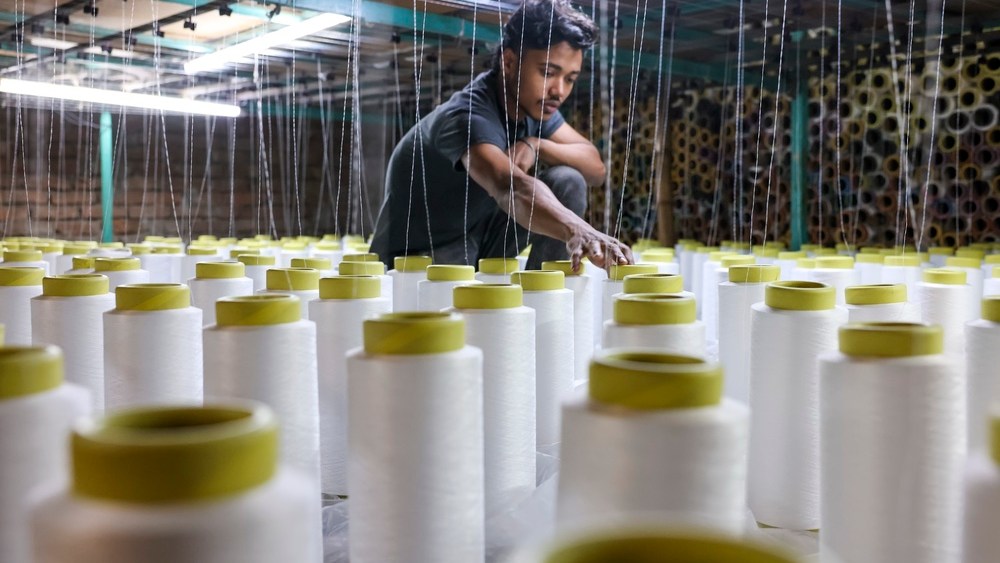
Virgin polyester has long been one of fashion’s most polluting materials. Now, a new life-cycle assessment from Textile Exchange and SCS Global Services maps out just how hard it is on the environment.
The report finds that purified terephthalic acid production and monoethylene glycol, used to polymerize polyethylene terephthalate, or PET, are the biggest contributors across nearly all environmental impact categories. Energy use is also a major source of impact, while non-polymerization chemical additives drive freshwater ecotoxicity.
But although swapping virgin inputs for recycled material is often framed as a silver bullet, such alternatives come with their own environmental and logistical trade-offs.
Chemical recycling, for instance, demands immense amounts of energy and chemicals to strip out impurities, especially from post-industrial waste streams. Thermomechanical recycling, another energy-intensive endeavor, relies on high-quality, homogeneous feedstock that can only be processed a limited number of times before the plastic degrades.
There are also labor issues at stake. Frequently informal and poorly regulated, both virgin and recycled polyester supply chains can expose workers to severe human-rights risks, including harassment, violence and abuse.
If there’s one takeaway, it’s this: polyester’s impact is complex, and there are no easy fixes.
“Right now there isn’t one recycling technology to rule them all,” said Ilan MacAdam-Somer, an LCA contract specialist at SCS Global Services. “We’re seeing a lot of different strategies being adapted to deal with different kinds of post-consumer waste streams.”
The study used 2022-2024 production data from five PET producers across China, Europe, Southeast Asia and the United States, covering virgin production, chemical recycling and thermomechanical recycling. Thermomechanical recycling focused mostly on post-consumer bottles, while chemical recycling included post-consumer and post-industrial textile waste.
Using a non-comparative, cradle-to-gate method that excluded downstream applications and packaging, the study tracked materials from extraction or waste collection to the final textile-ready product, whether PET chips, staple fiber or yarns. It assessed climate change, acidification, ecotoxicity, human toxicity and photochemical ozone formation, incorporating Textile Exchange’s LCA+ approach, which includes a social assessment component.
But even if it remains imperfect, recycled polyester still comes out ahead, especially when it comes to reducing fossil fuel extraction and overall climate impact.
“This LCA study identifies virgin fossil-based inputs as the largest contributor to environmental impact in virgin PET production,” said Beth Jensen, chief impact officer at Textile Exchange. “This underscores that reducing—and ultimately eliminating—reliance on virgin fossil-based inputs is a critical lever for driving impact reduction, as laid out in our principles of preferred production systems guidance and other resources.”
To fully unlock recycled polyester’s advantages, however, brands and manufacturers will need to look beyond the material. A recycling system’s true environmental performance, the report said, hinges on strategic choices such as locating recycling facilities near textile-waste sources, using cleaner and more efficient transport to cut emissions and powering processing plants with renewable energy rather than coal-heavy grids.
Working with recyclers to invest in better sorting technologies can also improve the separation of blended-fabric fibers and remove contaminants before recycling, resulting in better quality and environmental outcomes.
“Something that came up time and time again, especially with chemical recyclers, is that they’re still really struggling to make post-consumer recycling viable,” MacAdam-Somer said. “And one of the big obstacles in the way is getting better technology for sorting.”
Still, a lower carbon footprint counts for little if it rests on exploitative labor. Human-rights concerns span the entire polyester production chain, from crude oil extraction for virgin production to the collection of plastic waste for recycling. Workers can face unsafe conditions, hazardous chemicals, unfair wages, excessive hours and gender-based violence and sexual harassment.
The risks are especially acute for temporary workers, subcontractors and waste pickers, the study said. For these demographics, worker representation is frequently weak, grievance mechanisms are often difficult to access and social protections can be nearly nonexistent.
“The report highlights the importance of looking beyond labor rights alone and considering the full spectrum of human rights impacts when assessing effects on people,” Jensen said. “To address these risks, companies should work toward full traceability of their polyester supply chains by engaging supply chain actors and progressively mapping upstream to the origin of raw materials.”
The study comes with a major caveat to avoid the temptation of comparison. Since life-cycle assessments are sensitive to assumptions and contextual factors, the data is intended as a proxy for identifying supply chain pressure points rather than as a benchmarking tool.
“We’re just looking at the production of this polyester chip; we’re not thinking about things like comparing it to other fibers like cotton or nylon. That’s all outside of the scope,” said Keith Killpack, technical director at SCS Global Services. “This is intended to help businesses who are already purchasing polyester buy lower-impact polyester.”
