

PARIS — Five years after launching as an internal initiative within LVMH Moët Hennessy Louis Vuitton to give new life to its deadstock fabrics, Nona Source is expanding its ambitions well beyond fabric resale.
The group celebrated its fifth anniversary Thursday in Paris’ Jardin d’Acclimation, turning the Orangerie just steps from the Fondation Louis Vuitton’s Frank Gehry-designed building into an immersive installation.
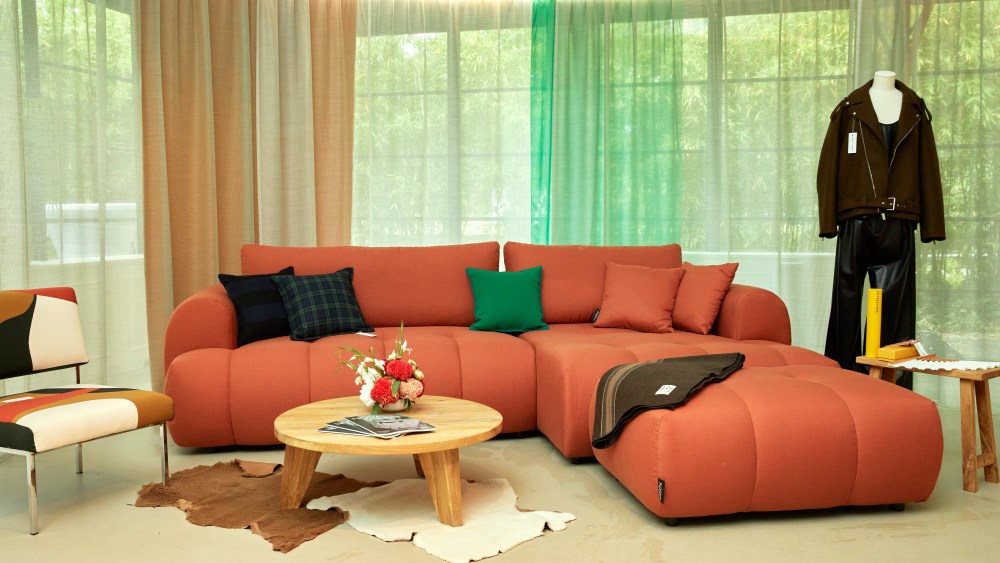
The group turned the building into an “apartment,” with rooms showcasing clothing, furniture, homewares and packaging projects created from the deadstock fabrics that can be sourced through its marketplace.
The exhibition served as both a retrospective of Nona Source’s first five years and a glimpse of where it hopes to go next.
“We really wanted to showcase all the possibilities that we can do with deadstock materials,” said Nona Source chief executive officer Anne Prieur du Perray. “It’s a showcase of what we’ve been doing for five years and to celebrate our community.”
Keeping circularity at the center, the exhibition was also created in partnership with resale site Le Bon Coin, so that objects such as a clawfoot bathtub used for the installation will be resold.

A Julie de Libran dress and a Patine swimsuit on display.
Angele Basile / Courtesy of Nona Source
Nona Source was created to give designers access to surplus fabrics and materials from luxury houses, but what started as a way to connect deadstock with emerging brands has evolved into a full ecosystem spanning fashion, interiors, packaging and creative collaborations, Prieur du Perray said.
The exhibition highlighted projects ranging from fashion collections by independent designers such as Weinsanto — the young French designer was Nona Source’s first customer on its first day, she noted — to furniture upholstered in deadstock textiles, decorative objects such as pillows and packaging innovations.
Among the featured collaborations were projects at a range of price points with pieces ranging from Stella McCartney, Julie de Libran, Jeanne Friot and Cecilie Bahnsen to the mass retailer Monoprix and beauty brand Guerlain, plus a sofa from a new furniture initiative with French brand Bobochic.
For Prieur du Perray, one of the biggest lessons of the past five years has been just how many applications exist beyond apparel.
“At the beginning it was really ready-to-wear, fashion shows, fabrics used for clothes and shoes,” she said. “We started to open our minds. Now it’s, ‘OK, we can do different things.’”
Case in point is the Guerlain collaboration, which is the first application in packaging. The beauty brand took unused ready-to-dye denim, applied different colors and embossed it with their logo to create lipstick cases.

A Weinsanto dress made with Nona Source materials.
Angele Basile / Courtesy of Nona Source
That evolution has followed deeper changes in perception across the industry.
While early adopters were often the indie designers looking for affordable access to premium materials, larger brands have now begun integrating deadstock into their own processes.
“The first brands that would come to us, they were the young brands that had a huge need for [material] because it solved one of their problems,” she said. It was a challenge to bring bigger brands on board, because they have established suppliers and many sourcing practices in place.
However, attitudes have shifted over time, she said. Luxury houses that initially viewed deadstock as a waste disposal challenge are beginning to see it as a resource. Working with Nona Source has changed their thinking.
Smaller companies too have helped in the shift, such as swimwear brand Patine, who has an ongoing collaboration with Nona Source and puts it front and center in their marketing. Such publicity helps elevate deadstock as not only a mark of sustainability street cred, but as an indicator of quality, too.
“The luxury houses now see that it is possible to reuse. Before they would say they didn’t have the solution because it was too complicated,” she said. But Nona Source’s digitized system has made it easier to source deadstock fabrics, as well as catalogue their own leftovers.
“The houses can also reuse their own materials, and now we are trying to work with them in order for them to reuse [in-house] before they even sell it to us,” she said. “It’s very efficient, and also it changes the mentality of the whole chain so it’s not just about selling the material, but thinking of how it can be reused.”
The platform now works with 25 luxury houses, including several outside the LVMH universe. Prieur du Perray said the company quickly realized the issue extended beyond a single group.
“Very quickly, we understood it was not a problem of LVMH business. It was more a problem of the industry that we were solving,” she said.

A Cecilie Bahnsen dress in the “bedroom” of the apartment installation.
Angele Basile / Courtesy of Nona Source
As Nona Source looks toward its next five years, Prieur du Perray said the focus will be less on simply selling materials and more on facilitating connections across the supply chain.
“I want to be closer to the designers,” Prieur du Perray said. “For me, we don’t sell fabrics. We put people in contact, and we find solutions.”
Nona Source is evolving as an intermediary connecting brands, factories and creators around circular solutions. That involves expanding their role from a marketplace into an entire ecosystem that helps the industry rethink waste.
“We are an incubator for ideas, but with concrete solutions,” she said. “If we don’t put them into action, for me it’s not interesting.”
