

Crystal International published its 2025 Sustainability Report, illustrating the Hong Kong-based company’s progressive transition to smart manufacturing.
Operating across Vietnam, China, Cambodia, Bangladesh and Sri Lanka the multi-category apparel and textile manufacturer is guided by Crystal Sustainability Vision 2030, a framework that covers eight impact areas across environmental, workers and community, aimed to tackle wider sustainability challenges.
Highlights for 2025 include planting 525,000 trees, providing free vision screenings for over 34,000 workers and supporting hundreds of families’ efforts to rebuild their homes after Typhoon Yagi.
The report emphasizes how the company is unlocking the power of solar energy. In 2025, 40 percent renewable energy across all factories.
At its intimate factory, Crystal expanded its rooftop solar installation beyond the contract demand to fully utilize the available rooftop space. The lifestyle factory has adopted a 1.29 MWh battery energy storage system. Crystal’s denim factory installed 2.09 MW solar system with a regulating device to better utilize the surplus solar electricity that cannot be exported to the grid. The device monitors the overall site power demand and allocates electricity proportionally across workshops.
New technologies are being implemented to reduce water usage.
In 2025, the factory introduced a pilot auto-washing machine that requires15-20 liters of water per kilogram of garments, compared with 25 liters per kilogram needed by conventional belly washers. Crystal said this 20–30 percent reduction in water consumption is an important step toward wider adoption.
Overall, Crystal’s per product freshwater intensities of factories have decreased by almost 8 percent against the 2022 level.
Optimized wash systems for denim have the potential to be a game-changer in the company’s water consumption. In 2025, the company increased the loading capacity of bulk washing machines while maintaining washing performance and product quality. This measure contributed to 10 percent water intensity reduction in 2025.
Additionally, Crystal’s denim factories doubled the share of washing processes carried out using the waterless enzyme technique to around 50 percent. Compared with traditional wet-processing, waterless enzyme treatments saved overall process water demand by up to 20 percent, reduced process time by 50 percent, consumed zero steam and reduced waterwaste and sludge.
The denim factory in Vietnam continued to advance its smart manufacturing transformation, which includes a smart warehouse management system, smart AGV system, a smart cutting system and intelligent production lines. In 2025, the newly launched AS/RS enabled accessory warehouse replaced manual sorting and record keeping with automated storage allocation and real-time inventory capture.
Meanwhile, the cutting workshop pivoted from individual automation tools to deeper process integration. The report explained how AI vision technologies were expanded to enhance data collection and automated decision making. AGVs now operate between the warehouse and cutting area, and another fleet manages transport between sewing workshop and the washing laundry. Crystal noted that planning for an inter-workshop AGV system is underway.
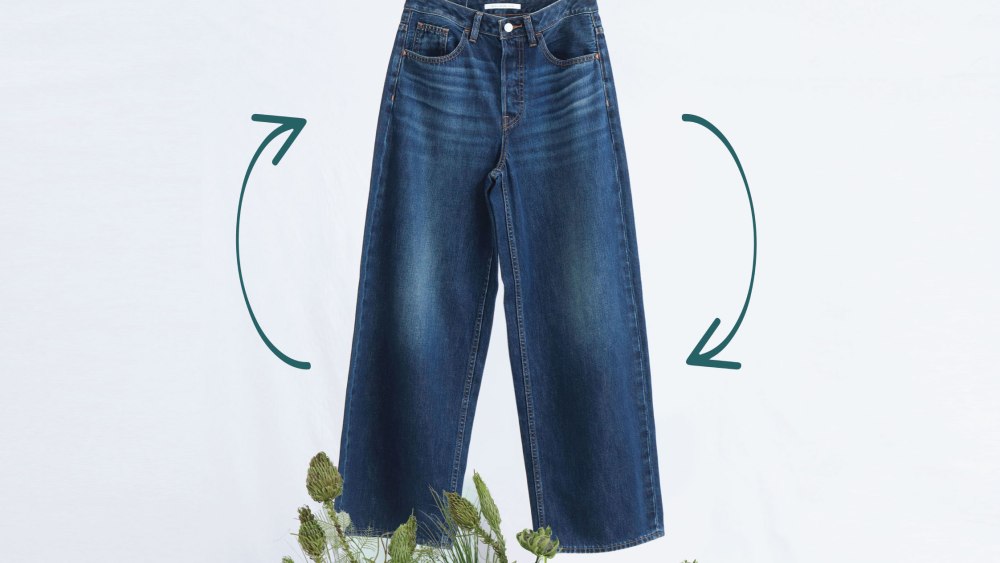
Denim was also a place for the manufacturer to experiment with garments that are designed to disappear. In 2025, Crystal launched CirClimate, a garment collection that incorporates 100 percent cellulosic fibers, 100 percent cotton threads, removable shank buttons and compostable packaging. As it’s made with biodegradable materials, the jeans leave no trace behind.
Eighty-five percent of the cotton sourced by the company’s denim division has sustainable attributes.
