

Can the fashion industry survive the polycrisis stress test?
Not if it continues with business as usual, said Marguerite Le Rolland, senior global insight manager of fashion at Euromonitor International.
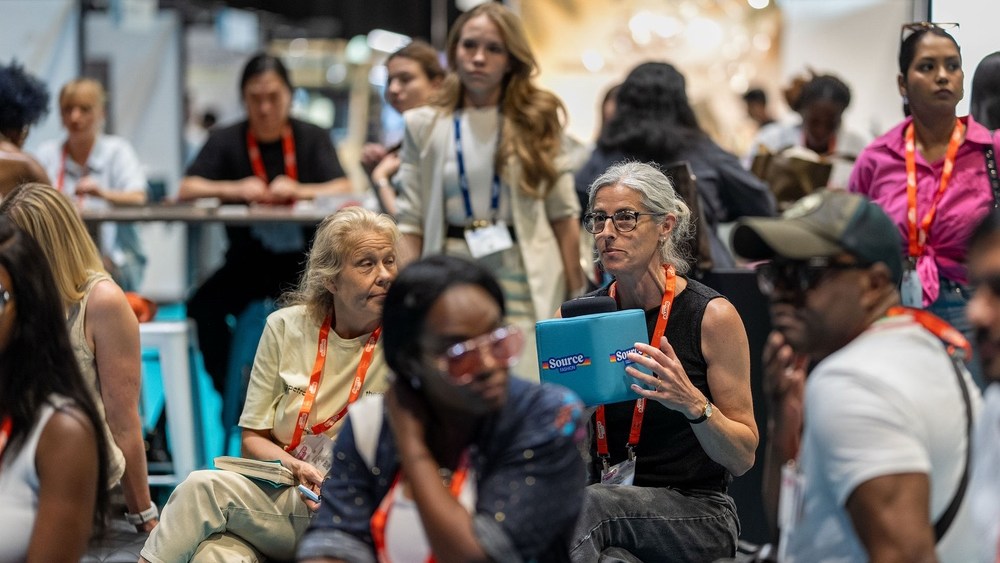
With converging socioeconomic crises, climate disasters and geopolitical conflicts forcing historic sourcing networks to reconfigure, she said at the Source Fashion trade show in London earlier this month, executives might need to tear up the old corporate playbook of chasing the lowest unit price in far-flung locations in favor of flexible, regionalized supply chains that can withstand localized shocks.
“Uncertainty is the new norm,” Le Rolland said. “I’m sure you’ve heard that before, but we do expect that to last, ultimately. And that means brands, retailers and manufacturers have to plan for uncertainty. They need to work with different scenarios in mind and strengthen their scenario planning accordingly.”
That means testing the limits of “China-plus-one” diversification, even though untangling from China’s highly mature, technically specialized ecosystem remains easier said than done.
“Mango has found a balance between its Asian supply chain and more local ones with greater speed to market for less trendy items that it needs to produce quickly,” Le Rolland said. “And it still benefits from the cost-effectiveness of Asia by producing the core collection there.”
In some cases, the stakes are existential. Global economic growth for 2026 is projected at 2.9 percent, Le Rolland said, down from 3.1 percent before rising tensions between the United States, Israel and Iran. If the war persists, the world’s gross domestic product could take a bigger hit. Spiking energy prices have inflated the cost of every step of garment conversion, from spinning and dyeing to transport and trucking. They have also made the cost of go-to synthetic fibers such as polyester highly unpredictable. Meanwhile, logistical bottlenecks, most recently from the Strait of Hormuz, have hiked up freight rates and slowed deliveries.
But while brands have taken to holding expensive “buffer” inventories to guard against the threat of missed retail seasons, she said, this only increases the risk of eventual markdowns.
Bill McRaith, former chief supply chain officer at PVH Corp., owner of brands such as Calvin Klein and Tommy Hilfiger, knows all about markdowns. Offshoring, he said at a separate session, has driven the share of discounted product from 6 percent to a staggering 60 percent. Markdown rates, too, have climbed from 10-20 percent to as high as 60 percent.
“Retailers are struggling with a model that keeps increasing inventories, makes it hard to liquidate excess stock, discounts product heavily and trains consumers to buy only discounted goods,” he said. “You would think EBITs, earnings before interest and taxes, would be going up. You would think people would be getting more profitable. That is an absolute fallacy. EBITs have been getting worse. Chasing low cost has not been driving us in the right direction.”
Brands are also missing out on selling popular items at full price because their long, slow supply chains make it impossible to react quickly.
McRaith’s solution, rather than an all-or-nothing offshore-or-onshore approach, is to create a so-called “supply lattice,” where some goods are produced overseas, others in neighboring countries and the rest where they’re sold.
“Imagine an ecosystem where you’ve got low-cost manufacturers offshore: Southeast Asia, China, probably Central America,” he said. “You’ve got nearshore players: Portugal, Turkey, Morocco, Egypt. But now, what I add to that are onshore players. So physically in the U.K., manufacturers who are onshore that have actually networked with the offshore and the nearshore players, where I now have this matrix supply chain that can top your inventory up to the perfect SKU level.”
Unknown quantities, or “fringe SKUs,” can be made closer to home in smaller quantities to test the market and react accordingly. This addresses the waste problem while sidestepping a popular industry workaround: using air freight to slash transport time.
“I’ve had people say to me, ‘Hang on a minute. I can make stuff in China and air-freight it into the U.S. as fast as any factory in the U.K. Midlands or the Carolinas can get it to a main hub.’ That may be true, but look at the reality,” he said. “We often talk about how consumer post-manufacturing care—washing and drying—makes up the bulk of a product’s carbon footprint. In logistics, ocean transport accounts for only 1 percent of that footprint. But the minute you put a product on an airplane, it becomes the single largest contributor to its carbon footprint. Air freight generates 50 times more carbon than sea freight, and because of the altitude, it is 70 times more damaging to the environment.”
Price is irrelevant, McRaith said, if you can sell it at full cost.
“We chase suppliers for a five-cent cost reduction,” he said. “We just saw it with tariffs. It was terrible. For every five cents we chase a supplier on, we’re losing $1 of markdowns and lost margin because we’re out of stock, or we have too much inventory, or we have to liquidate stuff.”
Indeed, multi-sourcing and nearshoring can be risk-mitigation measures in a turbulent world, or in an environment where protectionist governments increasingly demand that brands work with local suppliers to gain access to their markets, Le Rolland said.
A new consumer mindset
At the same time, consumer behavior is also evolving. In a recent Euromonitor International survey, 55 percent of respondents, including high earners, said they intended to increase their savings over the next 12 months. When consumers do shell out, wellness and travel are top choices, while fashion ranks fourth. Even then, it’s mostly in the form of secondhand clothing.
“Spending priorities are changing,” Le Rolland said. “Consumers are less interested in tangible goods and more in experiences, their health and wellness, and this is creating a new imperative for brands to remain relevant in terms of offering services and experiences, and moving beyond a purely product-centric business model.”
This “intentional consumption” is also creating significant market polarization, accelerated by widening income disparities. On one end, luxury is thriving; on the other, squeezed shoppers are migrating toward off-price channels and secondhand platforms. More of them, across markets as varied as Hong Kong, Poland, the United States and the United Arab Emirates, are also opting to repair rather than replace damaged items.
This hasn’t gone unnoticed among brands such as Ralph Lauren and H&M, Le Rolland said.
“Ralph Lauren’s done something interesting by buying back some of the items on peer-to-peer platforms and reconditioning them, offering a nice margin but also taking back control of its brand narrative by offering these curated archives that elevate the brand to another level,” she said. “H&M has been pushing its pre-loved corner, even launching a concept store in Beverly Hills last year that is dedicated to women’s wear with a mix of pre-loved and new items. And really, the appeal of its store is about the experience in an iconic building in Beverly Hills, and with lots of stylists at hand to advise shoppers on what to buy.”
It also isn’t for nothing that Vinted, the peer-to-peer resale marketplace, is France’s top clothing retailer by volume sold and the third-largest fashion retailer in the United Kingdom behind Primark and Next.
But Vinted is also trying to reposition itself as a fashion curator, embracing AI and working with former model Emma Willis to launch a TV series on Prime Video that features emerging European designers who create “runway-ready” outfits using only secondhand clothes.
“Vinted hasn’t exploded because people all around the world suddenly decided that they really care about the planet and they want to buy secondhand because they don’t want something new,” Jack Stratton, head of Insider Trends, said in a presentation about how longevity became the new luxury. “That has not happened, sadly. People are exactly the same as they were 20 years ago.”
The most listed brand on Vinted? Shein.
But if young people are outspending older people on luxury items, it’s because more than half of them believe those items will increase in value over time and even more view them as currency, Stratton said, pointing to recent data.
“A lot of younger people are, because they’re budget-conscious, thinking of items with some longevity, with some kind of long-term currency, as having real value in the future,” he said. “So that’s a big shift, and that’s one of the ways that the budget-conscious consumer is changing now.”
The rise of AI-powered shopping tools—“agentic AI, ChatGPT or whatever your version is of that”— is also transforming how shoppers discover products, particularly at the start of their “shopping journey.”
“So they’ll go into a chatbot, and they’ll ask it a slightly more sophisticated question than they used to,” Stratton said. “Instead of just putting in ‘Ralph Lauren polo,’ they might put in something like, ‘Where is my nearest stockist of Ralph Lauren vintage Ralph Lauren polos in London?’ So that the searches are getting more specific, and AI is getting better at providing better answers.”
The way Le Rolland sees it, fashion can build resilience amid the polycrisis in several key ways. Strengthening market foresight and scenario planning is one of them, but so is rethinking how inventory is held. Instead of stockpiling finished collections far in advance, brands can build smarter buffer systems, for instance by moving finished goods closer to core markets where demand is stable and margins are justified, while keeping half-finished products in other parts of the world.
She also said supply chain risk should be connected to merchandising decisions, with departments working together rather than in silos.
“I know it’s easier said than done, but given all the uncertainty, it may make sense to have pricing plans in place in case prices rise again, rely less on fragile launch dates and increase transseasonal products to avoid markdown issues if products don’t arrive on time,” Le Rolland said.
Equally crucial, she noted, is rethinking the industry’s overdependence on an Asia-centric model without abandoning its cost efficiencies entirely. Le Rolland cited Steve Madden, which moved a significant share of its production to Mexico and Brazil to mitigate tariff risks, only to shift some of it back to China because the Latin American countries could not match its capabilities in on-time delivery, product quality and competitive pricing.
Finally, she suggested that more brands could move toward a product architecture that is less reliant on virgin synthetics, such as Pangaia’s bamboo- and fruit-derived fibers, though she doesn’t expect it to happen overnight.
“Recent crises have shown how virgin synthetics ultimately can really increase prices and costs,” Le Rolland said. “They are not that cost-efficient anymore. So going forward, maybe there will be a need to invest in new materials that have been traditionally more expensive, but are more reliable. And in the end, with all the oil prices going up, might not be that much more expensive anymore.”
“There are still lots of moving pieces,” she added.
