

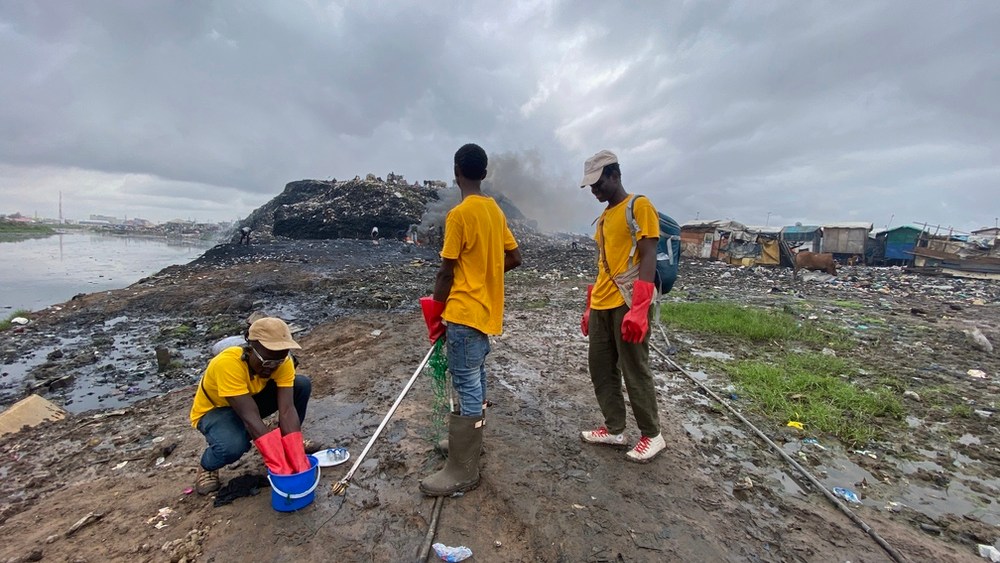
Three hours into a morning that began at 6 a.m., Bright Ayikpa had barely broken a sweat.
He had already walked nearly nine miles along Accra’s trash-choked Korle Lagoon—past ramshackle settlements, a towering mound of discarded fabric and plastic, and highways thrumming with traffic—before reaching Jamestown’s beaches, where city waste, including textiles from Kantamanto Market, empties into the Gulf of Guinea and out to the Atlantic.
Ayikpa, a citizen scientist with The Or Foundation, an environmental justice nonprofit, has followed this route weekly for more than two years, breaking stride only to collect water at intervals using a modified fishing pole and bucket. The routine that follows is often tedious, involving measurements of temperature, salinity, oxygen levels and total dissolved solids.
The more exacting work, however, awaits in the lab, where Ayikpa and others must manually count individual microfibers from each sample under a microscope, then repeat the eye-straining analysis with air samples from high-volume vacuum samplers and real-time sensors.
But the payoff is worth it.
“You can see the difference between upstream, downstream and around the dumpsite,” he said, pointing to squiggles on a screen that glow red for natural fibers or blue for synthetics, depending on whether they’re viewed under white or UV light.
Ayikpa’s efforts are part of a citizen science study, a collaboration between The Or Foundation and the Deheyn Lab at UC San Diego’s Scripps Institution of Oceanography, that found sharply elevated microfiber pollution around Kantamanto Market, linking it directly to the glut of textile waste flowing through Accra.
Kantamanto, home to 30,000 traders across 18 sprawling acres, is West Africa’s largest secondhand clothing market. The Or Foundation estimates that roughly 15 million castoff garments from Canada, China, the United States, the United Kingdom and the European Union enter the market weekly, and about 40 percent leave as waste because they are torn, stained or otherwise too damaged to resell.
A recent analysis from innovation platform Fashion for Good and the nonprofit Circle Economy, both based in Amsterdam, found that nearly 87 percent of garments sampled from bales imported as “rewearable” showed some form of defects.
“A lot of people think textile waste is limited to the giant mountains you see at the beaches or at the dumpsite,” said Katia Osei, head of environmental justice at The Or Foundation. “But incineration or even just textiles sitting in a dumpsite and getting rained on every day releases so many fragments that are invisible to us.”
The research has been years in the making. Branson Skinner, co-founder of The Or Foundation, first met Dimitri Deheyn, a marine biologist whose cross-disciplinary work focuses on biomimicry, in 2021 through The Biomimicry Institute. Deheyn has since visited Accra numerous times to help the organization set up its lab and train dozens of citizen scientists, including Ayikpa.
Deheyn is a firm believer in public participation in scientific research. In fact, he said, the study wouldn’t have happened without it.
“Citizen scientists are an incredible resource, not only because they represent an amazing manpower, but because they are passionate and have access to places where I, as a scientist based in California, frequently don’t,” he said. “They helped me generate the data so I can do the visualization, the statistics, the things that are pertinent for a science journal.”
That collaboration yielded the study’s central finding: Accra’s waste is driving a staggering amount of microfiber pollution, with airborne levels up to 20 times higher than in other global cities and aquatic concentrations in Korle Lagoon climbing to 45 times the global average. Isolating microplastics that slough off synthetic textiles such as polyester and nylon made the contrast even starker, with airborne levels rising to 100 times global baselines and aquatic concentrations soaring to 200 times higher.
The data also reveal how tightly this contamination is concentrated around Kantamanto, pinpointing the market as the epicenter. Particle counts, drawn upward by warm air, peaked within the market’s core before dropping sharply just one kilometer away at The Or Foundation’s headquarters and falling further in the residential neighborhood of Osu, 3 kilometers out.
“Imagine a cloud or dome that stays around the textiles, sometimes moving with the wind, and then when it rains, everything comes back down,” Deheyn said. “The first 20 minutes of rainfall are supercharged with microfibers.”
Fashion’s final sink
Accra wasn’t always like this, said Joe Ayesu, citizen science manager at The Or Foundation and a co-author with Deheyn and Skinner of a paper published in the July 2026 issue of Environmental Advances. When he was a child, Jamestown’s beaches were pristine places, perfect for hosting picnics and games. But something shifted in the early 2000s. Before long, the shorelines were disappearing under tangled piles of textile waste—nicknamed “tentacles” for their long, grasping forms—that bury themselves so deeply in the sand that they can only be extracted with a hoe or machete.
It’s the cost the city is paying for the phenomenon known as fast fashion, Ayesu added. One person’s bargain buy is another’s environmental crisis, and perhaps a health one as well.
“I knew there would be particles in the air, but the numbers were very alarming, especially when we moved from the dry to rainy season,” he said. “We’ve been inhaling them this whole time.”
While the impact of microfibers on the human body isn’t yet fully understood, a growing body of evidence suggests that these tiny fragments of clothing, once breathed in or ingested, can enter the bloodstream, the lungs and even the brain, where they may trigger inflammation and tissue damage that lead to cancer and other chronic diseases.
Compounding the issue, these particles often carry toxic manufacturing chemicals, such as flame retardants and polychlorinated compounds known as “forever chemicals,” that can now directly penetrate organs.
For Osei, this makes fast fashion’s toll on Kantamanto, where merchants already court economic ruin by gambling on bales of low-quality clothing, all the more insidious. The findings, she said, reveal that textile waste doesn’t simply sit and accumulate. Rather, what once seemed like a contained contaminant—relatively speaking—is now drifting into the air and seeping into waterways.
“The textile waste crisis is a lot more multifaceted than we realize,” she said. “It’s not just limited to, ‘Oh, there are so many clothes, we don’t know what to do with this.’ It’s that these clothes have real-life implications on the health of an entire city’s population, even entire generations of people.”
The study also compared garments from Kantamanto Market with textile waste from the lagoon and Jamestown beaches, matching brand tags from 172 market garments with those from 128 beach garments to see whether the same brands appeared in both. Together, the top 10 brands—Marks & Spencer, Primark, George, Tu, Next, Boohoo, F&F, H&M, New Look and Gap—accounted for 63 percent of the beach samples and 77 percent of the market samples, showing a nearly 60 percent overlap between the two.
This is a critical finding, Deheyn said, because life-cycle assessments of textiles rarely include their end of life. It also reinforces The Or Foundation’s argument that extended producer responsibility fees collected in the global North should “flow with garments” to their final destinations, like Kantamanto, to help repair the harm still being done.
“That shows that garments thrown away in the markets eventually make their way through the lagoon and then to the beach,” he said. “The pollution diffuses out.”
The weekly beach cleanups sponsored by The Or Foundation through the community-led Tide Turners initiative are “literally the last resort” to keep textile waste from leaking into the Atlantic and continuing to spread to the rest of the world, Osei said.
But ultimately, she said, the entire fashion system is rotten.
“We just have too many clothes,” Osei said. “Unless we solve the problem at the top, unless we restructure the entire system and make it more logical, the waste will just keep coming.”
