

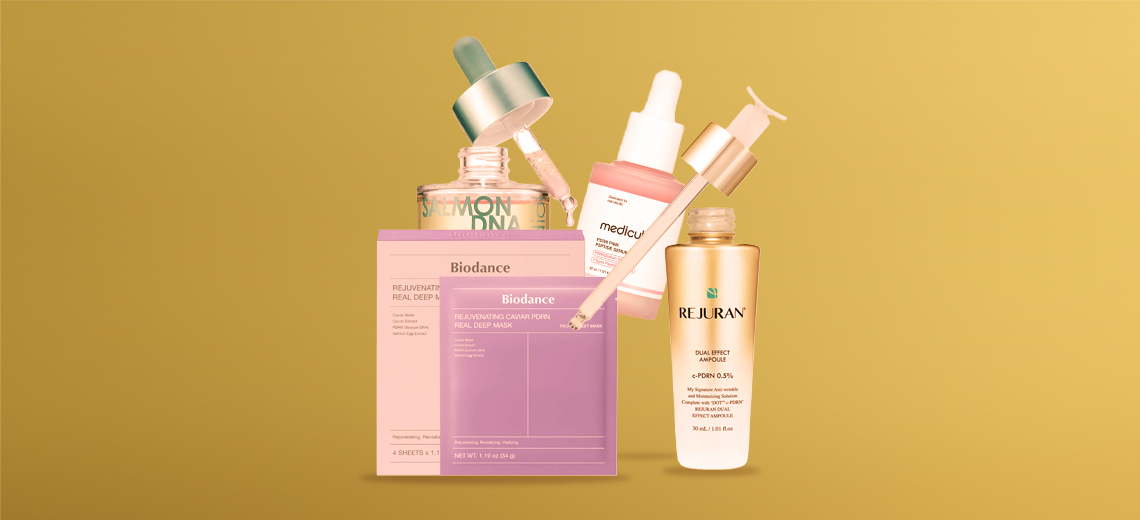
You’ve probably seen the four letters on serum bottles, sheet masks and even lip balms — or heard them on TikTok. PDRN stands for polydeoxyribonucleotide and typically refers to a DNA fragment that’s often, but not always, derived from salmon sperm and most commonly found in K-Beauty. Of course, on social media, PDRN has an obvious shock value to it, which has led to an onslaught of posts in which lines like, “I just got salmon sperm injected into my face,” provide perfect hooks to start videos.
In this week’s episode of the Glossy Beauty Podcast, co-host Sara Spruch-Feiner explores what PDRN is, what it purports to do for the skin, how it got so popular and how it is expanding beyond Korean beauty.
To explore the topic, Spruch-Feiner speaks with New York City-based dermatologist Dr. David Kim; the former editor-in-chief of Allure magazine and fractional CMO for K-Beauty distributor Landing International, Michelle Lee; and the founder of Rodial, Maria Hatzistefanis.
Highlights from the episode, below, have been lightly edited for clarity.
What PDRN is and what it does:
Dr. Kim: “So PDRN really stands for polydeoxyribonucleotide, which basically means fragments of DNA. And then what’s interesting is they’ve discovered that salmon sperm DNA is very similar to human DNA. So the compatibility is really, really high, anywhere between 96-97%. When you inject it, or when you apply it topically, you’re kind of waking up your skin cells [and telling them] to rejuvenate, produce collagen. [It] helps with skin texture and hydration, [and helps] you look more youthful, well-rested and glowy. So that’s the ultimate goal, whether it’s with an injectable as an in-office treatment or with [topical] skin care.”
In Korea, PDRN is simply, “on the menu”
Lee: “When you’re going to skin clinics [in Korea], it’s just one of those things. It’s almost like getting Botox here, where you have this menu of things you can get if you go to a med spa or a dermatologist, and lasers, Botox, filler, Rejuran and different injectables are just some of the menu items. In Korea, … I don’t want to say it’s old news, because people still talk about it … but it’s one of many things on a menu, versus here in the U.S. — it’s still not legal to inject PDRN, even though we all know there are some unscrupulous people who are doing it. What you can do [in the U.S.], which I see quite a lot, is that people will get micro-needling, or they’ll get lasers or some other treatment, and then they are able to topically apply PDRN on as an in-office treatment.”
Creating PDRN products for Rodial
Hatzistefanis: “I never really look at competition. [I know] that that PDRN has been available in Korean brands’ products. But … for me, what really excited me was [that] it’s an ingredient that had a strong story behind it. We also launched with a very unusual format. So, we launched what we call a Water Oil, which is half oil, half water. I eat a lot of salmon — it’s one of the most anti-inflammatory ingredients. This format gives you a lot of the omega-3, omega-6 oils that really nourish the skin and give you that extra boost. We combined the salmon DNA, the salmon sperm with those nourishing ingredients to give you the best results. So for me, it wasn’t about, ‘Oh, let’s just [take this] ingredient and throw it into a random serum and see what happens.’ Yhe process was all about coming up with a luxury product that really differentiates itself from the competition. And it really targets the Rodial woman who likes to use a luxury ingredient. She’s not the type of customer who’s scrolling through TikTok to find the latest trend. It’s: ‘We’ve tried it, we’ve tested it. We put it in a format that delivers that ingredient in a luxury format, and she’s loved it.’”
