

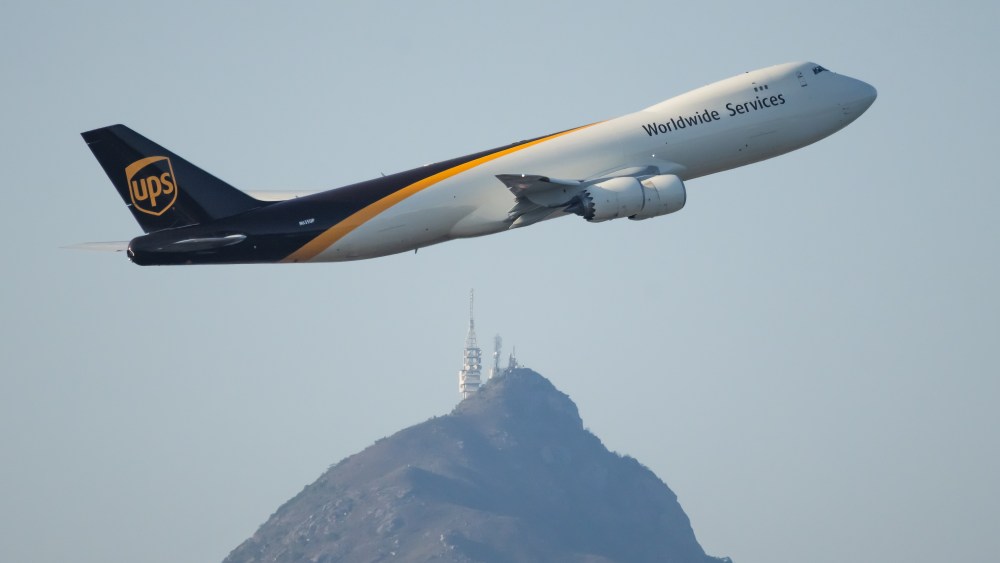
UPS has officially completed its 18-month “glide-down” of packages delivered for Amazon, with the courier increasing its full-year revenue and earnings guidance as it homes in on bringing more higher-margin volumes into its supply chain network.
And one year after air freight volumes on the trans-Pacific trade lane collapsed amid U.S. tariffs on trade partners and the end of the de minimis provision for Chinese goods, the delivery giant is starting to see a rebound.
In an earnings call Tuesday, chief financial officer Brian Dykes said the China-to-U.S. lane returned to year-over-year growth starting in May, with the company lapping the elimination of the duty-free trade exemption that month.
The parcel delivery company did not provide a growth figure for the route, but its reported improvement reflected the surge in air cargo from Asia to North America in May, aided by the weaker year-ago volumes after last year’s Liberation Day tariffs were briefly put into effect.
According to data from the International Air Transport Association (IATA), air cargo demand on the trade lane increased 19.9 percent that month. Aligning with the UPS volume trends, IATA said at the time higher-value air trade flows helped compensate for the structural adjustment following the end of de minimis.
Also coinciding with the cargo figures that month, China’s export numbers to the U.S. skyrocketed more than 35.4 percent to $39 billion, marking the strongest annual increase since early 2021. June’s year-over-year increase was more tempered, rising 13.8 percent from the year-ago period to $43.5 billion.
When accounting for the full April-through-June quarter across all markets, UPS’ total air average daily volume was down 2.3 percent year-over-year. But excluding Amazon, the figures saw a 1.2 percent increase.
The loss in volume from the e-commerce giant was the primary contributor to UPS’ 3.5 percent decline in ground average daily volumes.
The Amazon glide-down removed approximately $4.5 billion of related expenses over the 18-month stretch, with more expected by the end of the year.
During the second quarter, Amazon made up 9 percent of UPS’ revenue, according to UPS CEO Carol Tomé. This is down 100 basis points from a year ago, and down from a peak of over 13 percent during the Covid e-commerce boom.
Nevertheless, Tomé said the tech titan will remain an important partner of the logistics provider.
In the call, UPS now expects consolidated revenue of approximately $91.2 billion, up from the previously issued guidance of $89.7 billion. The company is also projecting a consolidated operating profit of approximately $8.65 billion. This implies full year diluted earnings per share of approximately $7.22.
According to Dykes, UPS will see volume growth ex-Amazon in the back half of the year across all segments. In the third quarter, when incorporating the glide-down, average daily volume is expected to decline mid-single digits.
For the quarter, UPS generated revenue of $22.8 billion, an increase of 7.6 percent versus last year.
Adjusted operating profit was $2.1 billion, a 12 percent bump up from the year prior. Adjusted operating margin was 9.2 percent, a year-over-year increase of 40 basis points, and up 300 basis points from the first quarter of this year.
Tomé highlighted the company’s ongoing investments in warehouse automation, RFID and AI, all of which have been drivers of the company’s larger cost-cutting initiative.
By the end of the second quarter, 68.5 percent of the volume in the UPS U.S. business was flowing through an automated building compared to 64 percent one year ago.
According to the CEO, the cost per piece in an automated building is about 28 percent lower than a non-automated building.
The automation has helped the company adapt to capacity shifts required when demand ebbs and flows, or in situations like the recent Amazon drawdown.
“The automated hubs give us the ability to add throughput much faster than what we used to have to do with conventional hubs. Our network is getting much smarter about how we can scale down, not just from month to month or peak to non-peak, but even day to day and week to week,” said Dykes. “We feel really good about that. We think that it aligns well with the demand environment and what we think we’ll see at peak seasons now that we’ve got a much more manageable peak, with a more stable set of customers.”
Tomé called RFID “the most significant package visibility advancement in a decade,” covering more than 2.2 million packages per day.
“We’re using it to move from a scanning-based network to a sensing network, eliminating hundreds of millions of manual scans every year,” Tomé said, noting that the deployment has stretched across all its U.S. delivery facilities and package cars, and is now moving internationally.
