

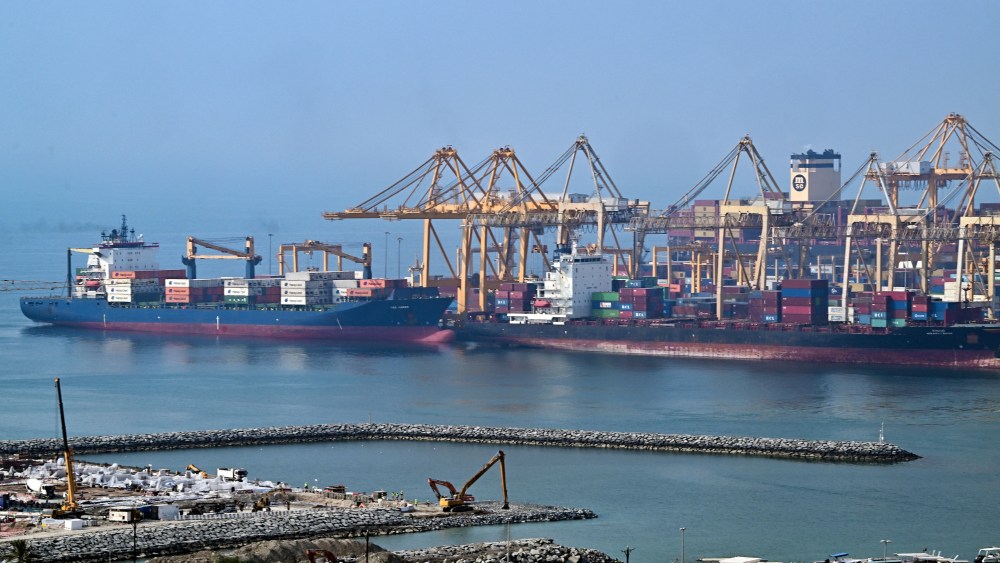
President Donald Trump said the U.S. will not pursue a 20 percent “reimbursement fee” for ships passing through the Strait of Hormuz, reversing course on a controversial proposal he made Monday when he reestablished the American naval blockade on Iranian ports.
“Based on highly productive conversations with Middle East leadership, I have decided to replace the 20% United States Reimbursement Fee with Trade and Investment Deals that the various Gulf States will be making into the United States,” said President Trump in a Tuesday morning post on Truth Social. “Those Investments will be MASSIVE but, at the same time, extraordinarily good for them, and their future.”
The president previously had said the U.S. would serve as the “guardian” of the strait, which has seen restricted shipping activity since the start of the war in Iran amid concerns of attacks on vessels. Trump’s suggestion of a toll followed that of Iranian authorities, who have in some cases, charged ships seeking to transit the Hormuz.
Trump confirmed the naval blockade was still going back into effect, “but only on Ships coming to and from Iranian ports, or carrying anything have to do with Iranian cargo.” The blockade is set to resume at 4 p.m. Eastern Time on Tuesday, according to U.S. Central Command.
The president did not clarify the full context of how the Gulf states are expected to reimburse the U.S. via potential trade deals and investment agreements. But he said that with these investments “we will see Factories, Plants, and Equipment pour into the United States at Historic levels,” which he expects to create “millions” of U.S. jobs.
Trump also had not specified how a 20 percent fee would be calculated, but charging based on the value of cargo held would have sent container prices skyrocketing, according to experts.
Lars Jensen, CEO of container shipping consultancy Vespucci Maritime, estimates that the rough global average of cargo within one 20-foot container (TEU) is $54,500. But with the proposed 20 percent fee, that number would tack on another $10,900 per TEU, he said.
Using the example of a container traveling from Shanghai to Dubai, Jensen noted that in the 12 months prior to the Hormuz crisis, the average spot rate for a TEU was $1,430.
“In other words, compared to the pre-Hormuz conflict, Trump’s tax would result in an increase in freight rates from Shanghai to Dubai of 660 percent,” Jensen said.
For a larger container vessel carrying 10,000 TEUs, total cargo fees would have amounted to $109 million—a fee that would be largely unaffordable for shippers.
Ocean carrier Hapag-Lloyd had openly spoken out against the potential toll system.
“It would be fundamentally wrong to levy fees for passage through international waters,” Hapag-Lloyd said in a statement. “Tolls for infrastructure such as the Suez Canal or Panama Canal are different, because they reflect major infrastructure investments. That is not the case in the Strait of Hormuz.”
Hapag-Lloyd is joining Maersk in raising its earnings guidance for the current financial year as freight rates continue to prop up container profits in 2026
The German container shipping firm, like its Gemini Cooperation partner, cited strong market demand throughout the year as a catalyst to the improved outlook.
Group EBITDA is now expected to be in the range of $2.7 billion to 3.7 billion, which represents a significant increase on the lower end of the projection. Previously, Hapag-Lloyd had guided to $1.1 billion to $3.1 billion in earnings.
Hapag-Lloyd’s operating profit is forecast to range between $100 million and $1.1 billion. This also saw a major swing from the previous estimate, which called for a potential $1.5 billion in operating losses and a maximum profit of $500 million.
“Against the backdrop of volatile freight rates and major geopolitical challenges, the forecast is subject to a high degree of uncertainty,” the ocean carrier said.
On Tuesday, DP World said it would invest $1 million in Hapag-Lloyd’s Ship Green product under a new agreement that will enable customers to reduce ocean freight shipment emissions through verified carbon insets.
The investment, which will be made over the next four quarters, is expected to avoid 4,762 metric tons of carbon dioxide (CO₂) using certified waste-based biofuels.
In the wake of the ongoing situation at the Strait of Hormuz, the Dubai-based company is reportedly planning to build both a new port and a new container terminal on the U.A.E.’s east coast on the Gulf of Oman, The Financial Times said Monday. The new terminal would be constructed at the existing Port of Fujairah.
The new project would allow containers to enter and leave the country without having to pass through the strait, before moving them on trucks overland to Dubai, Abu Dhabi and neighboring Gulf countries.
