

After culinary school, Alabanza worked in the kitchens of Campanile and Grace, two influential Los Angeles restaurants, as well as in Japan and at Thomas Keller’s Bouchon in Las Vegas. Then, about 11 years ago, she moved to Nashville, where she became culinary director of a creamery and fell in love with ice cream as a vessel for flavor experimentation.
In 2018, Alabanza learned about Sarah Estell, a free Black woman who ran a successful ice cream saloon in Nashville in the 1840s and became known as the “Ice Cream Queen.” She felt connected to Estell, whose trailblazing legacy inspired Alabanza to continue looking into the history of Black America and ice cream. “Black hands have been touching this for centuries,” she says. “Ice cream became this perfect tool to tell a story about joy.”
In celebration of Juneteenth, here Alabanza shares a recipe from her new book.
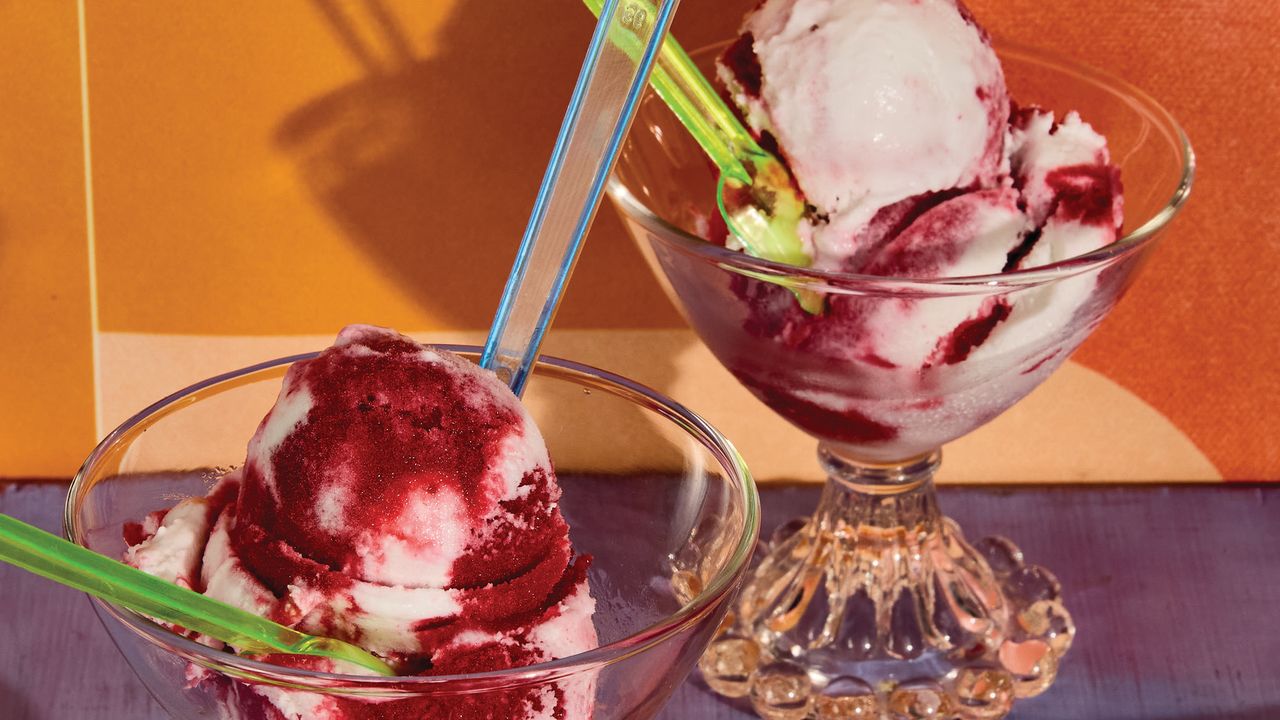
Juneteenth Sorbet

Photo: Brittany Connerly
Makes about 1 1⁄2 quarts
- 1 1⁄2 cups sugar
- 1 cup dried hibiscus flowers
- 1 1⁄2 pounds fresh or frozen raspberries
- 1 1⁄2 cups tapioca syrup or light corn syrup
- 1 1⁄4 cups fresh lime juice
- 1 teaspoon vanilla paste
- 1 teaspoon kosher salt
On June 19, 1865, two and a half years after President Abraham Lincoln signed the Emancipation Proclamation in the midst of the Civil War, Union army forces finally arrived in Galveston, Texas, to formally enforce it. Since then, Juneteenth has grown from a small celebration at Black Texan churches to a federal holiday. Among the many traditions associated with the holiday, like picnics, festivals, and even rodeos, the color red plays a very significant role, symbolizing the blood shed by the millions who were enslaved. At a Juneteenth celebration, you will find many versions of red foods and drinks, from red velvet cake to red whiskey. You’ll also find hibiscus tea, which has roots in the foodways of Western and Eastern Africa. Bissap, a common tea in Western Africa, features the boiled leaves of roselle, a type of hibiscus, and is both tangy and floral.
