

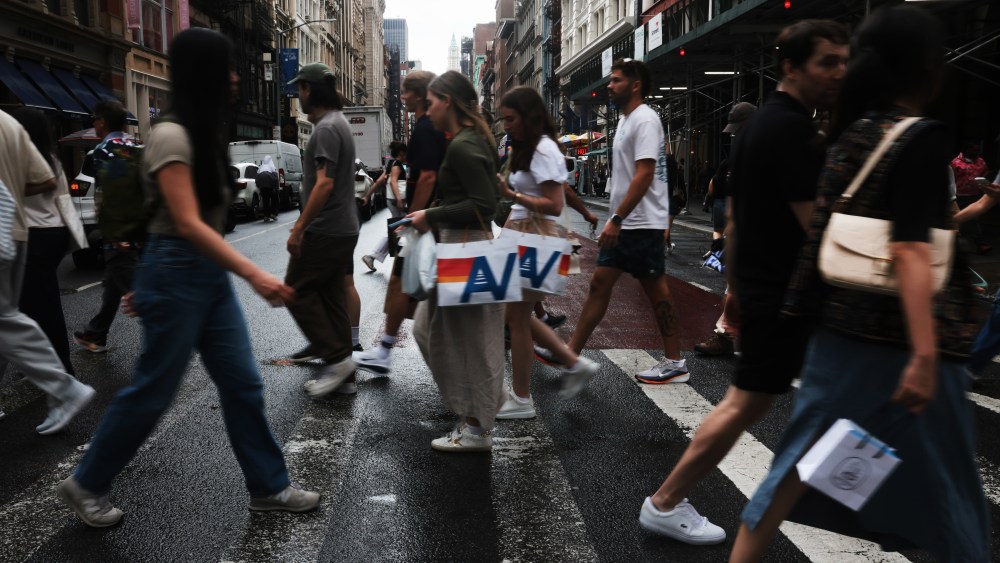
Somehow, retailing in the U.S. is holding up.
A flurry of industry reports and viewpoints issued Monday painted a positive picture on summertime spending and upcoming second-quarter results. Most major publicly held retailers report their second-quarter financial results this month.
Rising oil prices, wildfires, persistent inflation, and no solutions to the wars in Iran, Gaza or Ukraine in sight have impacted consumer confidence. But spending has remained resilient so far this year, with shopping spurred by aggressive price promoting, the stock market performing well and retailers’ operational improvements. There’s also been that post-pandemic desire to get out for the day or travel, and further spending sparked by the World Cup and the 250th birthday celebrations of the U.S.
“Retail sales maintained their steady upward momentum in July as consumers kept shopping despite ups and downs in other economic indicators,” NRF president and chief executive officer Matthew Shay said in a statement Monday. “Supported by a low unemployment rate and steady wage gains, households remained budget conscious but took full advantage of midsummer sales and early back-to-school promotions to stretch their dollars. Retailers helped balance budgets by remaining committed to affordability, ensuring that everyday products remain accessible for American families.”
Total retail sales in the U.S., excluding automobile dealers and gasoline stations, were up 0.32 percent seasonally adjusted month-over-month, and up 5.15 percent unadjusted year-over-year in July, according to the CNBC/NRF Retail Monitor. That compared with increases of 0.33 percent month-over-month and 9.41 percent year-over-year in June.
The Retail Monitor calculation of core retail sales, which excludes restaurants, auto dealers and gas stations, rose 0.3 percent month-over-month in July and increased 4.72 percent year-over-year. That compared with increases of 0.36 percent month-over-month and 10.08 percent year-over-year in June.
Placer.ai reported that mall foot traffic continued to grow in July, with visits up 0.5 percent year-over-year at outlet malls, 4.3 percent at indoor malls and 5.1 percent at open-air shopping centers. “Additionally, visit duration grew at all three mall formats in July, reversing a decline that had persisted since February. Average visit durations were up 0.6 percent year-over-year at outlet malls in July, 0.2 percent at open-air shopping centers and 2.7 percent at indoor malls.”
TD Cowen’s second-quarter report raised concerns that Walmart U.S. may not reach the Street’s estimate for a 4 percent comp gain, but maintained that Walmart can continue to gain share in groceries “while higher margin revenue streams support profitability.” TD Cowen predicted Walmart’s operating income growth at 10.4 percent, ahead of the Street’s 9.9 percent.
TD Cowen expects BJ’s Wholesale Club to beat the Street’s estimates for a 2.6 percent comp-store sales gain and $1.17 earnings per share. And on Target, TD Cowen reported, “Analysts think expectations could be above the Street’s 2 percent plus, despite management’s cautionary language around [the second quarter].…While underlying traffic and merchandising trends remain encouraging, top-line upside may be harder to achieve as tax refund benefits fade and Target laps its strongest comparison of the year at 1.9 percent.” TD Cowen said improvements in key discretionary categories, including home and apparel, are key for the company’s overall turnaround.
Meanwhile, Morgan Stanley issued an upbeat report on Victoria’s Secret. “Our proprietary intimates survey strengthens our confidence in continued sales momentum and reinforces our turnaround durability conviction,” Morgan Stanley reported. “VSXY [Victoria Secret’s stock symbol] already has strategies underway to address gaps in comfort positioning, value perception and store experience — initiatives we believe could drive the next leg of the turnaround and continued margin expansion.”
Morgan Stanley also cited the intimate apparel brand’s store fleet and “store of the future” program modernizing stores as a competitive advantages. But it suggested a stronger promotional strategy is needed to be more competitive with off-pricers.
According to credit and debit card data from the Bank of America, during the World Cup consumer spending in host cities rose around 5 percent, year-over-year, with the strongest gains coming from non-locals, whose spending was up more than 17 percent year-over-year. Restaurants, bars and hospitality were among the biggest winners, BofA reported. “The World Cup clearly gave a lift to local economies, the effect on overall U.S. consumer spending and GDP appears to have been more modest,” BofA noted, adding the spending lift largely ran its course by early July, with the soccer final held July 19.
“Retail’s [second-quarter] EPS season has only just begun, but the impacts have been reverberating,” reported Simeon Siegel of Guggenheim Securities. “So far this quarter, our coverage saw above-average sales and gross margin growers but almost universal SGA deleverage, which led to an average number of EBIT growers and almost universally negative stock price reactions. Interestingly, almost every company saw inventory dollars decline, with at least one citing challenges to receiving optimal inventory balances next quarter, which may prove a broader theme worth monitoring.
“We continue to believe investor fears are bubbling as we finally begin to lap the incredibly strong second half from last year and believe that until companies begin to show they’ve been driving idiosyncratic wins versus simply benefiting from tariff-induced-AUR-gains — we have been focusing on those that have been benefiting from outsized traffic gains this past year such as Ross Stores and Victoria’s Secret — the broader sector move will lean more toward the fear. We lower our price targets on Planet Fitness to $74 from $95, and Capri Holdings to $27 from $32.”
