

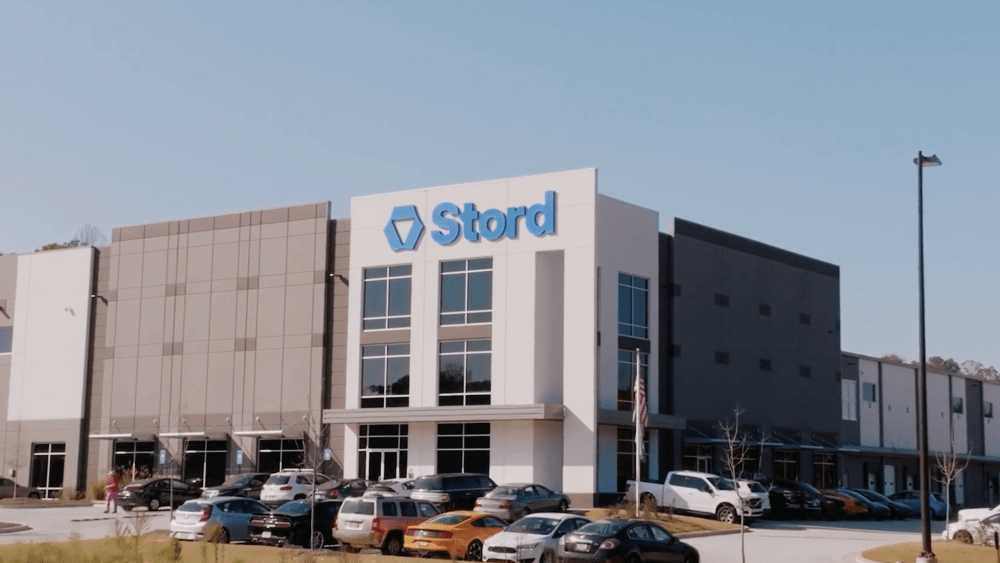
Stord has secured $250 million in new funding as it looks to position itself as a logistics counterweight to Amazon for independent brands.
Along with the funding, the e-commerce fulfillment provider announced the launch of Stord Labs, a 10,000-square-foot R&D testing ground at its Atlanta headquarters.
The environment is designed to test its agentic AI, robotics and automation technologies in real-world warehouse conditions before deploying them at scale across its network of nearly 100 fulfillment locations worldwide.
Steve Swan, president and chief operating officer at Stord, said the decision to build the lab was based on a need to create an environment rigorous enough to understand where potential warehouse productivity gains take place without needing to first apply the tests at the company’s 20 owned sites and 80 partner locations.
These workflow tests can often include new robotics configurations, AI-driven dynamic slotting and pick path optimizations, as well as new hardware designs.
“The core learning that drove the entire concept was this: vendor demonstrations are a poor proxy for real performance,” Swan told Sourcing Journal. “A robotics system that runs cleanly in a controlled environment with a single product type and predictable patterns can fail completely when you introduce it to the complexity of a real multi-client operation like mixed SKU profiles, variable order sizes and seasonal demand swings.”
With its fulfillment network running on one operating system and a single unified technology stack including a proprietary WMS and OMS, Stord can immediately send results from the testing ground without needing to be reintegrated on a facility-by-facility basis, according to Swan.
Stord refers to this combination as the “physical intelligence layer” that powers its fulfillment network, which processes more than $15 billion in annual gross merchandise value.
“What performs, deploys. What doesn’t, gets cut quickly,” Swan said. “If a technology delivers measurable productivity gains in a real multi-client environment, it moves across the network. If it doesn’t, we move on. The timeline is driven entirely by performance, not by a deployment schedule.”
The effort comes as logistics operators across the retail and apparel supply chain increasingly race to automate fulfillment operations amid rising labor costs, tighter delivery expectations and mounting pressure from giants like Amazon and Walmart, both of which have aggressively invested in robotics and AI-driven fulfillment optimization.
Swan said Stord’s vertical system integration has been a vital proposition for both the third-party brands it works with and those it is wooing.
“Across our network, brands save millions annually on parcel costs,” Swan said, highlighting that order routing decisions are made with full visibility rather than in isolation due to the integration of the company’s OMS, WMS and Stord Parcel carrier solution, which can cut per-package costs 12 percent to 15 percent on average.
Despite Amazon’s dominance in the e-commerce field, Stord aims to leverage its technology ecosystem to also assist across other areas in the supply chain, including brand loyalty, online checkout, delivery tracking and returns.
“For years, every independent brand has been left to figure out on their own how to compete against the consumer experience Amazon has spent decades and hundreds of billions building, and by every measure, independent brands have been losing. Stord exists to level that playing field,” said Sean Henry, founder and CEO of Stord, in a statement.
Stord’s slate of 1,000 customers includes apparel brands Fanatics, American Giant and True Classic, which credits the company for helping the DTC seller launch in Costco, Sam’s Club and Target.
Stord has been on an expansion kick in recent years, having acquired the Pitney Bowes fulfillment division in 2024, while scooping up other businesses including 3PL ProPack Logistics and AI fulfillment platform Shipwire.
Early in 2026, Stord acquired a Dallas-area fulfillment center from American Eagle Outfitters after the apparel retailer shut down its Quiet Logistics division. That move was bigger than a warehouse transaction, with Stord taking over Quiet’s former customer base and many employees moving over to the fulfillment provider.
Although Stord has completed eight acquisitions in total, each exceeding its targets, according to the company, “the Series F reflects what is already working organically,” Swan said.
The company’s software business is growing faster than its overall business, having tripled in 2025, he noted. Software bookings more than doubled quarter over quarter in the 2026 period as more Stord customers onboard the firm’s Consumer Experience suite of solutions.
According to Swan, the funding will be used to keep growing Stord’s team, which currently includes more than 4,000 employees. Over 200 of them are dedicated to software engineering, product, data science and physical infrastructure.
Additionally, Stord will use portions of the round to “continue expanding our fulfillment footprint so brands can position inventory closer to their consumers at lower cost,” Swan said.
The $250 million round included contributions from Strike Capital, Kleiner Perkins, Founders Fund, Franklin Templeton, Baillie Gifford, G Squared, Bond and Lux, among others.
In total, Stord has raised more than $770 million in funding since its foundation in 2015. The company most recently raised more than $80 million in a Series E equity round led by Strike Capital that also secured $120 million in debt. The combined equity and debt financing unveiled last May valued the company at $1.5 billion.
Over the past four years, the fulfillment provider has increased its revenue tenfold.
