

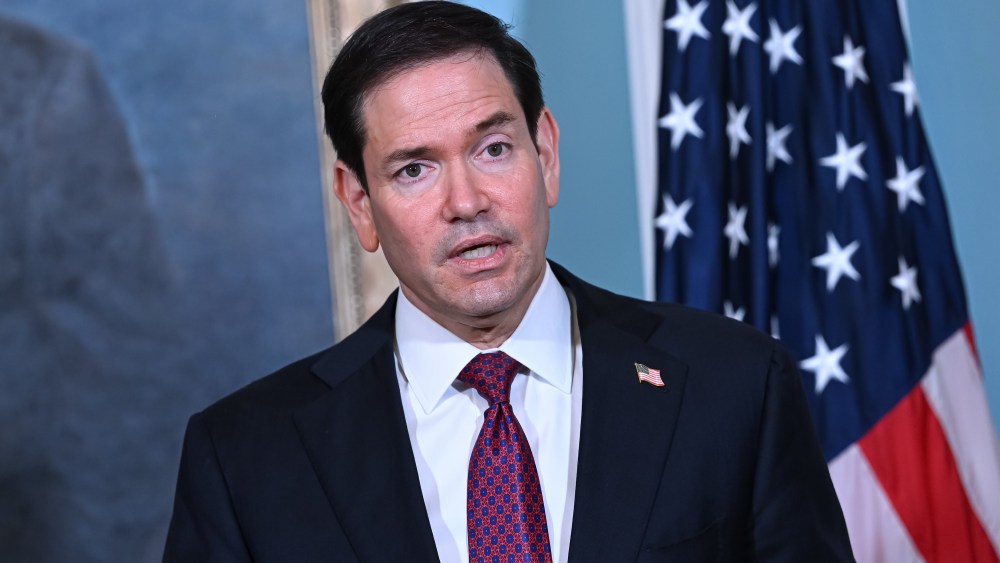
A deal to restore more normal shipping through the Strait of Hormuz could come “very shortly,” Secretary of State Marco Rubio said Tuesday morning, though negotiators have yet to finalize an agreement.
Although the Secretary of State declared the strait “open” and noted that there are ships moving through the strait, traffic remains largely restricted compared to pre-war levels due to Iranian attempts to control navigation in the waterway.
The United Kingdom Maritime Trade Operations Center reported that a cargo vessel had been hit by an unknown projectile off the coast of Oman early Tuesday.
The maritime traffic monitoring agency did not provide further information on the ship, including what flag the vessel was sailing under or whether it was carrying cargo.
Rubio’s comments follow those of another White House cabinet member suggesting a deal could make room for the free flow of shipping through the oil conduit.
Treasury Secretary Scott Bessent suggested in an interview with CNBC that the U.S. and Iran could reach an agreement Tuesday or Wednesday that would enable “freedom of movement” through the strait.
Several media reports indicated that a current proposal negotiated between Iran and Oman would enable Persian Gulf-bound ships to enter through the Iranian side of the strait, while outbound vessels would pass through closer to the Omani coast. The Associated Press said any deal would be linked to the U.S. lifting its blockade on Iranian ports.
Tolls would not be charged.
There are other signs of possible restoration of traffic, with a Bloomberg report indicating that Iran is considering allowing European countries to clear mines in the Strait of Hormuz. That concession could be part of a deal to normalize shipping in the waterway and ease broader peace talks with the U.S.
The move would represent a softer stance from Tehran, which had previously stated it would not allow foreign nations to participate in demining efforts.
Ahead of the reports, MarineTraffic indicated Monday that the U.S.-Iran diplomatic track “remains contested and should not yet be treated as stabilizing.”
“Over the next 24-72 hours, users should monitor whether Strait of Hormuz crossings recover from the low August 2 level and whether [Iran’s preferred route] remains the dominant route,” said Dimitris Ampatzidis, maritime risk and compliance manager at MarineTraffic in a Monday blog post. “A return of Hormuz traffic separation scheme crossings would be an important sign of route diversification, while continued concentration around the Iranian route would indicate that operators are still moving through a narrow and politically sensitive routing pattern.”
While the Hormuz uncertainty lingers, concerns about a flareup of Houthi attacks in the Red Sea don’t appear to have deterred major ocean carriers from sending more of their vessels through the Suez Canal route.
According to data from container shipping research firm Linerlytica, the total capacity diverted to the Cape of Good Hope route dropped to 5.2 percent of the global fleet to kick off August, reach its lowest point since January 2024.
The total number of diverted ships fell below 300 vessels with a total capacity of just 4.1 million 20-foot equivalent units (TEUs), down from a peak of 5.3 million TEUs earlier this year.
Yemen’s Houthis have also denied they plan on instituting any toll fees for vessels passing through the Bab el-Mandeb Strait, the pivotal southern chokepoint where ships sail from the Indian Ocean to the Red Sea.
The Iran-aligned group’s Humanitarian Operations Coordination Center emphasized in a statement Saturday that transit through the strait is free of charge.
The militant faction declared a maritime embargo against Saudi Arabian shipping in late July, including a blockade on ships of all origins attempting to enter the country’s ports.
According to Linerlytica, CMA CGM and Maersk are continuing to drive the early return to the trans-Suez route, directing ships on their EPIC and AE11 westbound voyages respectively through the Bab el-Mandeb. These ships will avoid calling at Saudi ports and will head directly to the Suez.
Saudi vessels are still avoiding the southern chokepoint. According to data from MarineTraffic, six Saudi-flagged very large common carriers turned away from the route, pivoting south on Friday before voyaging down the east coast of Africa.
