

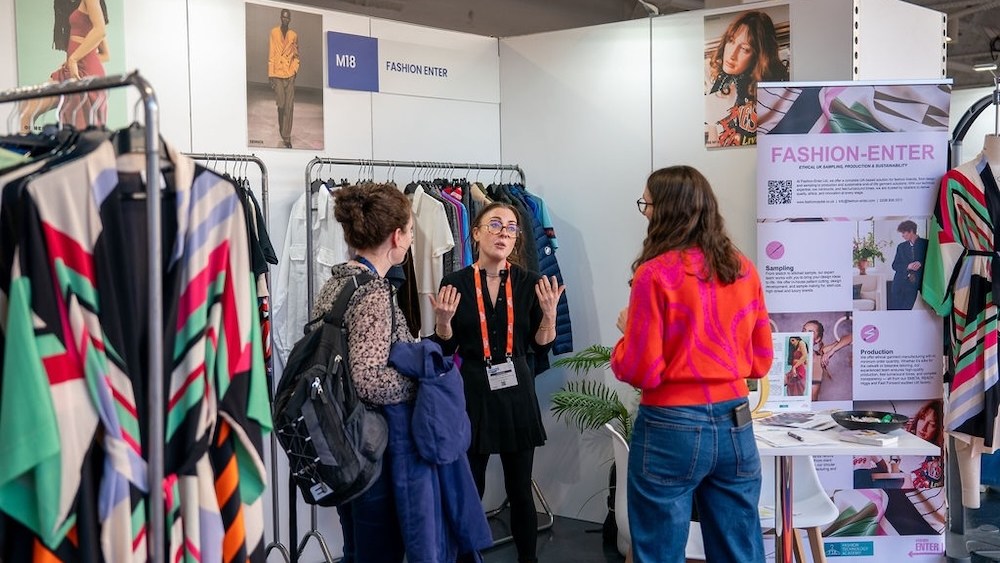
Although the case for sourcing diversification has been clear for around a decade, the risks of allocating orders to “one big basket on the other side of the world” are gaining renewed attention in the current environment.
Far shore, large-volume production’s usually attractive pricing is losing some of its luster as costs rise and transportation is bogged down amid the conflict in the Middle East. Retailers are already reporting increased expenses tied to air freight to circumnavigate the Strait of Hormuz and higher polyester costs due to oil spikes, eating into the savings they would typically see from producing offshore.

Suzanne Ellingham
“There’s only so many times you can get bitten by supply chain disruption,” said Suzanne Ellingham, director of trade show Source Fashion, part of Hyve Group. “Covid was a massive bite, and now with some of the geopolitical upheaval and the unrest in the Middle East, it’s making life difficult. We are seeing more intentional conversations about moving supply and having diversified buying strategies and diversified risk.”
As companies are diversifying, there has been a marked reduction in China’s share of global clothing exports. While it stood at 54 percent in 2010, today it is closer to 47 percent. Ellingham attributes this decline to the country’s rising labor costs, causing companies to seek out a cheaper needle in locales like Vietnam.
Despite the evidence of diversification’s growing traction, McKinsey data shows that for both American and European brands, nearshoring’s share of production has remained fairly flat in recent years. In the U.S., production allocated to North and South America didn’t move from 17 percent between 2019 and 2023, while EU brands’ share of production in the EU, Northern Africa and Western Europe actually declined slightly from 28 percent to 25 percent in the same timeframe. Back in 2021, 71 percent of apparel chief purchasing officers told McKinsey they were planning to grow the share of their goods that are nearshored, so actions have not yet lived up to the stated intent.
Even outside of the challenges tied to the Iran conflict, the tendency toward offshoring is creating other negatives for the industry including overproduction, demand misalignment and markdowns. This doesn’t mean that companies need to think of nearshoring everything. Rather, they should consider a balance where basics are allocated to farther away destinations and trend-driven merchandise is made in closer proximity. “Every business should be looking at de-risking their supply base,” said Ellingham. “They should be looking at having multiple suppliers for multiple specialisms in a few different regions.”
The term nearshoring has diverse interpretations, with the “near” destinations ranging from domestic sources to western Asia. Some of the regions that Source Fashion buyers are showing particular interest in are Turkey; Eastern Europe such as Romania and Lithuania; and northern Africa like Morocco and Egypt. These destinations are cost-friendly while also offering varied transportation routes to guard against risk.
Another area of growing interest is the U.K. Ellingham has seen buyers’ exploration of domestic manufacturing shift from merely looking to seriously investigating. But there is still a lack of awareness about the opportunities available, partly because these factories often lack a strong internet presence, such as social media strategies and placement in directories.
U.K. fashion manufacturing is “distressed,” with data indicating the sector has lost 70,000 jobs in the last five years; today, under 240 firms employ at least 20 people. Ellingham felt the call to use the Source Fashion platform to support the industry, describing the work to raise visibility of these suppliers as her “passion project.” At Source Fashion’s next edition, happening July 7-9 at Excel London, the show will debut a U.K. pavilion. Source Fashion’s efforts to court more domestic suppliers over the last year have included subsidizing booths to make participation more accessible, resulting in the U.K. being the second most represented country in terms of exhibitor numbers.

Courtesy of Source Fashion
Along with its show floor curation, Source Fashion has produced “Inside British Manufacturers,” a video series going inside some of these producers’ facilities, spotlighting everything from raw material makers to trims producers.
“British manufacturing has kind of lost its story somewhere,” said Ellingham. “If Source Fashion can shine a light on some fantastic manufacturers, it’s what we’re here for, and I think we have an opportunity to really make an impact in our own domestic market.”
Part of the education is also around the cost feasibility of U.K. production for more than luxury price points. “Where we need to do more of the messaging around where manufacturing in the UK can make sense is in the mid-market,” said Ellingham. “You need to stop looking at your in margin, and start looking at your total cost of range, how much you sell, your full-price strategy. When you add all of that up, it starts to really make financial sense to start manufacturing in the U.K.”
Driving this financial story home, Source Fashion’s seminar series will include a talk with Bill McRaith, an advisor for Future-Proof Fashion and the former chief supply chain officer for PVF Corp., on “making nearshoring make sense.” He will lay out financial models showing how the economics of nearshoring work, even in the current tough retail climate where margins are being squeezed.

Seminar series at Source Fashion’s January 2026 edition.
Courtesy of Source Fashion
A small change could have a big impact. Ellingham noted that even just shifting 5 percent of goods sold in the U.K. to domestic sources would be huge. However, if companies do want to source in larger volumes, the capacity can be found, with some factories banding together to spread the work around.
Another hurdle for U.K. manufacturers has been a lack of a collective voice in governmental affairs, leading to legislation that does not include the manufacturing segment of the fashion business. By bringing suppliers together, Source also intends to open up more dialogues. A report from Catherine West MP calculates that if the right support was given to the sector, it could generate 64,000 jobs. Former factory employees have retained their skills, providing a pool of talent to fill these roles.
Although nearshoring is mainly driven by risk reduction, an added benefit is better collaboration. “It comes down to what type of relationships you want with your manufacturers,” said Ellingham. “Do you see them as suppliers, or do you see them as partners? Because if you see them as partners, you want to go and visit them to see what they’re doing, and that’s when you start to get much better quality of product.”

Courtesy of Source Fashion
Source Fashion’s show floor will reflect the needs of its buying base, providing them with not only robust options closer to home, but also volume producers around the globe. Beautiful products with unique stories resonate with the fair’s attendees, and they are open to trying something new.
“Whenever we debut a new region or pavilion at the show, they always do well,” sad Ellingham. “It’s because U.K. buyers specifically are always looking at discovery and what can give them that next best seller, and that may not always be the factory that’s around the corner or the same people that they’ve always worked with.”
Click here to learn more about Source Fashion and register for the next edition, July 7-9 in London.
