

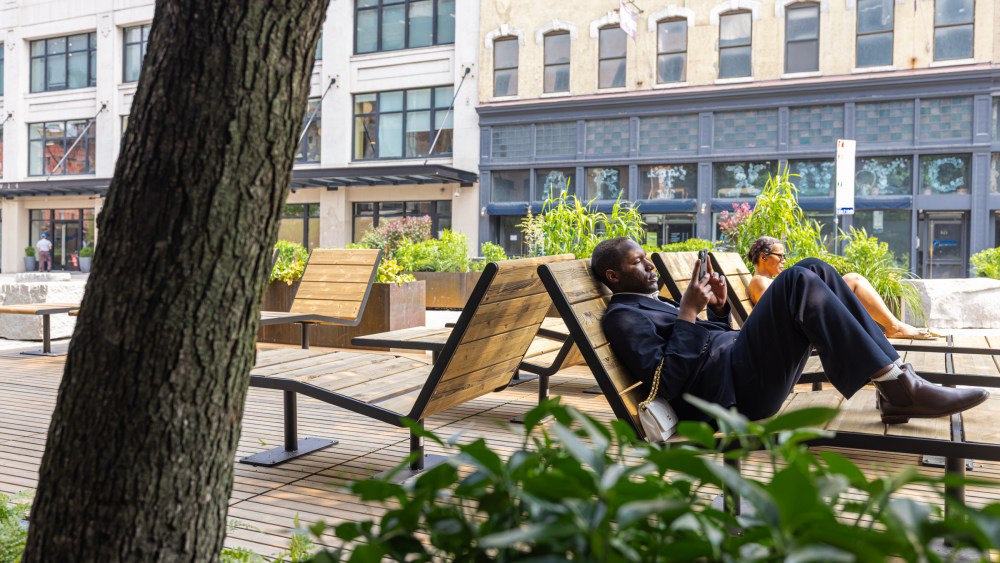
The transformation of Manhattan’s Meatpacking District isn’t letting up just yet.
The historic cobblestone streets and red brick warehouse architecture remain, but change across the retail landscape is ongoing as upscale stores and restaurants continue to flock to the neighborhood.
Just last year, Bottega Veneta, Baccarat, LiLi the First, Golden Goose, Luca Faloni, Metro Cinema, K’ab Juun, The Tox, Cadar, Trainer Court and Tuleste Factory opened for business there.
This year, Amouage, Scarlett Gasque, MooRER Verona, This Place Blows and Bernardaud opened their doors. And two fine-dining restaurants, Estelle’s, a contemporary American restaurant inside the Gansevoort Meatpacking NYC Hotel, and Verde, a French-Mediterranean supper club and restaurant, also opened this year.
Expected to open later this year: Bagatelle fashion; Lady Delilah supper club and jazz lounge; Bang & Olufsen high-end audio and electronics; Silent H, a Mexican restaurant; the Bilt Cafe, and Acne Studios, the Swedish contemporary fashion brand.
Annabel’s, the London-based members club, will be taking over an entire building at 675 Hudson Street, possibly next year or after.
Count the High Line, the Whitney Museum of American Art, the Chelsea Market, the Apple Store, the Standard Hotel, RH (formerly called Restoration Hardware) and Pastis, among the major destinations. They’ve been factored into decisions by international luxury labels such as Hermès, YSL and Baccarat to fill the void left by the rash of departures years ago that included Jeffrey, Stella McCartney, Scoop, Levi’s, Alexander McQueen and others. Insufficient shopper traffic, as well as high rents and internal issues, led to the string of closings.

Inside LiLi the First designer boutique.
“There’s a very clear artistic, creative vibe here. There’s much more to the Meatpacking District than just walking down a street of shops,” said Ifat Pridan, owner of LiLi the First, at 825 Washington Street, a 2,100-square-foot boutique specializing in independent, international designer brands, with another shop in the Georgetown neighborhood of Washington, D.C. LiLi the First is Meatpacking’s only multibrand retailer selling independent and international labels, both emerging and established, and has the distinction of being the only store in the city selling Vivienne Westwood, aside from the Vivienne Westwood store on East 55th Street.
Pridan refers to her shop as a place, not a store. “It’s a place to hang out and have an espresso,” she said. “There’s lot of artwork, there’s space and there’s shopping, of course. One of our customers created artwork for us. We’re not filling the space with racks and racks of clothing. But the clothing we do have reacts with the art, like a gallery. It becomes very personable.” She said the store’s point of view is “more about individuality” and showcasing designers with varied points of view, from avant-garde to sexy.

The Scarlett Gasque fashion shop. Photo by Jim Fryer and Iri Greco/ BrakeThrough Media.
BrakeThrough Media
John Terzian, cofounder of the Los Angeles-based H.wood hospitality group operating clubs and restaurants, scouted other neighborhoods in Manhattan before deciding on Meatpacking for a 10,000-square-foot, subterranean Lady Delilah restaurant at 50 Ninth Avenue. It will blend fine dining with live entertainment and is scheduled to open this fall. “The size of the space we found and the fact that the crowds are here made Meatpacking right for the Delilah brand,” Terzian said. “The location is amazing. It’s also discreet, has a one-of-a-kind, very Old World feel, with dark wood and lots of solid colors. Overall, the Delilah brand has an Art Deco feel.” There are also Delilah locations in Los Angeles, Las Vegas, Miami and Dallas.
“I remember when Meatpacking was grittier, with a lot nightlife,” Terzian said. “It’s been undergoing a renaissance and growing more and more. Definitely, in the span of the last four or five years, lots of places have opened. But I do see a void in the city for live music with actually great food.” It’s a concept, Terzian said, “as old as time, but not really prevalent.”
According to CBRE, the commercial real estate firm, the Meatpacking District recorded the city’s largest quarterly increase in average asking rents during the second quarter. It rose 14 percent from the prior quarter, and 7 percent year-over-year, to $303 per square foot. “Demand from upscale and luxury retailers has remained concentrated in the Meatpacking District, reducing available supply and supporting higher asking rents for newly marketed spaces,” CBRE said. “During [the second quarter], the addition of a new space with above-average pricing contributed to a modest increase in overall corridor asking rents.”
The West Side neighborhood has transcended its once seedy reputation for drugs, sex clubs, abandoned slaughterhouses — as well as excessive retail turnover — and has emerged post-pandemic as a pedestrian-friendly bastion of designer fashion shops, contemporary art galleries, and large “anchors” drawing tourists and locals.
“I’ve seen the whole cycle going back to the ’80s,” said Gene Spiegelman, vice chairman and principle of Ripco Real Estate, whose father was in the real estate business and had partners in the meat business. “Meatpacking got hot. It got cold,” Spiegelman said. “The customer traffic was never there in a consistent way. Retailers got excited about the authenticity of the neighborhood, but the sales volumes didn’t show up.”
Jeffrey, the 12,000-square-foot luxury designer store launched by Jeffrey Kalinsky in 1999 at 449 West 14th Street, “really ignited the neighborhood,” Spiegelman said. But it eventually closed along with the Stella McCartney and Levi’s stores that were also on 14th Street. The openings of Apple, RH, The Whitney, the Gansevoort Meatpacking NYC and The Standard hotels, as well as the High Line, and the Pastis and Catch NYC restaurants, collectively changed perceptions of the neighborhood that it couldn’t support much in the way of better and high-end retail.
“The neighborhood changed and started to draw consistent traffic. The strongest street became Washington,” Spiegelman said. “Fast forward to today, it’s now this real mix of culture, commerce and community. And the amount of luxury brands that have found a home, particularly along Gansevoort, is pretty miraculous.
“I understand retailers are very satisfied with their sales,” Spiegelman said. “The neighborhood is now what I would call stabilized. A lot of luxury retailers got pretty decent deals, from $200 to $350 a foot depending on the space and street. Meatpacking didn’t get the $400 to $500 SoHo rents. In the future [Meatpacking] rates will be higher.”
The days of 25 to 30 percent availability seen from 2016 to 2021 are over, Spiegelman suggested, pointing to the current availability rate of 10 to 12 percent, with some availability on the north side of Washington Street, and the Little West 12th and 13th side streets.

Jeffrey LeFrancois. Photo by Jim Fryer/BrakeThrough Media
BrakeThrough Media
“We seemed to have leveled off,” said Jeffrey LeFrancois, executive director of the Meatpacking District Management Association, a nonprofit business improvement district, addressing the area’s retail evolution. “A lot of the historic vacancy has been getting filled, or will be filled in the next year or so. Leases are signed on many places now. The neighborhood is trending up, both from a foot traffic perspective and a lease signing perspective. The district might not be the first place tourists go when visiting New York, but it’s definitely on their list because we have the Whitney Museum, Little Island, Hudson River Park, the High Line, the Chelsea Market. These are huge draws. Visitation hasn’t fully recovered from the pandemic, but it’s strong and the spend is higher. People are actually buying rather than just passing through.
“Our retail skews luxury. There’s no question about it,” LeFrancois said. “But we see it as having ‘tiers’ of fashion. There’s the crème de la crème with Hermès and YSL, and then there’s Frame and Paige,” two premium denim brands. “Theory is a great place for everyday wear, but also for someone buying a suit for their first corporate job. So we think the neighborhood can introduce people to brands at different tiers.”
Meatpacking is bordered by West 14th Street south to Gansevoort Street, and from the Hudson River east to Hudson Street.
The Meatpacking BID covers a swath from Horatio to 17th Streets, and Eighth Avenue to the West Side Highway, encompassing 7 million square feet of commercial space, more than 300 ground floor businesses, approximately 28,000 employees, 4,000 apartments and 7,500 residents. Occupancy within the BID stands at about 88 percent, putting Meatpacking’s vacancy rate at a post-pandemic low.
The Gansevoort Meatpacking NYC Hotel was renovated during the pandemic. “They’re crushing it right now,” LeFrancois said. There’s also The Standard, The Dream, The Maritime and Soho House New York hotels in the area, yet LeFrancois believes additional hotels are needed. “Our hotels are busy,” he said. “People want to stay here. I’d like more but the city has made it very challenging to build them.” (New York has strict zoning, permitting and labor laws and high construction costs.)
LeFrancois said the district could also use more food and beverage concepts. “There are restaurants in the works. I’d love a lot more but the challenge is how do we create that buzzy café culture that so much of Europe is known for, but without taking precisely what’s there. It needs to be its own.
“Nightlife has not materialized post-pandemic to the way it was,” LeFrancois said. “There is room for that. Daytime visitation is heavier because of things like The Whitney, the Chelsea Market and the shopping scene here.” LeFrancois added Meatpacking’s floor plates are often not suitable for restaurants, and that restaurants often generate thin margins.

Gansevoort Plaza. Photo by Iri Greco and Jim Fryer/BrakeThrough Media.
© BrakeThrough Media
On a recent walk through the neighborhood, LeFrancois underscored the impact of converting roads into pedestrian plazas. “Back in 2020, we developed our pedestrian-oriented district plan, or the POD plan, which was a series of strategic steps to reorient the district, putting the pedestrian first, which isn’t always the case in the city,” LeFrancois said.
The POD plan was designed to continue momentum following the 2019 transformation by the city, in partnership with the Meatpacking BID, of 30,000 square feet of roadway along Ninth Avenue from Gansevoort Street to West 15th Street into three new pedestrian-only plazas with seats, tables, umbrellas, plants and bollards: Gansevoort Plaza (13,500 square feet) at the intersection of Gansevoort Street and Ninth Avenue; Chelsea Triangle (12,200 square feet) on the north side of 14th Street along Ninth Avenue, and 14th Street Square (7,400 square feet) on the south side of 14th Street along Ninth Avenue.
Building off this, the Meatpacking BID’s POD plan led to the introduction of two new public plazas: Gansevoort Landing at the foot of the Whitney in 2023 (7,000 square feet) and the West 14th Street Promenade (13,000 square feet) from Ninth to Tenth Avenues in 2025.
“These are not only tremendous public assets and amenities for people to meet and enjoy, they’ve also transformed how we think about our streetscape and have helped inform businesses choosing to operate here that our philosophy on how we treat the public realm is very much in the spirit of how they treat their customers. I’m a strong believer that your experience when you are outside in the Meatpacking District should match the service you’re getting inside any of the shops and restaurants. It’s ‘car light’ because more space for people means more shoppers, and a better environment where you’re not distracted or annoyed by horns honking.

The 14th Street pedestrian plaza. Photo by Iri Greco/ BrakeThrough Media
© BrakeThrough Media
“We now have one of the largest run of plazas in the city,” LeFrancois said. “The plazas are the backbone of the neighborhood. I always tell people I see in our plazas that you’re sitting in what used to be the middle of the road.”
The plazas are seen as “the threads” that tie the neighborhood together, along the distinct cobblestone streets and red brick buildings. With approximately 50,000 visitors passing through the Meatpacking District daily during peak seasons between May and October, the public plazas often serve as sites for brand activations and art installations.
The Estelle’s restaurant is named after the grandmother of Sean Largotta, co-owner and partner at Gansevoort Hotel Group. “It’s American modern with an Italian twist, upscale, but approachable, very European,” Largotta said, describing the menu and aura at Estelle’s.
Years ago, “Meatpacking was the epicenter of clubs that brought in a young, kind of raucous crowd, 30 and younger. They came at 10 and stayed until 4 in the morning. Meatpacking was really a nocturnal place.”
“By the late ’90s, the neighborhood started to mature,” Largotta said, as new restaurants and stores moved in and The Whitney and The High Line opened. “It wasn’t the kind of evolution you saw happening in SoHo. It was well-rounded,” and attracting a much wider age range than before. Instead of being just a one-stop shop, Largotta said, almost every weekend there’s something happening in the plazas,” whether it’s an art exhibit, a performance or an outdoor movie.
Largotta said that for the businesses in a neighborhood to succeed, “You need that diversity of commercial spaces — culture, art, hospitality, a mix of mom-and-pop [stores]. I hope that Meatpacking maintains its pockets of independent restaurants and boutiques, not just those you see in magazines.”
Since LiLi the First opened in May 2025 in the Meatpacking District, “we are building awareness, one step at a time and trying to cultivate relationships,” said Pridan, who is “very encouraged” about business. “Word of mouth is working. It’s a process. Every month there is growth. I gave myself two years to turn profitable and I am exceeding plan. We already have returning customers.”
She did consider other Manhattan neighborhoods for her store before picking Meatpacking.
“I had to explore,” she said. “I went to SoHo, Bleecker Street, the Upper East and West sides. But Meatpacking had this vibe, and the square footage I could afford. On Bleecker, I would have paid the same rent I’m paying here for a tiny space with no basement, almost half of what I have here. It was almost insulting.”

The Baccarat flagship in the Meatpacking District. Photo by Iri Greco/ BrakeThrough Media.
© BrakeThrough Media
