

LONDON — Ten graduating designers from Istituto Marangoni in London presented their final collections at the Italian Embassy on Monday, transforming Casa Italia, as the building is known, into a showcase for emerging talent.
Designers from around the world explored personal identity and pursued innovative creative techniques that nodded to the future of fashion design.
Adi Maoz-Cohen, director of education at Marangoni London, said the program encourages students to embrace themes of identity and memory.
“We do not ask them to be safe — not at all. We ask them to be specific because in an age of endless possibilities, specificity is a designer’s most valuable asset,” said Maoz-Cohen. “The industry does not need more imagery, rather, it needs voices.”
The collections explored memory, migration, sustainability, heritage and identity through tailoring, knitwear and experimental silhouettes.
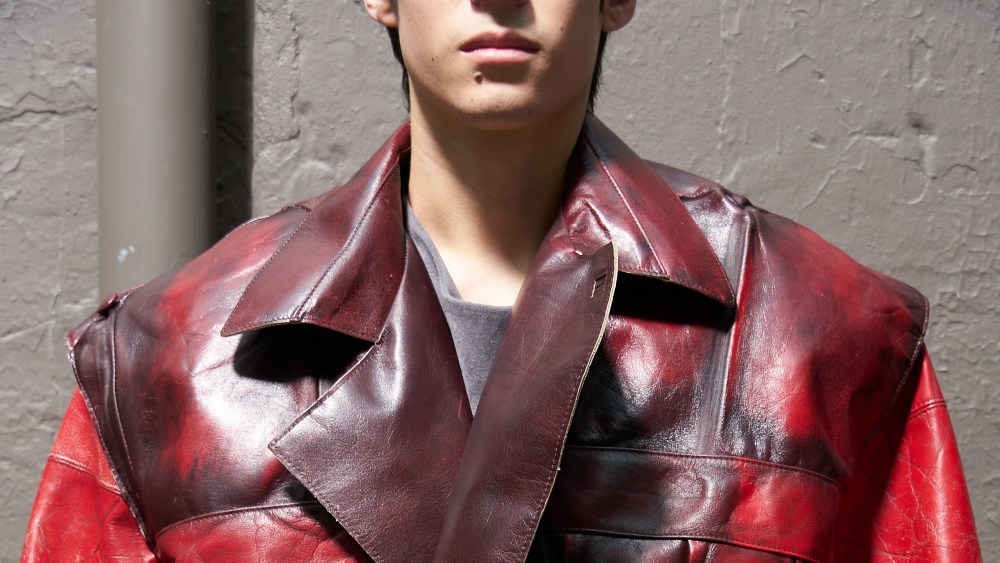
Virginia Bozzola, from Italy, transformed discarded materials, such as recycled car interiors and leather from furniture, into menswear.
She examined how leather ages and adapts to human use, and created outerwear and a whole wardrobe of shorts, hoodies and overalls, from worn — and later airbrushed — leather. She even begged her parents to let her dismantle her childhood couch for the project.
Rafael Stamatoiu, from Romania, whose interests are rooted in archival research and construction, reimagined historical imagery and utilitarian garment detailing.

A look from Liana Tsz Yan Chan.
Like most kids, he once wanted to be an astronaut, so he created a collection inspired by jumpsuits using paneled metallic eel leather and heat-reactive fabrics. He showed off oversize, outer space-themed jackets, trousers and vests with NASA-like patches.
Riccardo Sanna, who is British and Italian, blended his two worlds by exploring how contemporary design can preserve stories and traditions.
He said his Sardinian grandmother was his biggest inspiration, and helped him to make the fabrics in his collection. He recreated miners’ workwear in leather, and added a delicacy to the looks with tablecloth lace made by his grandmother.
Liana Tsz Yan Chan, from China, explored the possibilities of tailoring glass and other alternative wearable materials.
She looked at how obedience can become self-actualization, and drew on memories of her teenage Catholic school years and the uniform she wore. Her final dress, which took more than a year to finish, was made from hundreds of interconnected glass chain-mail loops.
Giulia Improta, from Italy, has been specializing in textile development, and using experimental embroidery techniques that involve knitting with alternative materials.
She was inspired by the novel “American Psycho,” and explored the main character’s two identities. She distorted a pin-striped suit and a camel coat with underwiring, allowing the wearer to manipulate the material as if it were his or her own emotions.
Fabio Rubino, Marangoni’s director in London, said the the school wants to educate students with different backgrounds and cultural identities. He said the world shapes them in different ways, “and now it is their turn to shape something here.”
Founded in 1935, Istituto Marangoni teaches nearly 6,000 students at 11 campus locations worldwide, including Milan, Florence, Paris, Dubai, Shanghai and London.
“Instituto Marangoni embodies a tradition that has helped make Italian creativity, craftsmanship and innovation internationally recognized and admired,” said Fabio Cassese, Italy’s ambassador to the U.K. “Its presence here in London is a testament to the strong cultural and professional ties that connect our two countries.”
