

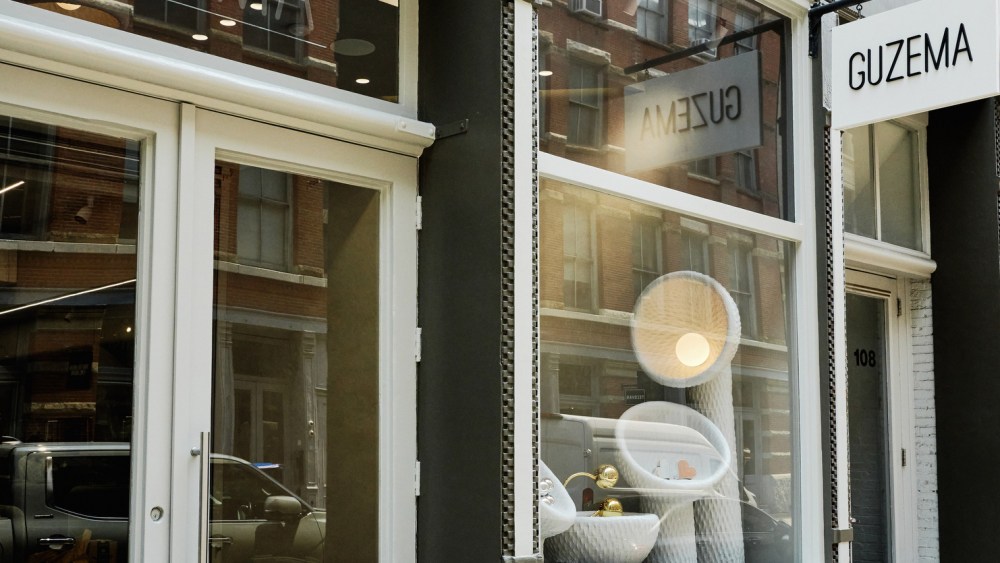
After several years of cultivating the U.S. market through wholesale, pop-ups and collaborations, Guzema Fine Jewelry is putting down permanent roots in New York.
Opening Wednesday at 112 Wooster Street in SoHo, the Ukrainian brand’s first U.S. boutique formalizes a presence it has been steadily building Stateside. The 1,100-square-foot store, the brand’s fourth and the first outside Ukraine, opens as the brand is celebrating its 10th anniversary, placing increasing emphasis on the American market.
“We tried SoHo with the pop-up and really felt that this was our place to be,” founder and creative director Valeriya Guzema told WWD. “Because of the people, because of our style, we understood: This is our place.”

Guzema store in SoHo.
Courtesy of Guzema
Designed in collaboration with Ukrainian architect and designer Victoria Yakusha, the boutique translates the brand’s restrained jewelry vocabulary into a nearly monochromatic interior. Monolithic gray counters and softened architectural forms are interspersed with furniture and lighting from Yakusha’s Faina collection. Rather than resting on conventional trays, the jewelry is presented on hand-sculpted vessels, lending the space the air of a private salon without becoming overly precious.
The boutique is designed to perform several functions at once: retail destination, private-client salon, working headquarters and a more complete physical expression of a brand that is still building recognition among a broader American audience. “This is our new home in the U.S.,” said cofounder and chief executive officer Mariana Lenha.
For Guzema, the investment in brick-and-mortar is intended to make its craftsmanship, service and emotional proposition more legible in an exceptionally crowded market.

Valeriya Guzema and Mariana Lenha
PUSHKA PRODUCTION UA
“We believe we can only tell our story when people try the jewelry,” Lenha said. “Buying a new brand online in the U.S. market, where there is such a huge supply, is very difficult. The best way to understand is to come to the store.”
Hospitality is not merely a sales mechanism for the founders. Before settling on jewelry as her medium, Guzema was drawn to hotels, restaurants and businesses constructed around how people are received. Jewelry stores, she said, are among the first places she visits when arriving in a new city.
That instinct underpins the brand’s retail philosophy, with the SoHo boutique intended not only to merchandise product but to choreograph a feeling around it: privacy, discovery and the sense that a client has entered a space calibrated around her rather than just a transaction.
The idea carries a different resonance in Ukraine, where the company’s boutiques have at times become places of respite amid the war. “In Ukraine now, we work not just with jewelry, but with beauty,” Guzema said. “It is a bit of mental health. People come after the bombing to have some time for themselves.”
In Kyiv, the stores can offer a temporary exhale. In New York, the purpose is more overtly commercial: building awareness, cultivating clients and proving that the brand can hold its own in one of the world’s most exacting jewelry markets. Yet the emotional premise coexists with the business one. In both cities, the founders see jewelry as a private ritual before it becomes a public signifier.
“I don’t have illusions that we are going to open the door and people are just going to come,” Lenha said candidly. “It is daily work for the team to keep the storytelling going and spread the word.”
New York is populated by sophisticated customers, strong independent designers and retailers with finely honed identities. The Ukrainian community may already know Guzema as an established name at home, but the broader American market still requires cultivation. What has encouraged the founders is the way American clients have begun to make their minimal jewelry more self-expressive.
The exchange has been revealing, with U.S. consumers styling the pieces with a looseness and irreverence they had not entirely anticipated. For example, clients have turned necklaces into bracelets and freely intersperse yellow and white gold.
“I was very sure that, because I created it, I understood all the ways you could transform it,” Guzema said of her designs. “Then I saw people here and thought, ‘Oh, really?’ They combine it very differently, and it inspires me a lot.”

Guzema store in SoHo.
Courtesy of Guzema
The New York assortment reflects that conversation. The boutique will carry eight exclusive styles adapted from the existing Classic collection, offered in white and yellow gold and newly amplified with diamonds. The pieces take established bestsellers and increase their wattage for the New York customer, including a version of the Orbs Transformer Earrings with pavé-set gold spheres.
The exclusives offer a concise expression of the brand’s U.S. strategy: preserve the silhouettes that built the business, but allow New York to push them toward greater visibility. That evolution is also feeding into the broader product strategy. Although built on restrained, everyday jewelry, customer demand has progressively pulled the company toward diamonds, bridal, bespoke work and larger stones. The brand’s prices reflect that evolution, ranging from $470 up to $40,000-plus.
“I said, ‘No diamonds. That is not for me. Never diamonds,’” she recalled of her early days, only working in gold. “But never say never.” Clients first requested small diamonds, then larger ones. The progression eventually led to a bridal collection introduced roughly three years ago, with plans to place greater emphasis on higher-impact pieces, including larger stones suited to red carpet and celebrity dressing in the fall.
The shift suggests that Guzema is testing how far it can stretch upward from everyday fine jewelry into a broader luxury proposition without forfeiting the restraint that distinguishes it. Even its bridal jewelry retains an element of discretion, including a small gold heart concealed inside certain bands and positioned close to the wearer.

Guzema store in SoHo.
Courtesy of Guzema
Before becoming a designer, Guzema worked as a fashion editor at Elle Ukraine, where she watched international brands construct and sustain their identities. She launched her company in 2016 with help from her mother, who opened a family jewelry box containing inherited gold, including metal from Guzema’s grandfather’s dental work, which helped inspire her first collection.
Ukrainian production remains central to the business, although international expansion has required it to develop additional manufacturing relationships in Italy and the U.S. According to Guzema, outside production partners were surprised to learn that the gold spheres used in the brand’s Orb pieces were formed by hand. “With machines, you cannot repeat the same thing,” she explained. The company spent more than a year identifying workshops capable of replicating the quality of its Ukrainian production.
The cofounders are careful not to position Guzema solely as a national brand. Its minimalist design vocabulary was conceived to move fluently across markets, and they want the house understood as a global brand with Ukrainian heritage intended to deepen the narrative.
“We want people to believe in Ukrainian craftsmanship,” Lenha said. “I would not discount it at all in comparison with Italian craftsmanship.”

Guzema store in SoHo.
Courtesy of Guzema
Los Angeles is emerging as the next market of interest as the brand develops its celebrity strategy and introduces larger-stone pieces suited to red carpet dressing, although any physical expansion remains in early stages.
For now, the founders are measuring the opportunity from Wooster Street, where their European-inflected jewelry will meet the eclectic personal styling that first convinced them SoHo was the right address.
“We come from overseas, but I am sure we have a lot to offer,” Lenha said. “Our jewelry is a great complement to the styles that already exist here.”
