

The latest round of Section 301 duties, announced by the United States Trade Representative in late July, won’t be the last curve ball thrown by the Trump administration when it comes to trade policy.
But reshuffling the sourcing map based on these weekly fluctuations isn’t a winning—or enduring—strategy, according to Tony Anzovino, director of product development, operations and sourcing at Dillard’s.
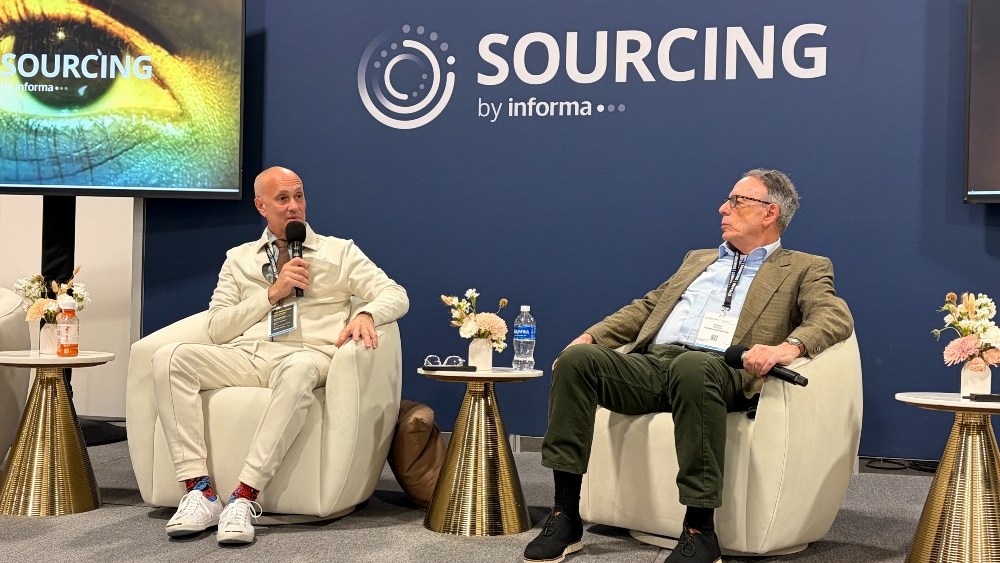
At the Sourcing at Magic trade show in Las Vegas on Monday, Anzovino spoke to an audience about the outlook for sourcing apparel in 2026 and beyond. For Dillard’s, the plan revolves less around movement and change, and more around recalibrating within an existing framework.
“We’ve stayed the course, for the most part, with our vendor base,” he said. “If you let tariffs dictate where you’re going to jump to when you haven’t built a long-term strategy in that region—that part of the world—you’re now onboarding a new vendor to build your product,” he added.
That’s not a position the Arkansas-headquartered department store chain is willing to put itself in. At this juncture, with so much uncertainty plaguing sourcing, the retailer’s most pressing consideration is maintaining product quality, he said. Probing new markets for short-term savings is not at the top of the sourcing executive’s list of concerns.
Instead, Anzovino said the company maintains a finger on the pulse when it comes to word from the White House, and works with its supplier base to react in real time. “As tariffs have moved up and down, you partner with your vendors; you can absorb some of it, they can absorb some of it, you renegotiate what you’re doing, but from the retailer perspective… the last thing we want to do is disappoint that customer.”
The Dillard’s shopper values the store’s consistency, he believes. There’s an expectation that must be maintained, and little desire to upset the apple cart amid what promises to be a long and winding journey through the next two-and-a-half years of the Trump tariff regime.
“We had a strategy in place pre-Liberation Day that we’ve maintained, and the tariffs have not helped—but the tariffs haven’t impeded what our strategy was,” he said. “Have we made mistakes? Sure. Have we adjusted in right-sized inventory? Have we made any strategic moves?” A few, he said, but mostly by titrating production within an existing vendor base.
Anzovino illustrated the breadth of that supplier portfolio while pointing out the countries he’s keeping an eye on.
“Pakistan’s coming on strong, Bangladesh has been growing, Vietnam—the the effort is still there, Indonesia is coming on stronger, India has maintained [its foothold],” he said.
Meanwhile, the Dillard’s sourcing leader is closely monitoring the status of a potential renewal of the African Growth and Opportunity Act (AGOA), which is slated to expire in December. The retailer has produced in Madagascar and Mauritius, both beneficiaries of the trade preference program, throughout the tariff turmoil.
Robert Krieger, president and chief executive officer (CEO) of Krieger Worldwide, said Dillard’s represents one end of a broad spectrum when it comes to sourcing behavior with its consistency-over-chaos approach. But that’s not how everyone is tackling the challenge of sourcing in 2026.
“Some clients are like ping pong; they were out of China, then they were in China producing a lot, then they moved out of China, found that they couldn’t satisfy their quality or timing, and moved back to China,” he said.
Bangladesh has proven a strong alternative to China over the past year, while Pakistan remains a popular destination for denim. The international logistics firm has also seen apparel clients favoring production in Cambodia, Indonesia, “and of course Vietnam has been the first choice of many of our clients.”
While the company works with some retailers, Krieger said many of its clients are wholesalers. These players have increasingly shifted their production away from China in anticipation that the sourcing superpower will continue to see high tariffs.
“Our clients have margins that they want to protect, and they can’t do it if they’re making it in China, or even in Vietnam at this at this point, where a lot of apparel is made,” he explained.
It’s been a steep learning curve for some, and an easier transition for others. One of the stumbling blocks for companies shifting sourcing between locales is the difference in lead times, which some have treated as an “afterthought.”
“How many weeks does it take fits to get from Bangladesh to the U.S. West Coast or to the U.S. East Coast? Or, if I’m buying something out of Africa, how reliable is that supply chain? We’re not getting those questions until actually, in some cases, things are going into production,” he said.
But even the most well-laid plans aren’t inoculated against fluctuations in the market. In recent months, Krieger has observed delays within the logistics sector—as well as heightened costs—perhaps due to shifts in the way companies are sourcing.
“The [ocean] carriers were playing some games whereby they were constricting the amount of containers and ships that they had going from certain origins to certain destinations, which created a false imbalance of cargo,” he said.
“Whenever that happens, the prices will spike up. The surcharges will spike up.”
