

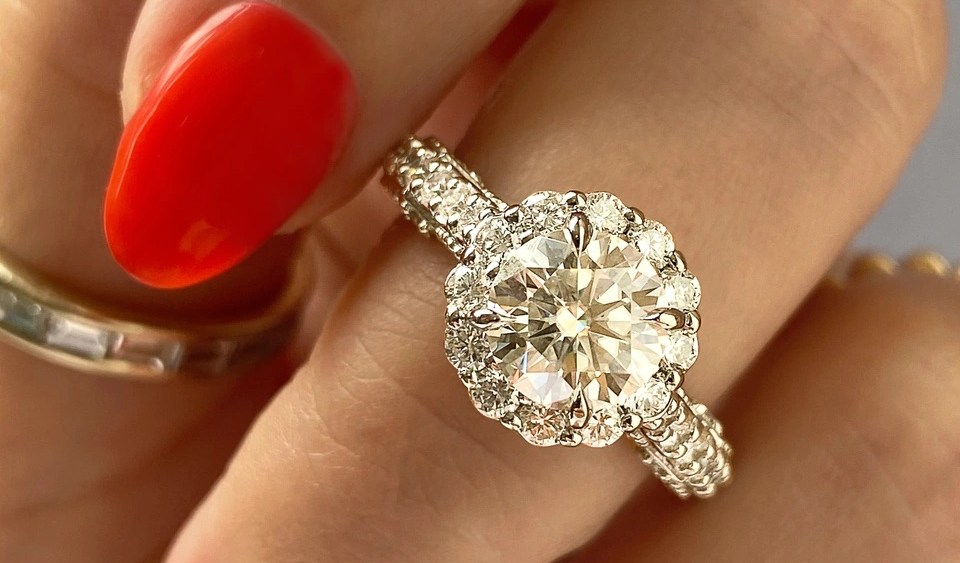
From chunky dome bands to east-west settings and colorful gemstones, today’s engagement ring market is increasingly defined by individuality. Despite evolving trends in bands, stone cuts and settings, the solitaire diamond ring has long reigned supreme, from influential celebrity engagement rings to the styles championed by leading jewelry brands. But as consumers increasingly seek pieces that feel more personal and less conventional, cluster engagement rings are gaining momentum.
Cluster rings are hardly new, though they have taken a back seat in recent years as demand shifted toward larger solitaire stones. New data from Adobe Firefly, Adobe’s all-in-one creative AI studio, analyzed how couples used the platform to design their dream rings and found that intricate, multistone settings are gaining traction this year. “Cluster settings are up 112 percent, while halo settings rose 53 percent and filigree designs increased 19 percent,” the report revealed. Unlike previous trend cycles, however, today’s interest in cluster rings appears to be driven less by aesthetics alone and more by a desire for personalization.
“There has always been a segment of customers drawn to cluster rings because they offer something distinctly different from a traditional engagement ring,” Kegan Fisher, cofounder of fine jewelry and engagement brand Frank Darling, said. “They tend to feel more artistic, low-profile, and expressive than a classic solitaire, often incorporating a mix of stone shapes, diamond cuts, or colored gemstones. That gives them a less conventional, more individual feel.”

Frank Darling’s cluster rings in an array of diamond cuts and styles.
The renewed interest in cluster rings reflects a broader shift across the bridal jewelry market. As consumers move away from one-size-fits-all engagement rings, designs that allow greater customization and self-expression are increasingly resonating with shoppers. Cluster settings, with their ability to combine different stones, shapes and silhouettes, are particularly well-positioned to meet that demand.
“As engagement ring trends continue to move toward personalization, cluster rings fit naturally into that shift,” Fisher added. “They allow couples to create something that feels truly one-of-a-kind rather than choosing a more standardized look. They’re also often more budget-friendly, since several smaller stones can create substantial visual impact for less than a single large center stone. For many people, that’s an appealing combination of uniqueness, personality, and value.”
While cluster rings are gaining traction, Fisher doesn’t see them dethroning the solitaire anytime soon. “I don’t think the solitaire is going anywhere,” she said. “One of the reasons solitaires remain so popular is that they’re effortless, versatile, and timeless. They work with almost any style and pair easily with wedding bands.”
Instead, Fisher views cluster rings as appealing to a different type of consumer altogether — one who is looking for a more distinctive engagement ring and is less interested in traditional bridal conventions.
“Clusters appeal to a different customer — someone looking for a more personal design statement and a ring that feels less traditionally bridal,” he said. “People who gravitate toward cluster rings are often drawn to their individuality and character. They’re the perfect type of ring to shop together and design something custom from the ground up.”

Country singer Lainey Wilson debuted a massive cluster, multistone engagement ring estimated to be around 7 carats.
Brian Friedman/Dick Clark Productions
The growing allure of cluster rings is also tied to value. By combining multiple smaller stones into a single design, cluster settings can create the appearance of a larger ring while offering more flexibility in both design and price point. “Part of the appeal is the finger-coverage-to-value ratio,” Fisher explained. “Traditional three-stone rings can become expensive quickly and sometimes feel quite formal. A center stone paired with clustered side stones offers similar visual impact and scale while using smaller stones more creatively, resulting in a ring that often feels larger, more distinctive, and a bit more unexpected.”
Today’s cluster rings are also evolving beyond the vintage-inspired styles that have historically defined the category. Designers are experimenting with asymmetric arrangements, colored gemstones and modern silhouettes that make the style feel fresh for a new generation of consumers.
“There are so many different styles of cluster rings,” Fisher said. “You’ll find everything from asymmetrical, gemstone-forward styles to Art Deco-inspired and nature-inspired styles. Some clusters are nested into the band, while others, like our Royale Party, sit above the finger more like a traditional engagement ring. At its core, a cluster ring is simply three or more stones set close together to create the look of a larger design. From there, the possibilities are almost endless.”

Frank Darkling’s deco-style multi-stone emerald-cut rings.
For brands, that versatility presents an opportunity to blend heirloom-inspired aesthetics with the comfort and durability expected from modern engagement rings.
“At Frank Darling, we’re always thinking about how to combine beautiful, heirloom-inspired aesthetics with modern design details that make a ring more comfortable and practical to wear every day,” Fisher said. “Designs like our Posie are a great example of that approach. From the top, it has the romantic, clustered look people love, with a soft vintage-inspired feel, but it’s engineered with the durability, comfort, and wearability that modern clients expect from an engagement ring. The result feels nostalgic and full of character without sacrificing everyday practicality.”
As engagement ring shoppers continue to prioritize self-expression over tradition and trends, cluster rings are poised to occupy an increasingly prominent niche in the bridal market. While the solitaire remains the industry’s dominant style, the rise of cluster settings suggests consumers are increasingly willing to explore alternative designs that feel more personal, customizable and uniquely their own.
