

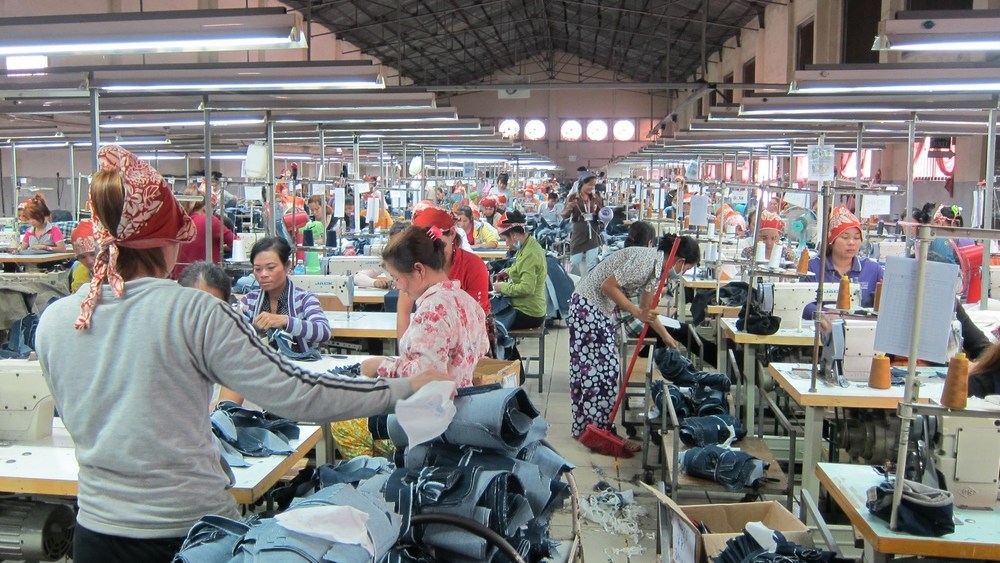
As Cambodia‘s exporters continue to face rising costs, labor pressures, geopolitical hurdles and the countdown to graduating from United Nations‘ Least Developed Country (LDC) status in 2029, industry leaders gathered in Phnom Penh last week to chart a path forward. Their message was clear: standing still is no longer an option.
The 2026 Cambodia Textile Summit last week brought together brands, manufacturers, government officials, labor representatives and development partners at Raffles Hotel Le Royal to discuss the outlook for Cambodia’s garment, footwear and travel goods (GFT) sector. The discussions highlighted the importance of a sector that accounts for nearly half of Cambodia’s exports; In 2025, GFT exports reached approximately $15.7 billion, including about $11.4 billion in apparel exports alone.
Adding further significance to the event was the announcement by the Organization for Economic Co-operation and Development (OECD) that its first regional forum on due diligence in the garment and footwear sector in Asia will be held in Phnom Penh from April 5-9 next year.
The forum will take place close to production facilities, giving stakeholders the opportunity to engage directly with sourcing realities on the ground. During the same week, the International Labor Organization’s Better Work Asia Regional Partners Forum will also be held in the Cambodian capital, placing the country at the center of regional discussions on responsible sourcing and labor standards.
Speaking at the summit last week, Labor and Vocational Training Minister Heng Sour described the gathering as taking place at a “truly pivotal juncture” for the industry.
He said the sector was navigating an “unpredictable blend of trade hurdles, fuel shocks, and worldwide economic instability, coupled with reciprocal tariffs that are heavily eroding export margins just as the global oil spike drastically inflates production and logistics costs.”
“With all these challenges, our objective today is to examine critical policies, regulatory frameworks and operational strategies that will reinforce Cambodia’s position as a favorable, competitive sourcing destination in the global apparel supply chain,” he said.
The summit was co-hosted by the Textile, Apparel, Footwear and Travel Goods Association of Cambodia (TAFTAC), the International Labor Organization (ILO), Better Factories Cambodia and Deutsche Gesellschaft für Internationale Zusammenarbeit (GIZ), with support from EuroCham Cambodia and Canada as an international partner.
One of the most closely watched announcements came toward the end of the day and was widely regarded by labor unions and worker organizations as a major milestone. Cambodia, which has emerged as one of the strongest performers within the Action, Collaboration, Transformation (ACT) initiative on supply-chain industrial relations, announced an extension of its groundbreaking garment and footwear sector agreement.
The renewed template collective bargaining agreement (CBA) secures commitments from global brands, employers and unions, reinforcing Cambodia’s role as a testing ground for new approaches to industrial relations and wage-setting.
“It was an important opportunity for us to show that the program is ongoing, that the platform between the employers, the unions and the brands continues to push the rollout and continues to grow the number of factories, as well as grow the number of brands that have signed up for the initiative,” David Cichon, head of programs at ACT told Sourcing Journal.
“We had a big breakthrough about two years ago, where the first cohort of brands signed the legally binding agreement with IndustriALL Global Union to support collective bargaining agreements that support higher wages and better working conditions in Cambodian factories, which is sort of coming to a close this summer, and that was really the opportunity to show proof of concept,” he said. “Now the process is being refined, it is being redeveloped, and everybody is involved in making sure it can continue to improve.”
The renewed template CBA will run from July 1, 2026, to July 31, 2029. It serves as a standardized, brand-supported document that becomes legally binding once adopted at factory level. Under the new terms, workers will receive a $6 increase in the monthly base wage through December 2027, followed by an additional $9 increase beginning in January 2028.
Christina Hajagos-Clausen, director of the Textile and Garment Industry at IndustriALL Global Union, told Sourcing Journal the new agreement is “significantly stronger than previous versions.”
“If you look at it, it has a lot of important language on gender, women’s empowerment, grievance mechanisms, extra maternity leave, a new paternity leave, and heat stress language,” she said. “We really applaud the employers and the unions for working hard to get a good agreement.”
However, she also argued that broader participation from brands remains essential if the initiative is to achieve its full impact.
“Those who don’t sign, they are not even free riders. They are actually obstructing and stopping workers in Cambodia from getting higher wages and benefits, even though they profess to say they have policies to support workers in their supply chains,” she said. “But when you actually show them proof of concept on how to do it, you don’t see them signing. And that’s the real problem. Until 70-80 percent of the brands sourcing from Cambodia sign the agreement with IndustriALL, coverage will remain limited, less work will be done, and not all workers will enjoy these benefits. That’s the reality of the situation.”
Another major theme running through the summit was Cambodia’s upcoming graduation from UN Least Developed Country (LDC) status, now scheduled for December 2029. While widely viewed as a significant achievement for the country, participants stressed that the transition will require extensive preparation from both industry and government.
Dr. Ken Loo, secretary-general of TAFTAC, emphasized that factories must increasingly compete on factors beyond cost if Cambodia is to remain attractive as a sourcing destination after graduation.
One initiative designed to support that transition is the Cambodia Skills Framework, an industry-led effort intended to provide factories with a clearer structure for workforce training, skills development and career progression.
“Cambodia’s garment sector has always competed on cost, but that is no longer enough on its own,” he said. “As we approach LDC graduation, the factories that will succeed are the ones that can offer something beyond price: reliability, quality, and a workforce that can move up the value chain alongside the products themselves,” he said.
“The Cambodia Skills Framework gives us, for the first time, a shared roadmap for what that progression actually looks like, from the factory floor to the management office. The next few years are about making sure every factory and every worker has a clear path to follow this framework.”
He also highlighted the role that TAFTAC and the Cambodian Garment Training Institute will play in rolling out the framework across the industry.
The importance of policy responses to mounting geopolitical pressures was another recurring theme throughout the summit.
Martin Brisson, executive director of EuroCham Cambodia, noted that a series of external shocks are simultaneously affecting supply chains and driving up costs. These include the Cambodia-Thailand border situation, ongoing uncertainty surrounding United States trade policy, and disruption linked to conflict in the Middle East. “We can see now that these aren’t isolated disruptions that the sector can absorb individually,” he said. “The border situation, tariff uncertainty and the fallout from the Middle East are all hitting at once, and they are compounding each other.”
Yet despite these pressures, he pointed to the sector’s continued growth as evidence of its resilience.
“What’s striking is that despite these shocks, Cambodia’s GFT sector has kept growing. Exports reached close to $16 billion in 2025, and we have seen continued diversification beyond garments into footwear and travel goods.”
Heat stress also featured prominently on the agenda, reflecting growing concern about the impact of rising temperatures on workers and factory productivity. The issue is increasingly being incorporated into industry initiatives, including programs led by Better Factories Cambodia, which has played a significant role in supporting labor standards and factory compliance in Cambodia for more than two decades.
“Heat stress has rapidly become one of the most pressing occupational safety and health challenges facing the industry globally, and the summit highlighted the strong momentum building in Cambodia to address it,” said Froukje Boele, country program manager for Better Factories Cambodia. “Progress will depend on timely and effective regulation, continuous monitoring, low-cost tailored workplace solutions, and collaboration between factories and brands to protect workers from extreme heat.”
Better Factories Cambodia, a joint initiative of the ILO and the International Finance Corporation (IFC), currently works with approximately 800 factories across the country.
Industry observers at the summit noted that while Better Factories Cambodia has demonstrated considerable adaptability in responding to changing industry demands, it will also need to continue expanding its own capacity as the number of factories grows and ownership structures evolve.
One participant, who asked not to be identified, pointed to the increasing number of foreign-owned factories, particularly those under Chinese ownership, as an example of how the operating environment is changing.
“As a lot of factories in Cambodia are foreign-owned, primarily Chinese. Part of the focus has been on providing training sessions in Chinese as well, including on freedom of association and collective bargaining. The goal is to reach managers directly so they can communicate effectively with workers, while ensuring important issues such as the right to join unions and engage in collective bargaining are properly understood at the factory level,” he said. “The industry is no longer preparing for change—it is now managing it.”
