

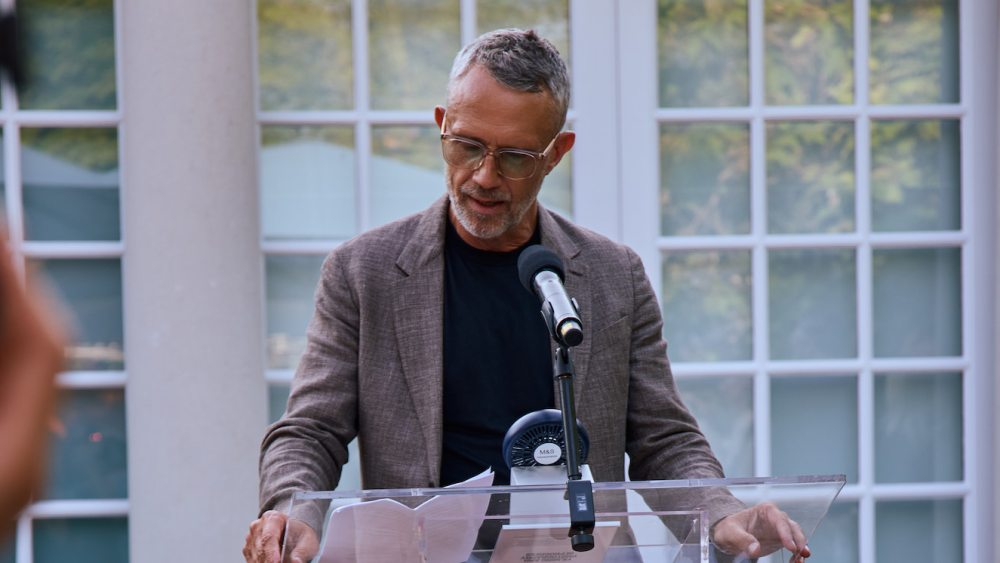
At the British Fashion Council’s summer party at London’s Serpentine Pavilion on Wednesday, Sadiq Khan, the city’s mayor, was cheered on by one of his most enthusiastic constituents: a dog that yapped every few sentences, as if in agreement.
“Let’s hope Andy Burnham understands ‘woof,’” he said, referring to the Labour Party politician widely tipped to become Britain’s prime minister later this month following Keir Starmer’s resignation.
Khan, addressing a crowd armed against the heat with only cold drinks and white paper fans — including comedian Munya Chawawa, musician Arooj Aftab, costume designer Sandy Powell, Burberry creative director Daniel Lee, Chanel chief executive officer Leena Nair and Starmer’s wife, Victoria — thanked the fashion industry for making London one of the world’s greatest cities.
“It doesn’t feel that way when it comes to policies of successive governments, when it comes to the impact of geopolitics on this sector, but you are appreciated,” he said. “We know the difference you make in terms of innovation, in terms of creativity, in terms of identity.”
It’s why Khan and Justine Simons, deputy mayor for culture and the creative industries, have poured more than 800 million pounds — nearly $1 billion — into the sector over the past decade, he said, adding that more is to come. He is also working with Laura Weir, the BFC’s CEO, and David Pemsel, its chairperson, to “impress upon the government” not only the “joy” brands like Alexander McQueen, Paul Smith, Burberry, Mulberry, Vivienne Westwood and Barbour bring but their financial firepower as well.
But the reality on the ground remains fraught. Weir recalled a recent conversation with Philip Treacy, who said there was “no way” he or the late Lee McQueen would have made it today, given the soaring cost of studio space in London.
In response, the BFC, working with the King’s Foundation, will for the first time provide subsidized studio space in the capital, “supporting designers as they make that vital transition from education to creative practice and business.”
Weir also pointed to a string of major schedule wins for September’s London Fashion Week, which will see the return of legacy brands McQueen, Christopher Kane, Mulberry and Barbour, alongside the debut of Marks & Spencer, the “beloved high street icon.”
Cos, Barbour and Saint Laurent have also agreed to launch new scholarships, joining Chanel, Dior and Casely-Hayford.
“Our government funding position has remained steady,” she said. “While I’d like to have seen increased investment in our sector, the BFC is grateful to the Department for Business and Trade, the Department for Culture, Media and Sport and the Mayor of London for their continued support. This impact is driven by our patrons and partners, the BFC team and the board, and their commitment to seeing British fashion succeed.”
Even so, the prospect of a Burnham premiership prompted a sense of déjà vu from Pemsel.
“Two years ago we hosted this event, and it was a day of optimism after the Labour government came to power, and there was a sense of change,” he said. “We felt it in this room, but sadly, two years on, here we are again.”
Last week, Pemsel wrote to Burnham about “fashioning growth in every postcode,” nodding to his Manchester speech outlining an ambition for “good growth in every postcode.” In it, he set out several “simple asks,” including recognizing creativity as economic infrastructure, creating the conditions for creative businesses to thrive and giving organizations like the BFC “access, backing and authority” to deliver “action and impact.”
“Fashion businesses face rising costs, limited investment, shifting routes to market and intense international competition,” Pemsel said. “And we need policies that connect creativity with trade, investment, education, skills and exports, while creating the conditions for businesses to grow.”
The dog, still barking, seemed to approve.
