

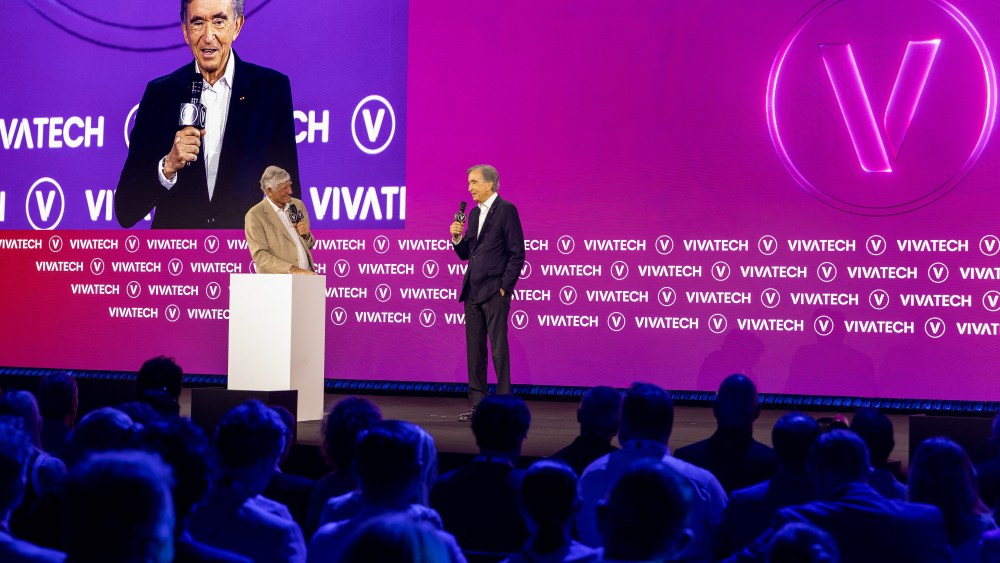
PARIS — VivaTech started with Bernard (Arnault) and Bezos (both Jeff and Lauren) on Wednesday, setting the stage for a conference that mixed politics, power, and product development.
“In my function I feel very often like a French ambassador in the world,” the LVMH Moët Hennessy Louis Vuitton chairman and chief executive officer said on stage, a fitting opening for three days that welcomed Indian Prime Minister Narendra Modi, French President Emmanuel Macron, French Economy Minister Roland Lescure, and German Federal Minister Karsten Wildberger, among other high-level politicians, with European sovereignty high on the agenda.
For VivaTech’s 10th anniversary, the message was scale. Bezos drew one of the biggest crowds, with Sánchez Bezos sitting front row applauding enthusiastically as he spoke. VivaTech has long called itself the “Fashion Week of Tech,” though there was no official word on whether the power couple would extend their stay in Paris for men’s fashion week, opening Tuesday, or couture in early July.
Beauty was everywhere on the convention floor, with AI-enabled personalization. From Beacon Pro’s hair loss analysis tools to SystemAge’s biological age diagnostics and AI-driven glucose coaching systems, the category was front and center at Samsung’s sprawling booth. After his stage appearance with Modi, Macron toured the space himself.
L’Oréal also grew its presence, following an announcement that the beauty group has formed a partnership with OpenAI, including a format where contestants competed in a game-show-style environment for prizes, and AI-based analysis that saw lines wrapped around the halls.
Across the hall, brands were showcasing AI-powered design and production tools, from 3D simulation platforms to systems that let designers test and refine products directly with manufacturers. One example, Draph, turns a single product image into GEO-optimized content designed to be readable by AI systems.
Perfit, a shoe-fitting start-up, showed how foot-scanning technology is already moving into retail. Columbia has reported a 15.4 percent sales lift using the system, while Mizuno has seen a 28 percent return reduction after adoption, a spokesperson for the tech said.
There were several panels on climate change, though more focused on infrastructure and adaptation than activist. Kate Williams, CEO of 1% for the Planet, told WWD that uptake among fashion brands remains limited.
“I think we haven’t necessarily gotten through to them to make the business case,” she said. “It’s a missed opportunity, because consumers would love that. Fashion is one thing they feel a lot of guilt about because they do have an understanding that fashion is a polluter.”
Word of the Week Is AI
One of the clearest themes across the conference was how AI is reshaping discovery, as consumers turn to tools like ChatGPT, Gemini or Perplexity for recommendations. Across multiple panels, speakers said traditional SEO is no longer enough.
Instead, brands now have to think about how they appear inside the LLMs with generative engine optimization, or GEO.
“If your brand is not present there, you’re essentially forgotten by the modern consumer,” said Optimize GEO cofounder and CEO Krithika Reddy.
For fashion brands, that shift goes beyond marketing and advertising.
Reddy framed the moment as one of competitive volatility: “Market share is won and lost at times of transition,” she said. “It’s your opportunity to leapfrog, and if you are the dominant brand, it’s your opportunity to behave like the challenger brand.”

Agibot X2 Robots dance during the 10th edition of the Viva Tech.
Anadolu via Getty Images
Applied Tech for Fashion
Peppered among dancing robots and other surreal displays were the fashion-focused start-ups, such as PatternFast, a California-based company that is moving into enterprise solutions based on 13 years of R&D — including pattern work with now-defunct retailer JoAnn Fabrics.
PatternFast now has proof-of-concept projects underway at an unnamed Milan-based luxury cashmere house and an L.A.-founded, Switzerland-headquartered denim company, as it seeks to bring its AI-powered sketch-to-pattern technology from development phase to large-scale commercial use.
It aims to streamline one of fashion’s most labor-intensive processes and says its AI-powered “fashion intelligence” platform can transform sketches or images into production-ready patterns, graded sizing and technical specifications in seconds, a process that traditionally took weeks or months.
“What we have found is by switching to this new methodology, brands actually save over 90 percent of costs, which counts to over $3 million for every 1,000 designs generated for brands,” founder and CEO Yuliya Raquel told WWD. For large companies with multiple brands with thousands of designs, that can be “over $100 million a year in savings.”
While the company is pitching substantial cost savings to large brands, its most game-changing proposition could be fit. The tech would enable labels to more easily offer petite, plus-size and other specialized size ranges without rebuilding patterns from scratch.
Another of the more fashion-specific technologies on display was La Vitre, a French start-up whose life-size interactive screens are designed to replicate the experience of in-person collaboration across long distances. Already used by luxury houses including Chanel and a network of international suppliers, the technology aims to preserve the visual precision and spontaneity of face-to-face meetings for design reviews, fittings and product development.
On the ground at VivaTech, the company demonstrated its fashion applications with designer Claire Châtaigner, who created a garment live from a single piece of fabric using only pins, while connected remotely to her Paris atelier.
The company also used the event to broaden its appeal beyond large luxury groups, unveiling a new subscription model starting at 500 euros a month, a move intended to make the tech more accessible to indie designers and smaller fashion houses.
Elsewhere, the EssilorLuxottica booth was packed with visitors wanting to try on the Meta collaboration glasses. Representatives of the company, under giant banners of Blackpink’s Jennie in Ray-Ban and Kylian Mbappé in Oakley, said the conversation has now shifted from the technology to pushing fashion adoption and as a creator product rather than a gadget.
Executives at the booth highlighted that more than 10 million Ray-Ban Meta glasses have been sold since launch, with the recently unveiled Oakley Meta line extending the concept into performance and sportswear. The company also hinted that additional brand collaborations, including a future luxury partnership, are in development and will be revealed soon.
The company said it had been active at the Cannes Film Festival through private creator events and influencer activations, and added that further fashion-focused programming is to come during the upcoming men’s fashion week in Paris.
Growth of Experiences
Across industries, executives said loyalty is shifting away from transactions and toward experience, meaning, and ongoing relationships.
Jean-Yves Minet of Accor framed luxury hospitality in particular as something far beyond rooms and bookings. He described modern travel brands as creators of what he called a deeper “sense” in people’s lives.
“The next generation of loyalty is that sense of belonging, participating, and doing something for the greater good,” he said, pointing to creator collaborations, community activations, and programs like Novotel’s “37 Collective.”
Beauty Takes Center Stage
Speaking on “Brand, Boardroom and Bots,” L’Oréal Group chief digital officer Asmita Dubey and Adobe chief marketing officer Rachel Thornton described a beauty industry being rebuilt around AI, creators and fragmented discovery.
“LLMs are becoming the front door to beauty discovery,” said Dubey, who highlighted L’Oréal’s “Create Tech” platform, which connects multiple AI systems across marketing and content production.
Thornton pointed to “the fragmentation of the consumer journey,” arguing AI could help “consolidate that ecosystem back.”
Later, L’Oréal global chief of social Sandy Moragon described a deeper shift in how the company works with creators.
“Beauty being the number-one conversation on social, creators are part of this conversation,” she said. Through programs like Creator Club and L’Oréalista, she described a move toward “trust, community, mentorship, coaching.”
“We have seen creators…creating between four and eight times more content, not because we are asking them to, because they genuinely want to” once they are part of the programs.
The shift, she said, is from campaigns to long-term creator development, and treating creators less like “media buys” and more like ongoing brand partners.
The New Attention Economy
Speaking about creator economics, Substack France head Renée Kaplan said the creator economy is shifting toward owned audiences and reliability. The dominance of the platform and algorithm is over.
“What [platforms] won’t deliver is reliability, the knowledge, the guarantee, the sense that your content…is reaching the right audience.”
With newsletters and owned IP, “[creators] own the list, it is portable,” she said. “You own the audience and the value of the audience.”
Kaplan reframed Substack less as a publishing tool and more as a system for durable attention, and the next frontier for partnerships. “We want reach that we know delivers value, whatever your definition of value is,” she said.
