

“In 2006, when I first showed in New York, I lacked exposure. My understanding of global fashion was still quite parochial because I had not seen enough of the world,” Sabyasachi Mukherjee said.
Nearly two decades later, the designer is returning to do a New York runway show with considerably more mileage behind him — and an increasingly global ambition for the Indian luxury house he has spent the intervening years building.
On Sept. 15 during New York Fashion Week, Sabyasachi will unveil fine jewelry, marking the first chapter of a multiyear collaboration with The Metropolitan Museum of Art, beginning with designs informed by the art and material culture of the Byzantine Empire.
While future iterations are expected to extend across jewelry, accessories and clothing, the debut chapter exists solely as high jewelry alongside Mukherjee’s cross seasonal ready-to-wear and accessories collections.
For Mukherjee, the timing of the return is as much about the maturation of his own company — giving him the perspective he felt he lacked when he first arrived in New York — and a shift he sees taking place in the luxury ecosystem.
“The top echelon of customers globally are becoming less interested in certain brands because they are ubiquitous,” he said to WWD. “They are looking for discovery. They want products that might come from somewhere unexpected, but which speak very clearly about quality, authenticity, craftsmanship and luxury.”

Sabyasachi necklace inspired by the collection of The Met.
Courtesy Sabyasachi
It’s this opening that is central to his larger ambition for Sabyasachi. “For a long time, the world came to India to make luxury,” he said, highlighting the country’s role in the global luxury system by supplying its gemstones, textiles, embroidery and generations of specialized artisans. But what interests him now is shifting its position from behind the scenes to one in which Indian companies own the brands, ideas and cultural narratives surrounding that expertise.
“I think it is time for India to take our luxury to the world. Sabyasachi has a role to play in that,” he said.
The Met collaboration gives that proposition a particularly visible platform. Conceived as a multiyear relationship rather than a single capsule, it opens the museum’s holdings — spanning more than 5,000 years of art and culture — to interpretation through Sabyasachi’s own visual language and India’s living traditions of craft.
“The deeper I went into The Met’s collections, the more it reinforced something I have believed for a very long time: in the pursuit of modernization, the world has lost an enormous amount of craftsmanship,” he explained.
India, in Mukherjee’s view, remains unusual because many of those traditions have not been relegated to history. Specialized techniques continue to be practiced, commissioned and passed among generations, giving designers a bridge between historic modes of making and contemporary luxury.

Sabyasachi Mukherjee
Courtesy of Sabyasachi
For the collaboration’s first expression, Sabyasachi turned to Byzantium, drawing from imperial medallions, architectural ornament, ancient statuary and stonework, religious iconography and jewelry across The Met’s holdings. The civilization’s position at the intersection of continents made cultural exchange fundamental to its visual identity: Egyptian, Greek, Roman and Persian influences converged with ideas.
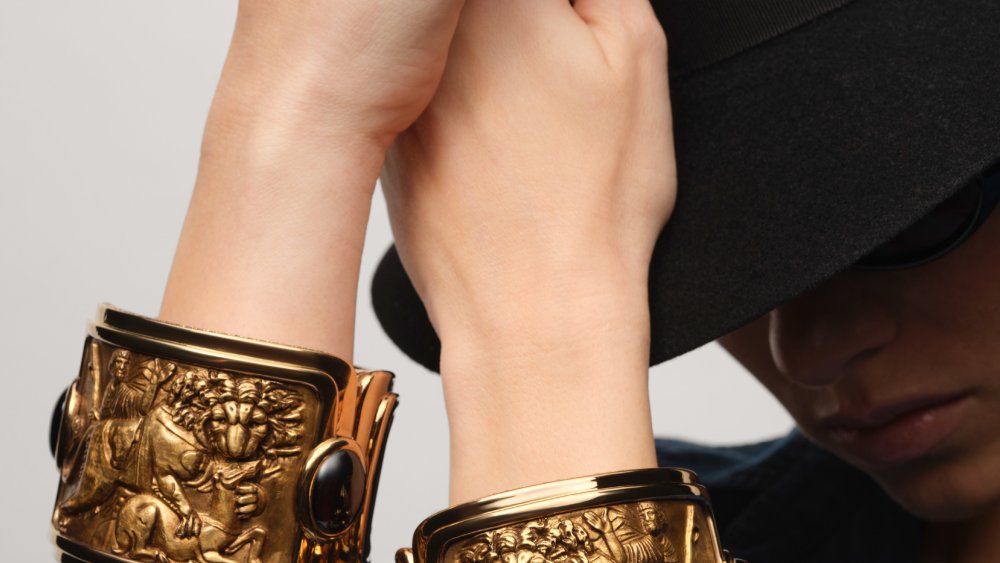
The references are translated quite literally at times, but through Sabyasachi’s opulent material vocabulary. Wrist cuffs combining 18- and 22-karat gold set with garnet and tourmaline cabochons take their cues from third-century Roman sarcophagi, while a pendant necklace mixing tourmaline, garnet, jasper, lapis lazuli and jade looks to a Roman funerary relief. Elsewhere, a 12th-century Italian or Byzantine carved panel depicting animals is reimagined as a tiger-claw necklace in 18- and 22-karat gold, set with tourmaline and jade cabochons and punctuated by brilliant-cut brown diamonds.
Mukherjee found a particular affinity in Byzantine jewelry and its almost mosaic-like approach to material where gemstones and less intrinsically precious elements could coexist within the same object. “That democracy of materials is very close to my own philosophy of jewelry,” he said.

Sabyasachi x The Met necklace.
Courtesy Sabyasachi
Beyond the historical references, the collection also reinforces Mukherjee’s belief that the value of jewelry lies not simply in the intrinsic worth of its materials, but in what is done with them. “Luxury has always derived its value from scarcity,” Mukherjee said. “Design, craftsmanship and provenance will increasingly determine the value of high jewelry, not the stone alone.”
That idea returns the conversation to India. Mukherjee sees the country’s generations of living craft knowledge not simply as cultural inheritance, but as an increasingly valuable form of intellectual and creative capital — provided the people practicing those skills are given the economic relevance required for them to survive.
“The future of Indian luxury cannot only be about being an anonymous part of somebody else’s supply chain,” he said. “We have to move from being suppliers of craftsmanship to rightful proprietors of intellectual property, design, brands and the cultural narratives that surround them.”
The argument comes at a moment when technology and increasingly sophisticated machine production are rapidly changing how objects are made. “The imperfect evidence of the human hand will become more precious than ever,” he said.
