

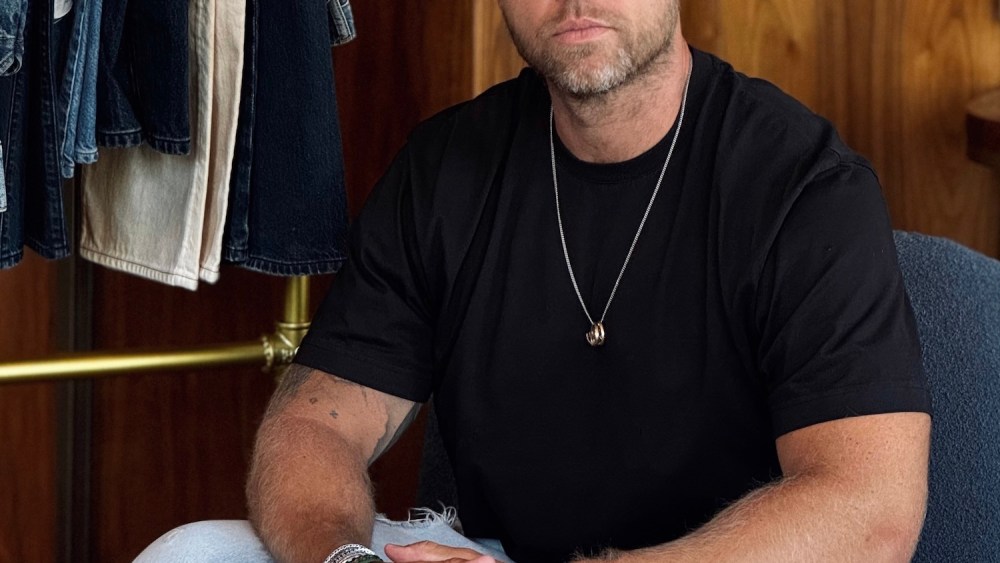
Triarchy has never positioned sustainability as a marketing angle—it has always been the foundation. But in today’s climate, that commitment is being tested. The Canadian-born, Los Angeles-based brand is navigating tariffs, compressed margins and the fallout from the bankruptcy of Saks Global, which once accounted for the majority of its wholesale business.
Still, co-founder and CEO Adam Taubenfligel remains resolute. Rather than scale back its environmental standards to protect profitability, Triarchy is doubling down—investing in next-generation fabric technologies, maintaining strict non-negotiables around plastic-free production and transparency, and even launching a crowdfunding campaign in March to support its next phase of growth.
In this conversation with SJ Denim, Taubenfligel discusses why integrity remains the brand’s competitive edge, the realities of operating with thinner margins, and what it takes to build a resilient denim business in an era that demands both accountability and adaptability.
SJ Denim: Triarchy has built its reputation around low-impact denim production. How has your sustainability strategy evolved in the past few years?
Adam Taubenfligel: The way that it’s evolved over the years is based on the technological advances in sustainability that keep changing. We are not necessarily changing things, but we keep on top of what’s coming in the market. Then we test it to see its validity and then deciding whether we want to adopt it or not.
When we started with sustainability, it wasn’t even a buzzword yet. The number of [technologies and processes] we’ve gone through is kind of dizzying. And you know, barely any of them stick or prove to be actual solutions, but the ones that do are the ones we embrace. Whenever we find a new one, we dive into it pretty deep.

SJ Denim: What specific environmental benchmarks are non-negotiable for the brand—even during challenging times?
AT: Plastic-free stretch denim from Candiani Denim. That’s a non-negotiable for us. The more time that goes by, the more I really feel like anything that’s made of plastic is just future garbage, and I refuse to be a brand that contributes to future garbage. I just cannot do it. I mean, there have been times when it’s really made sense to because it’s a super expensive technology, but I would rather not offer a stretch product than have to sell it with petrochemicals.
SJ Denim: Triarchy launched as a non-stretch denim brand, and you’ve remained deeply committed to that philosophy by using Candiani’s Coreva technology. Are there other principles that are non-negotiable for you?
AT: I think to our detriment, they’re all non-negotiable. There’s been so many times where I’m like, can we put a couple back on the negotiating table, because it’s such a difficult balance to try to run a business and have all these non-negotiables. But once we’ve developed washes that don’t rely on hazardous chemicals and that don’t rely on water, how do you go back? How do you go, ‘Oh, you know, what? Throw the chemicals in again.’ The integrity runs too high.
The problem is not necessarily that we sell less product, it’s that we make so much less margin. Then we don’t have a competitive advantage, because we can’t afford marketing. We continue to deliver the same incredible product and people still buy it and it’s still competitively priced. But it just means that we have less margin. And that’s been the hard part—to not be able to shout about these amazing innovations because we just don’t have the money.
SJ Denim: Have you had to rethink sourcing or manufacturing partners due to supply chain instability, rising costs or other factors?
The biggest—and really the only thing—that has made is rethink our production is tariffs. That obviously threw everyone for a loop. Tariffs are the main thing because if you consider the fact that we have less margin because of all the sustainability, and then you add tariffs, it starts to feel like we’re operating a not-for-profit. So, we do have to mitigate the tariffs as best as we can, but we haven’t really found a very strong solution to that yet.

SJ Denim: What breakthroughs in fabric technology or wash processes excite you most right now?
AT: Digital dye because we all know what a printed jean looks like. It’s cute and it’s fun, but it’s essentially a screen print, right? It’s a picture on top of fabric. With digital dye, it’s like the peak on another sustainability mountain that we didn’t even have existed, because it eliminates the need for a laundry. In denim, the laundry is such a pain point, because obviously it’s so consumptive of resources, but also, it’s extremely expensive and there’s so much room for error. That’s where all the problems come from—the shrinkage, the color, blah, blah, blah. With digital dye, you really can just hit it the first time perfectly. It never needs to see the laundry. You’re basically turning denim into a cut and sew garment, which to me, is a miracle. I know digital dyeing is in early days, but it’s the most promising thing I’ve ever seen since we started.
SJ Denim: Consumers are increasingly skeptical of greenwashing. How does Triarchy maintain transparency and credibility in its sustainability claims?
AT: The only way for a brand to responsibly share anything to do with sustainability is through a third party. I don’t think any brand should be able to speak for itself, because they are controlling that narrative. And I’m not saying that people are being malicious, but they might not actually even know what they are talking about that well.
We work with Renoon, which is the third-party auditor that we supply data points from all our production to and then they publish that information independent of us via their platform. The information is accessible through QR codes on each garment.
That’s actually the one thing that I would never put on the chopping block. As far as marketing goes, that is a non-negotiable, because you can literally scan the code and see everything. You can see where the cotton was grown, where we cut, where we wash. You can download the organic cotton certificates. You can see the carbon offset projects. It’s all there, and it’s all completely transparent, and it’s not coming from us. To me, there’s no greenwashing possibility there.

SJ Denim: Are consumers using the QR codes?
AT: Yes, the usage rate is around 50 percent. That’s pretty good.
SJ Denim: Has wholesale versus direct-to-consumer strategy played a role in stabilizing revenue during unpredictable times?
AT: If you asked me that question [earlier this year], the answer would have been very different, but with the Saks Global bankruptcy—they accounted for 80 percent of our wholesale between Saks and Neiman Marcis—it’s been brutal, to be honest. It’s forced us to put more effort into our DTC, because we must have a revenue stream that we’re in complete control of. No one is immune from that instability.
SJ Denim: What about smaller boutiques?
AT: To run hundreds of boutiques across the country, you have to have a very simplified core offering. We’re not set up like Frame. For a small brand like ours, we do a lot of unique fashion styles and a lot of that is seasonal. Boutiques view us more as a fashion brand than we are a denim brand for that reason. We can’t really benefit from what other more standardized denim brands can rely on.
SJ Denim: What’s selling? Which fits and washes are resonating with consumers?
AT: We’re seeing people come to the brand for everything that’s baggy and comfortable—not necessarily casual because a lot of it can be dressed up and down, and the detailing that we do on denim is fun. it is
SJ Denim: What do you have planned for the Fall/Winter 2026-2027 collection?
AT: We are working a lot with our best-selling fits like the Birkin and then working into fashion detailing across that range, because I want to make it easier for buyers and customers to basically buy repeat pairs. The Birkin is mid-rise straight leg. It’s somehow kind of amorphous—it looks great on everyone who puts it on. If a fit works for you, I want to give you as many reasons as you want to buy more of it without wondering if it’s going to fit.

SJ Denim: What advice would you give emerging designers who want to build sustainability into their business model from day one?
AT: What I always say when I talk to students is if you start with sustainability as your North Star, it really makes your job a lot easier, because you don’t have to fix anything later. Your design lens is restricted. I see a lot of projects—sometimes beautiful things—but it’s all plastic garbage. I understand that there’s an artistic element, and I think that’s great, but I don’t think the world needs more plastic art. So, in 2026 and looking forward, you have to be creating with natural fibers. You have to be thinking of sustainability, or honestly, the world doesn’t need it, regardless of how beautiful it is. And that’s kind of a shitty thing to have to say and to have to believe, but it’s true—we don’t need more stuff in landfills.
SJ Denim: Looking ahead five years, what does a truly resilient and sustainable denim brand look like?
AT: It’s one that does not stray from its values and does not stray from those non-negotiables that we mentioned earlier. It’s really one that finds its lane and stays in it, even if it might not be as financially lucrative as one that could just blow up if they did everything as cheaply and easily as possible. When you look at the pie of total denim sales globally, there’s enough room for everybody. We don’t have to have five brands dominate a multi-billion-dollar industry.
SJ Denim: And as a consumer, it’s not fun to shop from just five brands.
AT: Exactly. The reason why buyers love us is because we offer something different in denim. I think that that kind of spills into the question of de-growth. Instead of this ‘growth at all costs model’ that everyone seems to subscribe to, why can we say this is enough. People are earning a great salary. It’s a beautiful brand. It’s telling a great story. Cool.
SJ Denim: Where do you see the biggest growth opportunities for Triarchy?
AT: We’re in the process of fundraising right now, because we can only get so far with being a self-funded brand, especially with all the things that have come up in the last year. It’s important to bring on partners responsibly, but because we have so many non-negotiables, it really restricts that pool. We want to bring on partners that understand the level of integrity that we bring to the brand and that we bring it to the market as a whole and grow with us in that way.
I think when you find partners like that, you can unlock the biggest growth opportunities that are appropriate for the brand you’re building—not just the ones that exist for everyone. Let’s carve our own path and build something for the long term together.
