

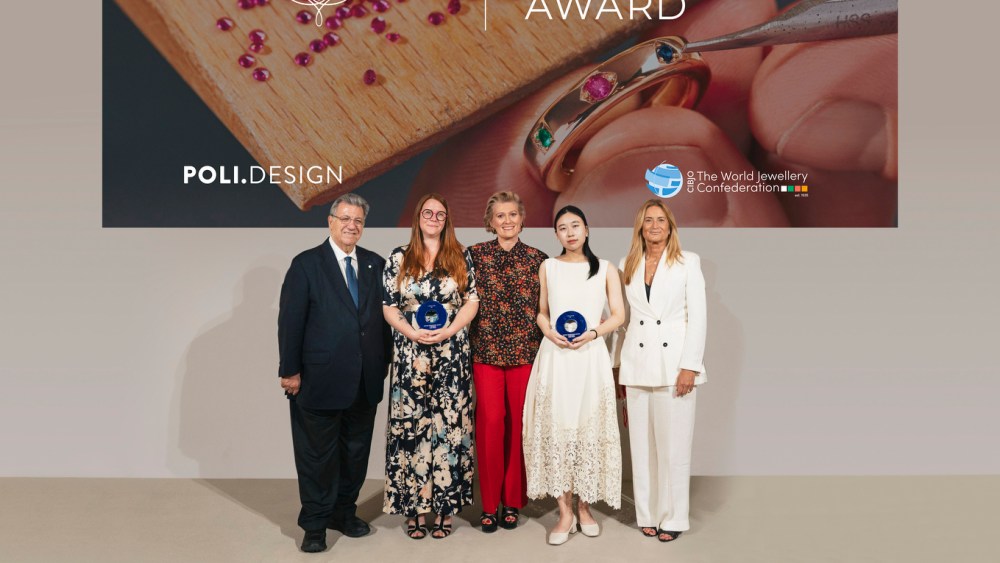
PARIS — Techniques for tracing gemstones back to their origins, even if they have spent decades in a vault, and turning compact discs into gem-grade options were the winning projects of the second edition of the Kering Generation Award x Jewelry.
Six-year-old GeoGems, a gemological expertise firm developing methods to prove the origin of stones through scientifically verifiable information, took home the award in the start-up category at a ceremony on Thursday at the French luxury group’s headquarters in Paris.
At the heart of its expertise is gemstone dating, which relies on the analysis of the stone’s constituting elements to calculate its age and track back to the geological context in which the stone was formed.
GeoGems beat out 44 other innovative projects presented in its category, which included fellow finalist Novanoma, a Japan-based company working on plant-based gemstones.
Yang Yuchang, a third-year undergraduate student majoring in jewelry design at the Beijing Institute of Fashion Technology, was distinguished in the student category for “Perching Willow,” a contemporary jewelry piece with a striking iridescent center element.
This part of the curving black lacquered design, which also includes diamond-set shapes evoking the tree’s heaving branches, was created from discarded compact discs integrated by using inlay techniques traditionally used for mother-of-pearl.

“Perching Willow” by Yang Yuchang.
Courtesy of Kering
Yang emerged as the top contender among 300 student projects.
The awards were presented by professor Alba Cappellieri, head of jewelry at Politecnico di Milano and scientific director of the award, and Gaetano Cavalieri, president of the World Jewelry Confederation, or CIBJO. Both organizations are partners of the contest.
Cappellieri lauded “the quality of the submissions, [which] continues to improve year after year, demonstrating that collaboration between academia and industry is a key strategic driver for the advancement of our sector.”
“The success of our Kering Generation Award x Jewelry demonstrates just how ready the next generation is to reinvent sustainable jewelry,” said Marie-Claire Daveu, Kering’s chief sustainability and institutional affairs officer. “For Kering, fostering innovations at the crossroads of craftsmanship, technology and environmental responsibility is no longer an option — it’s a necessity.”
This year’s edition continued the “Second Chance, First Choice” theme of the first edition, with the aim of fostering pioneering solutions that contribute to reducing the environmental footprint of the jewelry industry across products, processes, services and technological innovation, including AI.
Cavalieri called the awards “not only an important platform for emerging talent, but also a valuable window into the expectations, values and aspirations of the next generation of consumers, helping to shape the future of the jewelry industry.”
Students from 10 participating universities and institutions were invited to create jewelry that reimagines waste as a resource. Start-ups were encouraged to submit an existing product, technology or service in the jewelry sector that aligns with the contest theme.
GeoGems will get mentorship from Poli.design, while Yang Yuchang will be offered an opportunity to intern at Pomellato.
