

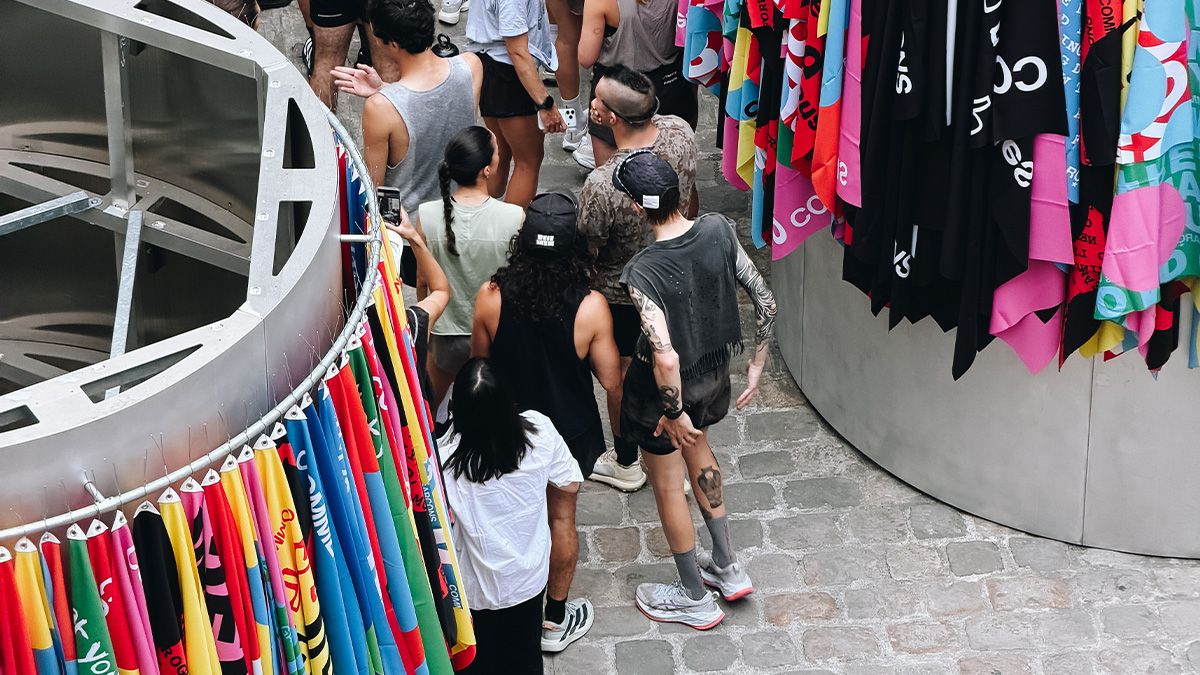
At Dover Street Market’s Rose Bakery in Paris on day four of Men’s Fashion Week, around 40 runners arrived for breakfast, drenched in sweat. The invite-only event was being hosted by Satisfy, the French running brand with a punk rock aesthetic. Afterwards, the brand hosted showroom appointments for buyers to place orders for its Spring/Summer 2027 collection.
Just two days earlier, District Vision, the design-led LA brand, hosted an evening drinks reception in its showroom in the Marais; guests from retailers such as Mr Porter were invited for a night of relationship-building and organic networking in an environment that’s more relaxed than a typical sales meeting. Sports brands have not historically been a regular fixture of the Paris Fashion Week landscape, and yet, it’s increasingly common: this is how modern running brands are doing business.
Where marathon weekends have become a boon for customer events, Paris Fashion Week has become the running industry’s luxury trade show for brands with wholesale ambitions. Running brands once almost exclusively sold their wares into mainstream specialty stores, either via individual appointments in local markets or through sport-specific trade shows, such as The Running Event (TRE) in Texas. But today, fashion-led retailers are among the biggest stockists for many style-minded performance brands focused on apparel. Plus, Paris Fashion Week is an excellent place to capture eyeballs.
.jpg)
“It’s the one place where 120 of our wholesale accounts show up, all of our sales agents reliably show up, and our orders are growing 30-40% season-on-season,” says Max Vallot, co-founder of District Vision.
Running has become a fashionable pursuit in recent years. Running clubs were popularized as a sober way to socialize, and completing a marathon — once a niche pursuit — has emerged as a modern status symbol for today’s consumer. The global running apparel and footwear industry was worth $23.3 billion in 2024, according to a report by Custom Market Insights; it’s expected to grow at a compound annual growth rate (CAGR) of 9.2% until 2033, hitting $51.6 billion. “We’re a luxury retailer, but our sports category is on a constantly upward trajectory,” says Daniel Todd, head of buying at Mr Porter, which stocks design-minded brands like District Vision, Satisfy, Norda, and Literary Sport, among others (the latter is known as “The Row of running”). “Previously, sports was driven by footwear, but right now, there’s stronger growth in the apparel category.”
It makes sense. The lines between sportswear and lifestyle continue to blur, as performance labels become part of affluent consumers’ daily wardrobes, often paired with luxury fashion. “We’ve always said we make products for people who run, not ‘runners’,” says Daniel Groh, head of design at Satisfy. “That naturally attracts a much broader audience.” Similar to how Arc’teryx Beta jackets became an urban staple, performance pieces today don’t always look like performance wear. District Vision’s collection includes lightweight, floppy-collared merino sweaters, for example, which are sold alongside its precision sports eyewear that’s handmade in Japan.
