

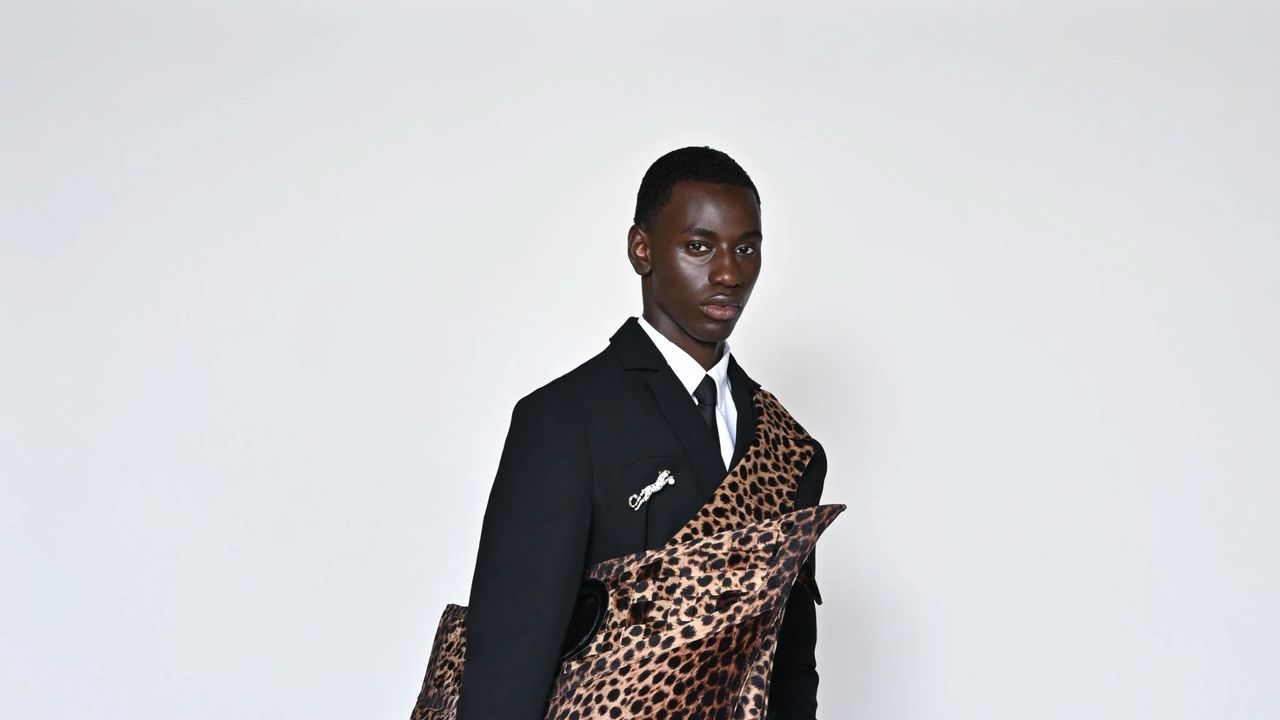
Dubbed the “Moniama” suit, the design is cut from silk crepe and features a double-breasted, single-button front, sharply sloped shoulders, and a softly sculpted waist. Mak’s signature trompe-l’oeil collar and a leopard-print velvet panel bring together cultural symbolism and technical tailoring. To complete the look, he designed a star-shaped bag intended to represent Congo’s ambitions at the tournament. The piece incorporates handwoven mats crafted by African artisans, transforming traditional techniques into a contemporary geometric object.
Today, Mak tells Vogue that he has opened orders for both the suits and matching bags through the brand’s website. He has already received more than 100 orders.
The World Cup wardrobe draws deeply from Congolese cultural references. Central to the collection is the leopard print, a motif with profound symbolic meaning throughout the country. “The leopard is the emblematic and totem animal of Congo,” Mak explains. “Across institutions, ethnic groups, and many villages, it symbolizes power, resilience, fighting spirit, bravery, and honor.”
The tailoring also nods to La Sape—short for Société des Ambianceurs et des Personnes Élégantes (Society of Ambiance-Makers and Elegant People)—the Congolese fashion movement celebrated for its impeccable tailoring and vibrant palette. Long regarded as an expression of both aspiration and identity, La Sape offered a framework Mak sought to reinterpret for a new generation of athletes. “It reflects a mindset of ambition and self-expression, which strongly inspired me and which I wanted to convey,” he says.
Mak never attended fashion school, instead teaching himself through YouTube tutorials. Before launching his own creative practice nearly a decade ago, he worked in sales for both luxury and contemporary fashion brands. He first designed looks for the Congo team’s appearance at the 2025 Africa Cup of Nations, including a leopard-print shirt with braided shoulders. Ahead of the World Cup, he approached Congo’s Ministry of Sports with a proposal for an entirely new wardrobe. What followed was a lengthy process involving multiple fittings and alterations as players prepared for the tournament.
“I want to showcase our vision, our expertise, La Sape, the leopard, and our spirit.” DRC does not recognize dual citizenship, which has only amplified Make’s want to champion both his Congolese and French identities through his work.
The designer’s connection to the team is also deeply personal. Football has been part of his life since childhood, and he once dreamed of becoming a professional player before an injury ended those ambitions. Through this collaboration, he says, he has found another way to participate in the game he loves. “Football has always remained part of my life,” he says. “Through this project, I feel like I am living part of that dream.”

