

MILAN — Damiani has succeeded in reflecting the artistic genius of some of the world’s most famous masterpieces in a high jewelry collection.
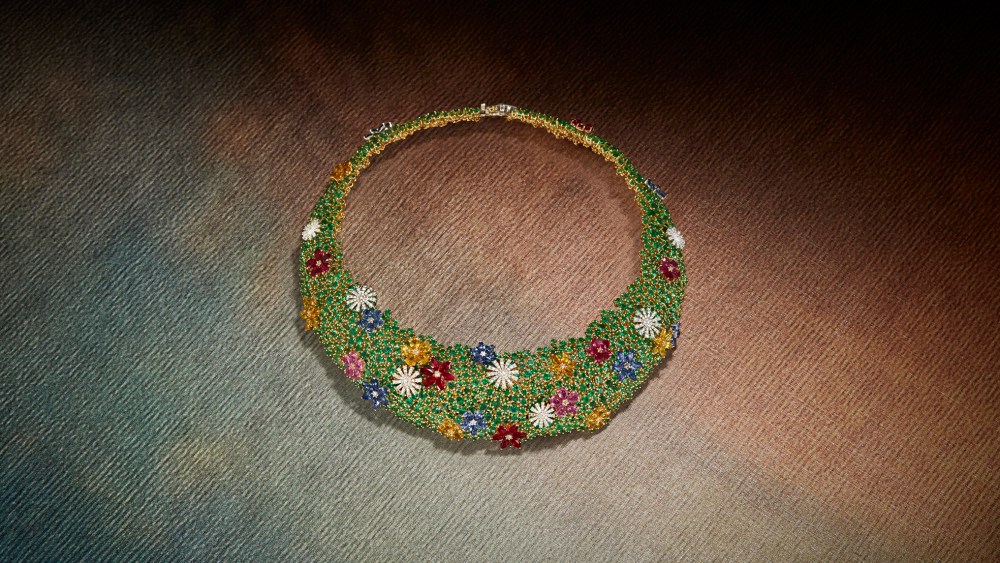
Titled “Arte Maestra” and unveiled on Thursday evening with a gala dinner and event at the stately 16th century Villa Pliniana on Lake Como, the collection reflected and translated the most distinctive elements of eight classic paintings: Caravaggio’s “Medusa,” Sandro Botticelli’s “Spring,” Katsushika Hokusai’s “The Great Wave off Kanagawa,” Jeong Seon’s “A Leisurely Cat in Autumn,” Wassily Kandinsky’s “Gray Form,” Gustav Klimt’s “The Kiss,” Claude Monet’s “Water Lilies,” and Vincent van Gogh’s “Sunflowers.”
“High jewelry allows [us] to fully express our creative capacity,” said president Guido Grassi Damiani in an interview ahead of the event.
The Italian jeweler has an in-house team of designers dedicated to this segment, which Grassi Damiani believes allows them to “feel free to let their creativity [be] unrestrained, to have fun without thinking of budgets.” Also, high jewelry contributes “to transmit the essence of the brand.”
Damiani relies on expertise developed over more than a century as it was established in 1924 in Valenza by master goldsmith Enrico Damiani, passed on to his son Damiano and then his own children Guido, Silvia and Giorgio.
Grassi Damiani underscored the knowledge of the brand’s customers, “loyal and returning,” who “understand the creative and artisanal work behind the jewels and their value, as they can be handed over across generations.”
Clients, he continued, seek jewels that can be worn on more occasions, and the events held to present the house’s high jewels are opportunities “to show them new beautiful places,” but especially to respond to a need of clients that “want to be informed, who rarely buy on impulse, and are increasingly more attentive and educated. They like to talk and build on the relationship with our designers, with the gemologist and with us as family members.”
After a presentation last year in Rome at Palazzo Ripetta, Como was chosen because “it’s become increasingly sophisticated, with the opening of luxury hotels and Michelin-starred chefs, yet it also offers privacy.”
Some of the standouts of “Arte Maestra” included the Malìa necklace, inspired by Caravaggio’s celebrated 16th century “Rotella con la testa di Medusa” (internationally known as “Medusa”). The jewel reinterpreted the painting’s most distinctive elements — the entwined serpents and the expressive intensity of the Gorgon, the mythical creature with serpent hair whose gaze could turn anyone to stone — through an intricate structure with sinuous snake-like forms sculpted in pink gold and embellished with alexandrites, black and brown diamonds, while pear-cut rubies define their striking heads. At its center shined a stunning Burmese pigeon’s blood ruby of over 6 carats, with reflections evoking Caravaggio’s signature chiaroscuro technique.

Damiani’s Malìa necklace.
Fabrizio Scarpa
The Impetuosa necklace draws inspiration from the 19th century “The Great Wave off Kanagawa” by Japanese artist Katsushika Hokusai, which depicts a towering wave crashing over fishermen’s boats, with Mount Fuji in the distance. Damiani’s artisans captured the moment when the wave, having reached its crest, begins its descent toward the shore. Crafted in white gold, the necklace was adorned with a pavé of blue and light blue sapphires, Paraiba tourmalines and diamonds — all brilliant-cut — recreating the depth and movement of the water. The gemstones were meticulously arranged in tonal gradients, progressing from deeper shades at the base to more luminous hues at the crest. Beneath the wave’s peak emerged a certified 3-carat brilliant-cut diamond, a subtle reference to Mount Fuji, visible in the original composition.

Damiani’s Impetuosa necklace.
Fabrizio Scarpa
Inspired by the embrace of the lovers portrayed in Gustav Klimt’s “The Kiss,” Estasi reinterpreted some of the painting’s distinctive elements, such as the use of the color gold, the geometric motifs and mosaic-like compositions. In the necklace, yellow gold tiles, adorned with baguette-cut diamonds, onyx inserts and brilliant-cut diamonds, alternated with circular elements embellished with rubies. At the heart of the jewel stood a cushion-cut spinel of over seven carats, in a vivid orange-red hue.

Damiani’s Estasi necklace.
Fabrizio Scarpa
In addition to Damiani, which has A-list celebrities from Sharon Stone and Tilda Swinton to Gwyneth Paltrow among some of its fans, the namesake group includes the Salvini and Bliss brands; Calderoni, founded in 1840 in Milan as a high jeweler and now a business unit of the group specializing in the trade of natural diamonds; Venini, the artistic glassmaker based in Murano and founded in 1794, and Rocca, the multibrand watch and jewelry distributor and heritage watchmaker.
In January, Compagnie Financière Richemont sold its Geneva-based Baume & Mercier watch brand to Damiani in a private transaction, the terms of which were not disclosed and Grassi Damiani said the closing is expected in July.
“Baume & Mercier completes our portfolio and will help us build know-how and authority in the watch category,” said the executive.
Grassi Damiani said the group has a long-term approach to the brand and plans to enhance Baume & Mercier’s visibility and reach by leveraging its own multibrand distribution network and opening select monobrand boutiques in strategic locations over time, including a first in Milan.
Grassi Damiani spearheaded the merger with one of the best producers in Valenza, Rizzetto Srl, creating the Laboratorio Damiani, with more than 100 artisans. Last year it acquired Laboratorio Carraro Srl, in Valenza, with the goal to further strengthen its know-how and production ability.
The group recently acquired the former Palafiere di Valenza for a new production pole, with a museum and a goldsmith school.
The Damiani Group closed the financial year ended March 31 with sales of 400 million euros, up 6 percent on the previous year, and Grassi Damiani said “April and May started off well, above budget.”
