

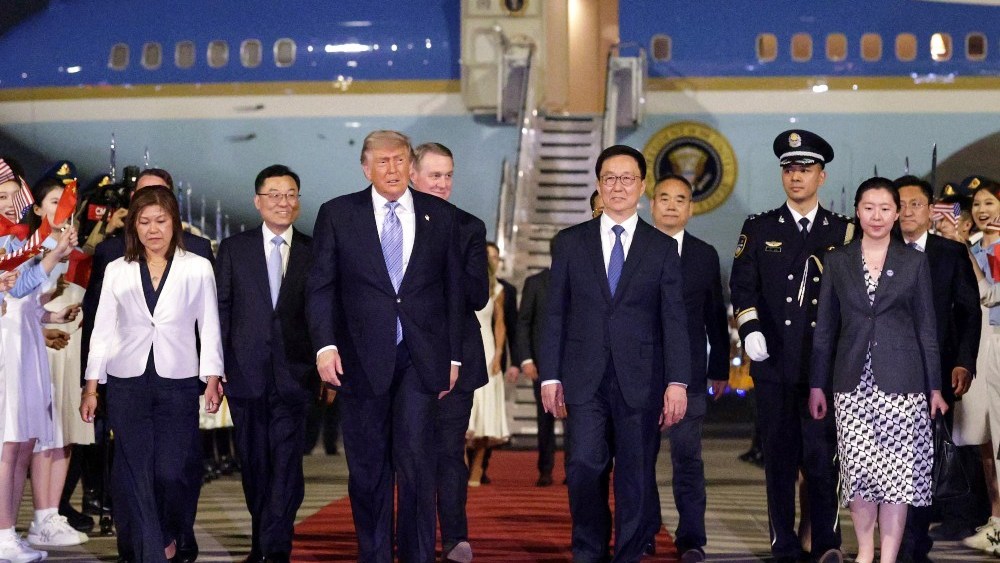
In a full show of force, President Donald Trump arrived in China on Wednesday afternoon for his Thursday meeting with Chinese President Xi Jinping flanked by more than a dozen U.S. business titans from Tesla and SpaceX’s Elon Musk to Jensen Huang of Nvidia, Tim Cook of Apple, Kelly Ortberg of Boeing and Jane Fraser of Citigroup.
The corporate leaders, some of whom flew with the president on Air Force One, aim to negotiate better business terms for their companies within the Chinese market.
Ahead of the president’s arrival, China’s top trade negotiator met with U.S. Treasury Secretary Scott Bessent in South Korea for a whirlwind discussion. Bessent and Chinese Vice Premier He Lifeng engaged in a three-hour, closed-door meeting on Wednesday at a reception hall at the Incheon International Airport before the American official boarded a plane to Beijing to join Trump and the American delegation.
The sit-down, which proceeded meetings with South Korean President Lee Jae Myung at the presidential Blue House, consisted of “candid, in-depth and constructive exchanges” concerning economic and trade issues “of mutual concern” to the U.S. and China, according to Chinese state media outlet Xinhua. He and Bessent also discussed as “expanding practical cooperation,” the outlet said.
“Guided by the important consensus reached by the two heads of state, the two sides upheld the principle of mutual respect, peaceful coexistence and win-win cooperation,” Xinhua reported.
Neither Bessent nor He took questions from the media after the meeting, leaving mystery hanging in the air after the relatively brief meeting. Previous trade negotiations between the U.S. and China have played out over days, not hours.
The president was more forthcoming about his priorities for the coming days, Truthing that he “will be asking President Xi, a Leader of extraordinary distinction, to ‘open up’ China” so that the U.S. billionaires “can work their magic, and help bring the People’s Republic to an even higher level!” The tete-a-tete will be Trump and Xi’s first in-person meeting since October, when they fleshed out the terms of an informal and tenuous trade truce, and Trump agreed to lower tariffs on China.
It will be the first visit to China by a sitting U.S. president in nearly nine years. Trump visited in 2017, during his first term in office.
Officials have intimated that this week’s discussions, slated for Thursday and Friday, will center on solidifying trade terms between the two countries. But there are other geopolitical considerations at play: Trump is eager for China’s support in bringing the war in Iran to a conclusion through the reopening of the Strait of Hormuz, and Xi would like to see the U.S. back off its support of Taiwan, which China views as a part of its territory.
“Heads-of-state diplomacy plays an irreplaceable role in providing strategic guidance for China-U.S. relations. We welcome President Trump’s state visit to China. During the visit, the two heads of state will have an in-depth exchange of views on major issues concerning China-U.S. relations and world peace and development,” China Foreign Ministry Spokesperson Guo Jiakun said during his Wednesday briefing.
“China stands ready to work with the U.S. to expand cooperation and manage differences in the spirit of equality, respect and mutual benefit, and provide more stability and certainty for a transforming and volatile world.”
