

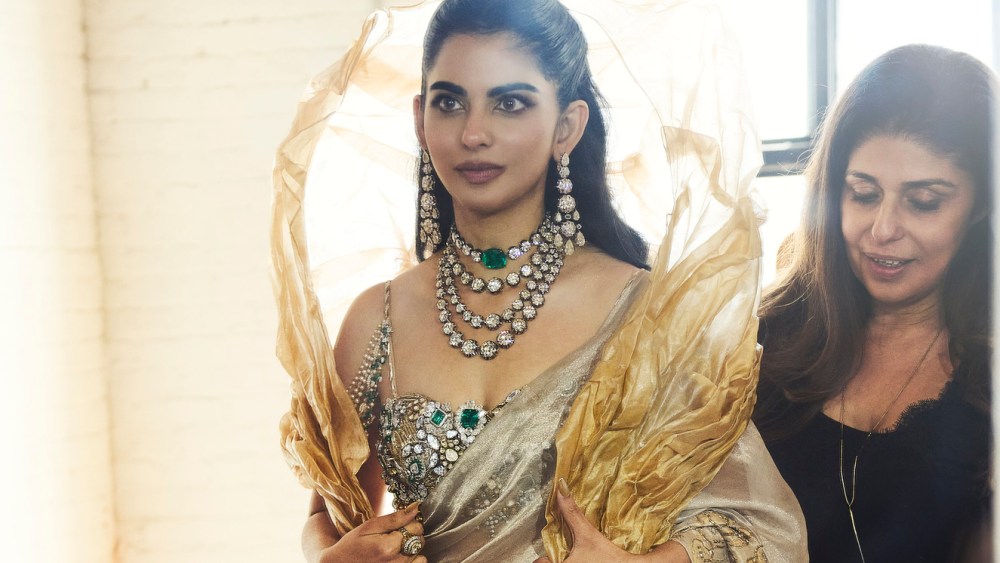
Hours before walking up the Metropolitan Museum’s steps, Isha Ambani stood still as final adjustments were made to a hand-painted tissue silk sari woven with real gold. It was her first sari on the Met Gala carpet, and her first turn in Gaurav Gupta Couture — a deliberate choice, she said, for a night themed “Costume Art.”
“Wearing a sari on the Met steps for the first time, especially this handwoven piece, fills me with immense pride,” Ambani said. “It feels like carrying a piece of India’s heritage on an iconic global stage.”
“There is no garment more deserving of that space than the sari,” she added. “It is timeless, inherently elegant, and despite its deep-rooted tradition, it continues to feel endlessly relevant in the modern world.”
In an interview from his Delhi atelier, Gupta said the look and choice of what to wear was unanimous between him, Ambani and stylist Anaita Shroff Adajania from the start. A sari, in its most traditional draped form, not the sculptural sari gowns Gupta has been credited with reinventing over two decades back home in India. “Here we wanted to go back and celebrate one of the oldest living costumes of the world which has survived not just centuries, but millennia.”
For Ambani, Gupta was the natural collaborator for a “Fashion Is Art” theme. “His work exists at the intersection of sculpture and fluidity,” she said. “He has a truly unique way of reimagining form while still honoring essence.”
The fabric was hand-woven with real gold by artisans of the Swadesh collective. National Award-winning Pichwai art master Trilok Soni and his team were flown to Gupta’s atelier, where they spent more than 150 hours hand-painting the sari with motifs drawn from the Ajanta cave murals — one of India’s oldest recorded depictions of the sari. Gupta’s embroiderers then layered zardozi, aari and dabka work on top in gold thread, metal coil, sequins and crystals. A traditional sari draper has been flown in for the carpet.
“It wasn’t about reinventing the sari,” Ambani said, “but about honoring it, allowing its form, craftsmanship and inherent strength to speak for themselves.”
The blouse — constructed on tulle and lined with brocade — was handcrafted at the Ambani residence, where Gupta’s embroiderers worked alongside the family’s jewelers to break down heirloom pieces and re-set them directly into the bodice. More than 1,000 stones totaling over 1,800 carats were embedded into the fabric using zardozi anchoring and hand-tucking: old mine diamonds, polki, kundan, emeralds and pearls, drawn largely from Ambani’s archive. At the center sits a historic sarpech from the Nizam’s collection, set with rose- and table-cut diamonds and finished with antique emerald bead drops in meenakari.
“In India, adornment itself has always been elevated to art,” Gupta said, citing the traditional 16 steps rooted in ancient traditions women traditionally do to get ready, symbolizing beauty, prosperity, and divine feminine grace. “We wanted to celebrate that art form as well.”
Forty artisans worked on the blouse over more than 500 hours. Across the full look, 25-plus craftspeople logged upward of 1,200 hours.
“More than any single stone, it’s that sense of continuity and inheritance that feels most meaningful to me,” Ambani said.
For the red carpet, Gupta wanted to add “that drama for the Met stage.” A second Banarasi tissue sari was commissioned and sculpted using his signature in-house resin draping, transformed into what he described as a halo-like cape that frames Ambani’s neck and trails behind her alongside the pallu or long trailing sash of the sari.
For Shroff Adajania, one of India’s most celebrated stylists, the brief was to celebrate heritage and craft with drama and restraint. “Working with both Isha and Gaurav is always such a treat. This look marked Isha’s first time wearing a traditional sari at the Met and for Gaurav a departure from his usual couture language,” she said.
The look was completed with a jasmine-inspired hair sculpture, an artistic reinterpretation by Brooklyn-based artist Sourab Gupta of the traditional mogra gajra, or fresh jasmine flowers traditionally worn in the hair. The final accessory was also aligned with the theme, a Subodh Gupta mango sculpture in the form of a handbag.
Ambani was clear about the message she wanted to convey. “I hope women across India and around the world see this as a reminder of the strength and beauty of our traditions,” she said, “and feel a sense of pride in how they continue to evolve and resonate worldwide.”
