

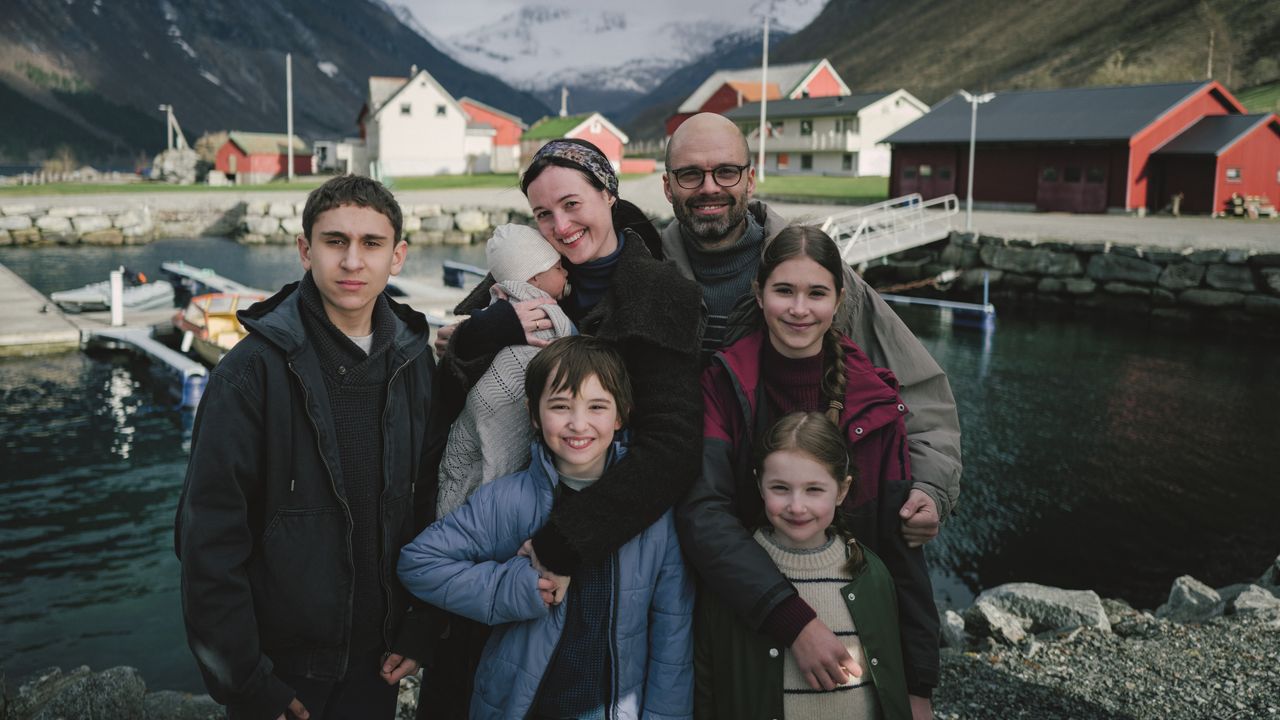
Romanian auteur Cristian Mungiu won the Palme d’Or back in 2007 for his harrowing abortion drama 4 Months, 3 Weeks and 2 Days. Now, he’s back with another admittedly tough but urgent sit: Fjord, a tale of immigration, hostility and clashing cultures set on the remote edges of Norway, which stars Oscar nominees Sebastian Stan and Sentimental Value’s Renate Reinsve. Fascinating and detailed, nuanced and thorny, it was easily the best movie I saw at the 2026 Cannes Film Festival.
At its center is the Gheorghiu family: the Romanian Mihai (Stan, who is himself Romanian-born); his wife, the Norwegian Lisbet (Reinsve); and their five children. Following the death of Mihai’s mother, they’ve decided to relocate from his homeland to Lisbet’s, to be closer to her family. With their precise, wondrous framing of the mountains, lakes, and chocolate-box houses of this new home, Mungiu and his immensely talented cinematographer, Tudor Vladimir Panduru, invite us into a fairytale, of sorts; the Gheorghius’ neighbors are warm and generous, the children begin making friends at school, and they seem to have found their community.
But tension quietly bubbles just beneath the surface. Lisbet is a nurse, caring for the bodies of the recently deceased. She’s told to avoid bringing religion into the workplace but, being a devout Christian, finds herself reaching out to a grieving woman, offering her number, a Bible, and a space at their church, if she needs it. Meanwhile, Mihai, an aeronautical engineer who has taken a job in IT as a result of the move, plays hymns on the piano, prompting atheist colleagues to raise their eyebrows. Their children pray and are carefully disciplined, though a new friend and classmate, Noora (Henrikke Lund Olsen), starts to bring out rebellious tendencies in the two eldest, Elia (Vanessa Ceban) and Emmanuel (Jonathan Ciprian Breazu). The more the Norwegians learn about the Gheorghius, the more they bristle at their foreign ways.
One day, Elia comes to school with a red bruise on her face. Given their knowledge of her parents, her teachers assume they’ve hit her. When she’s asked if her parents ever get physical with her, she admits that, yes, they do sometimes give her a slap on the bottom if she’s misbehaved.
Without hesitation and in an atmosphere of eerie calm, those in charge decide to get child protective services involved. A police officer comes to speak to Mihai about how exactly he punishes his children. And, in one of the most shocking and painful, and still weirdly serene, sequences of the film, Lisbet is told that her children are being taken away from her, for their own safety—not just Elia, but all five, including her baby who is still being breastfed. Reinsve’s face shifts from confusion to stunned terror, as a Norwegian flag flutters in the wind just outside the window behind her. This, she’s reminded, is how the law works in regards to the safety of children in her homeland.
The scene in which she’s separated from her baby is another masterclass: Mihai watches through a window that perfectly frames Lisbet placing the child into a car and staggering back as it drives off. You don’t see Stan or Reinsve’s faces, but every inch of their body language conveys their utter heartbreak.
So, the battle begins. Lisbet takes parenting classes, Mihai takes anger management courses, and they visit the children, who are now in separate foster homes across the region. They, too, just want to come home, but a full investigation and trial must take place. When Lisbet inquires about getting her breastmilk to her baby, she’s told that the powers that be will have to check in with “the mother”—meaning the baby’s new foster mother.
