

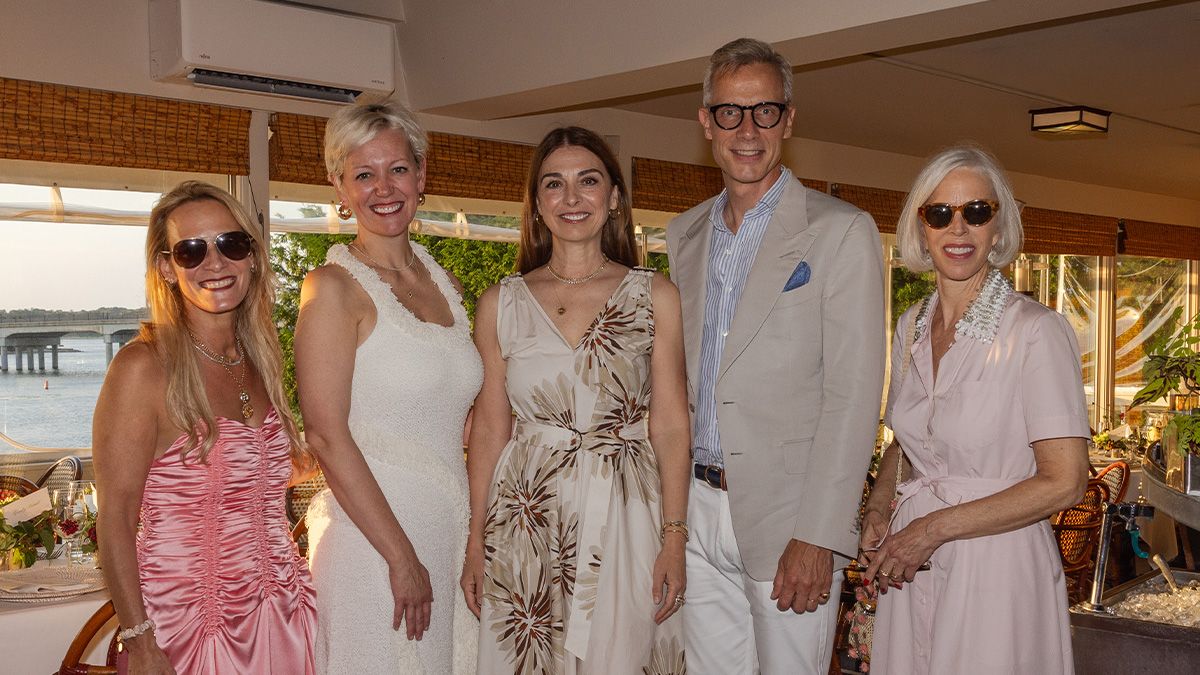
About 20 minutes before Exemplar Luxury Group (formerly Saks Global) hosted its first-ever client dinner, CEO Geoffroy van Raemdonck is personally inspecting the place settings and name cards at The Beacon, the private members’ yacht club in Sag Harbor, NY.
It’s rare that guests and leaders of each of the group’s retailers — Saks Fifth Avenue, Neiman Marcus, and Bergdorf Goodman — come together at one event. But van Raemdonck wanted to put on a unified front and introduce top clients to the newly renamed group, less than two months after Saks Global exited bankruptcy with enough financing to reinvest into the business and rebrand. In addition to the VICs, designers, retail execs and celebrity guests including Tory Burch and CEO Pierre-Yves Roussel, Andrew Rosen, Wes Gordon, Stacey Bendet, and Brooke Shields also came to support. Guests — donning designer brands like Fendi, Dior, and Michael Kors Collection — slurped oysters and sipped cocktails before sitting down for a three-course dinner.
“It’s a new day,” says van Raemdonck. “Our retailers are united by one thing: customer devotion. We care about our customers. Our mission is to create a relationship with them. So in our first year, we wanted to bring them together for this umbrella event. We have the liquidity we need. We have 75% less debt. We’ve taken a lot of action focusing on luxury, streamlining the stores. We’re ready to start the next chapter.”
Van Raemdonck, formerly the CEO of Neiman Marcus, was appointed to lead the retail group in January after former chief execs, Marc Metrick and Richard Baker, stepped down amid the bankruptcy filing. Van Raemdonck was tasked with both steering the ship out of bankruptcy — which it completed in June with $500 million in new financing — and convincing brands and customers that they could trust the group’s retailers again. Brands were owed hundreds of millions of dollars in unpaid invoices; van Raemdonck says a substantial portion of financing went to paying back the brands, and the company paid more than $600 million worth of claims to hundreds of partners, which has helped to rebuild trust. He adds that once inventory is replenished, the executive hopes to win back the more casual customers, who maybe last visited a store over the holidays and noted the lack of stuff inside.
But he asserts that top customers, like the ones in the room on Thursday, “never declined as the company declined”, and sales associate revenue was up in the first six months of the year. About 1,500, he says, do more than $1 million in sales per year, and in aggregate, they bring in more than $2.8 billion in revenue. “You can’t manufacture that, or replicate it,” van Raemdonck says, which he sees as the group competitive advantage.

