

SHANGHAI — The 2026 World Artificial Intelligence Conference here marked a defining moment for China’s AI ecosystem: artificial intelligence has moved beyond experimentation and entered a new phase of commercial deployment.
The scale of this year’s event reflected that transformation. Exhibition space surpassed 1 million square feet for the first time, with more than 1,100 companies showcasing 3,000-plus technological achievements and more than 300 global first releases. Offline attendance exceeded 300,000 visitors, while 57 key application scenarios secured 16.2 billion yuan, or $23.7 million, in intended cooperation ahead of the conference.
Once primarily focused on computing power, algorithms and infrastructure, WAIC 2026 demonstrated a significant shift: AI is no longer only a technology race, it is becoming a consumer experience engine, reshaping industries from fashion and beauty to retail, lifestyle and personal wellness.
At the opening ceremony, Chinese President Xi Jinping described AI development as “a symphony of global cooperation, not a solo performance by one country.” The message reflected China’s broader ambition to accelerate AI adoption across industries. In June, eight government departments introduced the country’s first dedicated “AI + consumption” policy framework, highlighting smart wearables and other consumer-facing technologies as key growth areas.
For fashion, this signals a new chapter. AI is moving from the sidelines into the industry’s core — transforming how products are designed, experienced, purchased and personalized.
AI Meets Fashion: Three Consumer Categories Reaching Commercial Scale
At WAIC 2026, three categories stood out as indicators of where fashion technology is heading: AI glasses, AI-powered beauty solutions and virtual try-on experiences.
Together, they demonstrated a broader industry transition: From technology demonstrations to products that integrate seamlessly into everyday life.
AI Glasses: From Technology Gadget to Fashion Accessory
Smartglasses have long represented the promise of wearable technology, but previous generations often struggled with one fundamental challenge: They were designed as technology products rather than lifestyle objects.
WAIC 2026 showed a different direction. The competition is shifting away from technical specifications toward design, comfort and real-world usability.
According to IDC, China’s smartglasses shipments are expected to reach 4.51 million units in 2026. Brands are increasingly focusing on lightweight design, aesthetic appeal and daily scenarios, positioning AI glasses closer to eyewear and fashion accessories.
Chinese newcomer Moonix captured attention with its ultra-light, 14.9-gram design and 4mm temples, offering multiple materials and 39 frame styles. Rather than emphasizing technical complexity, the brand focused on wearability, personalization and everyday usefulness, including features such as real-time translation, recording and AI memory.

Moonix’s eight core functions — seamless recording, auto-generation, long-term memory, real-time translation. Courtesy photo
Meanwhile, established players including Rokid, INMO, RayNeo and XReal are accelerating adoption by developing operating systems and practical applications, such as meeting transcription and real-time translation.
The next stage of competition will not be defined by who adds more features, but by who best understands how technology fits into consumers’ lifestyles.
AI Beauty: Moving From Marketing Tool to Industry Infrastructure
Beauty was another major area where AI demonstrated its commercial potential.
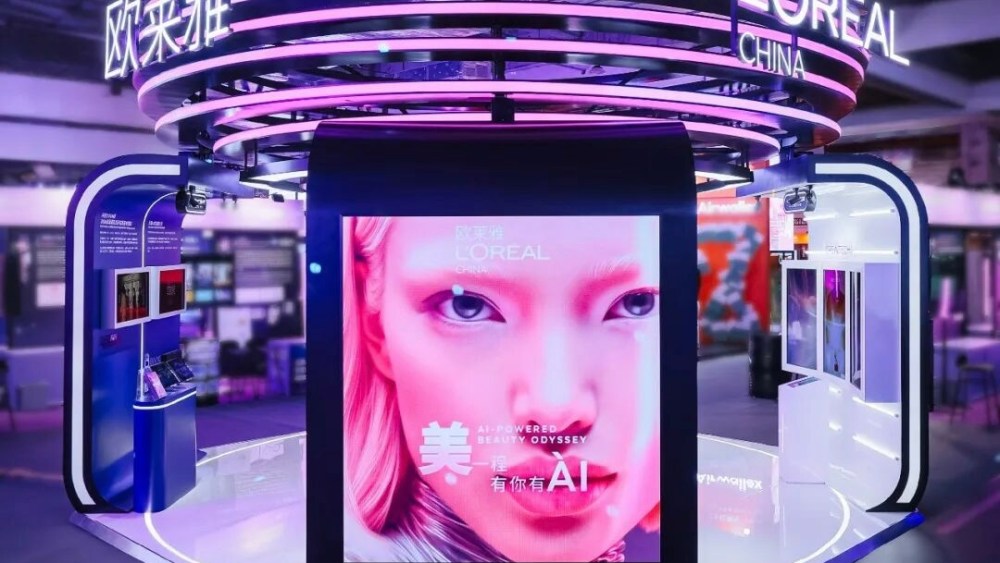
L’Oréal’s participation at WAIC — as the only global major beauty group exhibiting during the conference — highlighted how artificial intelligence is becoming embedded throughout the beauty value chain, from research and development to consumer services.
On the innovation side, L’Oréal North Asia’s CreAItech laboratory uses generative AI to accelerate product development, reducing processes that previously required months into significantly shorter cycles. The company has also integrated its ModiFace virtual beauty technology with large language models, creating AI-powered solutions for product development, testing and consumer engagement.
At the consumer level, L’Oréal introduced 3CE GENBA, a generative AI beauty consultant designed to provide personalized recommendations based on skin type, makeup preferences, clothing and occasions.
Its AI-powered “magic mirror” experience enables consumers to virtually test hair colors, styling options and makeup looks, addressing one of the beauty industry’s longstanding challenges: the gap between consumer expectation and real-life results.
AI is therefore becoming more than an engagement tool. It is emerging as a new productivity layer for the beauty industry, connecting data, creativity and personalization.
Virtual Try-on: Closing the Loop Between Imagination and Consumption
Fashion’s AI transformation is also moving beyond visualization.
At WAIC 2026, virtual try-on technologies demonstrated a complete consumer journey — from AI-generated design concepts to digital fitting and physical production.
At the Zhangjiang AI Roadshow Center, visitors could create personalized patterns through AI, preview designs through smart mirrors and transform digital concepts into physical products such as customized T-shirts and nail products.
This represented a significant evolution. Virtual try-on is no longer only a marketing experience; it is becoming part of a broader consumer fulfillment ecosystem.
The growing maturity of China’s AI-fashion landscape is also attracting international technology companies. U.S.-based virtual try-on platform SpreeAI highlighted China’s advanced consumer environment and manufacturing ecosystem as important factors in accelerating global AI-fashion innovation.
The Next Competitive Advantage: Human Needs, Not Technology Alone
While WAIC demonstrated AI’s significant potential, it also revealed a new challenge: technology categories are becoming increasingly competitive and increasingly similar.
Across AI glasses, beauty technology and virtual try-on, hardware capabilities, algorithms and user interfaces are rapidly converging. Technical innovation remains essential, but it is no longer enough to create lasting differentiation.
The next generation of fashion-tech leaders will be defined by their ability to solve meaningful human problems.
This shift can be seen in companies such as Eight Sleep and Inair, which have built their identities around specific consumer needs rather than technology alone.
Eight Sleep aims to transform sleep technology into a broader wellness experience by focusing on a universal human challenge: recovery and quality rest. Its AI-powered Pod system combines sensors, adaptive temperature control and personalized algorithms to create a more intelligent sleep environment.

Eight Sleep cofounders Massimo Bassi (left) and Alexandra Zatarain (right), with cofounder and chief executive officer Matteo Franceschetti. Courtesy photo.
The company’s appeal among entrepreneurs, athletes and high-performance individuals demonstrated an important lesson for fashion and lifestyle brands: Consumers are not buying technology itself. They are buying improved experiences, better lifestyles and solutions to everyday challenges.
Similarly, Chinese technology company Inair has moved beyond the crowded smartglasses category by focusing on productivity and spatial computing. Rather than competing only on wearable design, it has developed an AI-powered AR system designed to support mobile work, multiscreen interaction and lightweight digital lifestyles.
Both examples point toward the same conclusion: successful AI innovation begins with human needs.
China’s AI-Fashion Future: From Innovation Race to Lifestyle Transformation
WAIC 2026 offered a clear view of China’s next phase of AI development. Artificial intelligence has moved beyond concept demonstrations and entered real consumer environments — from eyewear and beauty to apparel and personalized experiences.
The future competition will not simply be about faster algorithms or more advanced hardware. It will be about understanding consumers, creating meaningful scenarios and transforming technology into human-centered experiences.
For the fashion industry, AI is no longer a future possibility. It is becoming a new foundation for creativity, personalization and business transformation.
Editor’s note: China Insight is a monthly column from WWD’s sister publication WWD China looking at developments and trends in that important market.
