

Trend-right product across the portfolio lifted Steve Madden‘s second quarter earnings, and things are looking up for the rest of the year.
The company’s chairman and chief executive officer Edward Rosenfeld told investors during the firm’s earnings conference call that the flagship Steve Madden brand continued to gain momentum as consumers responded “enthusiastically” to the product mix.
“In women’s , we saw strong performance with dress shoes at various heel heights and outsized growth in the casual category,” he said. “We capitalized on a variety of trends in style and materials, including split toes, jellies, hidden wedges, rhinestone mesh, ballet-inspired looks, thongs and needle heels.”
The CEO acknowledged that some products, such as boots and suede, are items that have a longer shelf life since they can sell year-round. “That being said, we’re still in the business of trend and the trend cycles move faster than ever today,” he said, emphasizing that the company is not going to suddenly have styles that run for years and year.
Other highlights were men’s footwear, which performed well across a range of categories, with particular strength in loafers. And the Nordstrom Anniversary sale also has been a “really positive story us. We’re having a really phenomenal event,” Rosenfeld said. “I think every division in the company that participates in that sale is seeing increased sell-through versus the prior year.”
According to the CEO, the real standout has been Steve Madden women’s footwear business. The brand had a very strong Nordstrom event last year, when he said the company “started to see the inflection in the business and a significant improvement in sell-through.” And even on top of that strength, setting the stage for tough comparisons this year, “we’re seeing big increases in both overall volume and sell-through percentage. So, very pleased with the Nordstrom anniversary performance,” Rosenfeld said.
Overall, wholesale footwear revenue was $240 million, reflecting a 9 percent increase. Excluding Kurt Geiger, the increase was 7.8 percent.
Rosenfeld said that the company is building out it Kurt Geiger store base, opening two full-price stores in premium malls in the quarter, in Tysons Corner and Dadeland. There are now seven full-price stores in the U.S.
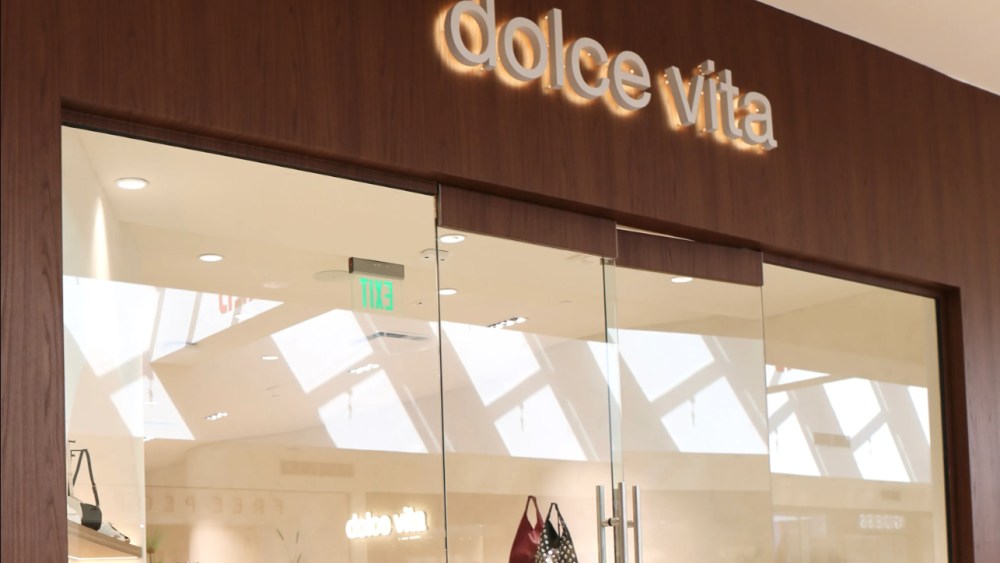
At Dolce Vita, “we had an outstanding second quarter with strong growth across wholesale and DTC (direct-to-consumer) channels, driven by a compelling product assortment highlighted by jellies, ballet flats, Mary Janes, mid-heel dress shoes and thongs.”
As for the store base, Rosenfeld said that full-price stores continue to outperform the outlet channel. “In the U.S., we were down one percent in Q1 in outlet, and that rebounded to up 12 percent in Q2. So, a nice recovery there. Again, not as strong as the full-price stores in the U.S., which were up 16 percent or e-commerce in the U.S., which is up 20 percent, but still a healthy number,” the CEO said.
Zine Mazouzi, chief financial officer and executive vice president of operations, told investors that the company thus far is absorbing the higher shipping costs to customers for the DTC business.
The CFO also said that the tariff rate for the third quarter reflects the new Section 301 25 percent duties on Brazil and the new 10 percent to 12.5 percent that went into effect on July 24 for forced labor. In addition, the company has a 15 percent rate built into fourth quarter estimates.
“So, it’s a little bit higher than the currently announced tariffs,” Mazouzi said. “But we also know that there are two more investigations that are pending.”
