

In the boisterous Ghanaian capital of Accra, where 15 million garments from the global North pour every week into the sprawling secondhand clothing marketplace known as Kantamanto, upcycling the absurd bounty of obroni wawu—or “dead white men’s clothes” in the native Twi—has become an act of resistance in more ways than one.
Each day, customers flock to the 18-acre labyrinth of corrugated aluminum and timber to haggle for bargains on castoffs from Canada, the United States, the United Kingdom and elsewhere in Europe. But an estimated 40 percent of the clothing that enters Kantamanto also leaves as waste—too stained, torn or poorly made to resell, according to The Or Foundation, a local environmental justice nonprofit that is developing solutions to tackle the unchecked overconsumption suffocating the city.
Designers trained by the organization’s OWO School, a four-month circular fashion accelerator named after the monthlong Obroni Wawu October festival, eye Kantamanto’s discarded bales not as trash but as raw material waiting to be mined. Several of these full-time thrifters have turned to denim as their preferred form of expression for its durability and versatility.
Still, the work isn’t easy: As fast fashion continues to flood the market with low-quality synthetic-stretch blends, finding sturdy 100 percent cotton has become a progressively grueling—not to mention costly—scavenger hunt. Kantamanto’s beleaguered retailers often complain about the worsening condition of the 120-pound shipments they purchase sight unseen. Holes aren’t even the worst of their problems; many of the garments are increasingly riddled with mold, blood or worse.
“I’ve hardly been able to get five pieces a day even after going through the whole market,” said Jonathan Tackie, his voice barely audible above the honking traffic outside. The Kala Blaq creative director was sitting in The Or Foundation’s glass-walled “The Other” showroom, a 15-minute walk from Kantamanto, surrounded by a colorful riot of reconstructed button-down shirts, tote bags, mop heads and water bottle holders that suggested some second-life possibilities for the marketplace’s discards.
But even the quality of available “hard” denim—best for ripping apart and resewing into new, more sophisticated silhouettes that hold their shape—continues to deteriorate. Levi’s and Wrangler jeans, once common enough, have become scarce, or when finally unearthed turn out to be damaged in some irreparable way. There have been jeans so thin they were virtually transparent. Or so flimsy they shredded instantly under a needle.
Even so, Tackie, a.k.a. @bone_bwoy on Instagram, views these clothes not as lost causes but rather “wounded.” Every “tear, stain and patch” is a “scar” for his sewing machine to perform a type of textile kintsugi, except that he uses stitches instead of the gold favored by the Japanese to mend the broken pieces. In Tackie’s hands, the face and back sides of the reclaimed denim are juxtaposed to form high-contrast patchwork chessboards that “expose every move” made to save it. Hacked-up pieces from different jeans, pockets and all, get Frankensteined into a completely different pair of trousers. Bleach streaks provide fresh points of visual interest while masking imperfections.

Kala Blaq Kintsugi
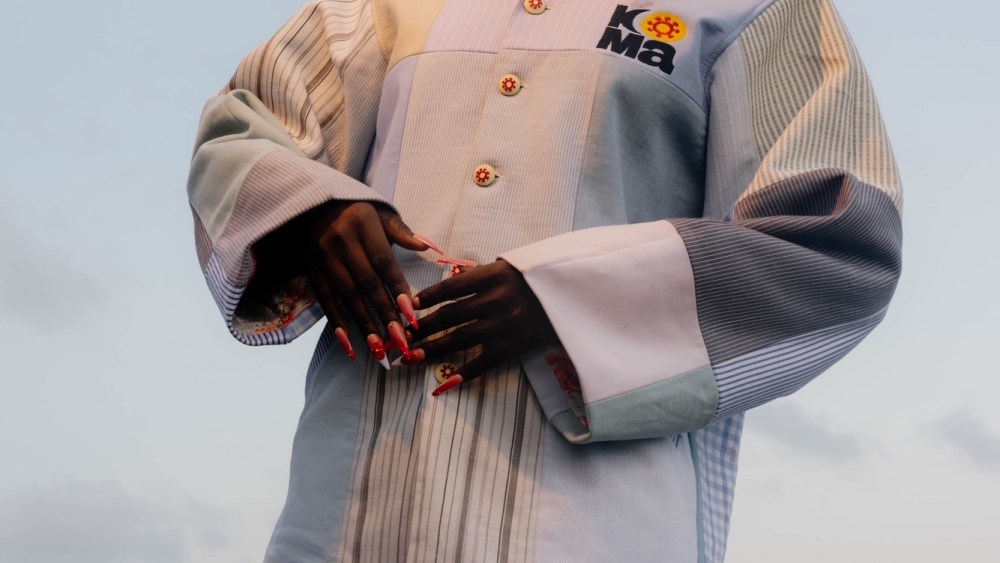
For fellow OWO School graduate Derek Boadi Asare, founder of Koma Afric and @obiba_jr on Instagram, rescuing rejected garments carries personal weight. Asare was born with a shorter left arm but doesn’t consider himself disabled, preferring the term “unique.” It’s a perspective he applies to the secondhand clothing he works with. Jeans with split seams or busted zippers aren’t “dysfunctional,” he said, but can transcend their perceived flaws to become something else. They just need a bit of coaxing.
“It’s my life that inspires me in everything that I do,” he said. “I try to make people understand that there’s always a way. Just find it and move on.”
It’s the materials Asare finds that eventually tell him what they want to be: a chore coat layered with a crazy-quilt of various corporate pinstripes, perhaps, or a women’s blazer that first tapers, then widens at the waist so it doubles as a minidress. Sometimes he finds himself buying clothes he doesn’t have an immediate use for, certain that their time will come.
In mending and upcycling, Asare sees a way to “fix a problem in the environment or in the world.” In repurposing, he has found his own purpose.
On the airy rooftop of The Or Foundation’s four-story office next door, the latest cohort of OWO School was in session. Twenty tailors, shoemakers, designers and merchants huddled around several pushed-together tables, deep in conversation. David Neal Dodoo, creative director of the brand Chiip O Neal and the program’s facilitator, had blindfolded representatives from each team and asked them to pick from a pile of material scraps—T-shirts, kente cloth, linen, beads, denim—and challenged them to create a product they could commercialize. Now they were figuring out brand identities for their fictional companies.
On one end, Jessica Ngon Kemoum, a branding mentor, told WasteleX, a group that had created a portrait of a woman from a wild assemblage of fabrics, threads and buttons, that any logo they choose must be easy to screenprint or embroider. (She has also banned the color green as a shorthand for sustainability, along with trash cans and chasing arrows.) Most of all, she said, it must tell a story.
The story WasteleX seeks to tell exposes the central tension at the heart of Kantamanto, and indeed Accra: the desire to make a living from clothing resale versus the crushing social and environmental toll of what Liz Ricketts, The Or Foundation’s co-founder and executive director, describes as the global North’s “extreme excess,” littering beaches, clogging waterways and piling into burn pits and open dumpsites.
Several clothing charities and exporter associations in North America and Europe, along with some importer groups in Ghana, have cast doubt on these stark claims, framing them as propaganda meant to drive them out of business. But the reality of the 65-foot clothing-stuffed landfill that looms over the banks of the formerly pristine Korle Lagoon is difficult to dispute. Neither is the lived experience of volunteers who have to resort to hoes and machetes to dislodge massive textile “tentacles” from the sands of Jamestown Beach, only to find themselves wrestling with even more monstrous configurations the following week.
Ricketts, who moves between Accra and her native United States, remembers eating at a Jamestown bar in 2016 when she and her partner and co-founder, Branson Skinner, spied an ominous shape “surfing the waves.” They both stood up, squinting in the sun. It turned out to be a pair of jeans.
“That was the first piece of textile waste we saw out in the environment,” she said. “A few years later, we started seeing pieces of textile waste coming up from the beach, but not mounds of it. They’d be like peeking out from the sand.”
This, too, soon changed. When Accra’s only engineered landfill at Kpone burst into flames in 2019, another inflection point arrived—just as fast fashion pivoted to a digital-first, algorithm-honed, influencer-led model that significantly accelerated the pace of production and consumption.
“That’s when we really had a deficit in terms of places to hide the waste, right?” Ricketts said. “Since then, we’ve had a lot of the mounds of material being burnt out in the open or ending up on the beach.”
The X in WasteleX, the team said, means stop.

Antydote
Back in “The Other” showroom, Emmanuel Tetteh, creative director of Antydote, struggled to quantify how long it takes to create one of his upcycled looks because he gathers different elements from Kantamanto “in bits and pieces.” It can take a week or more to find what he needs for the mosaic-like designs he constructs from denim scraps, then overlays with appliqués—the Rolling Stones tongue, for instance, or Mother Mary.
Tetteh, who goes by @humblyemma on Instagram, likens upcycling to freestyling—a way to tell stories based on emotions, much like a musician riffs to a rhythm. He’s always loved fashion, he said, but OWO School helped him finesse a vision.
“For me, using secondhand fabrics gives me a second chance, because I feel like I’m starting my life afresh,” Tetteh said. “I resonate with the fabrics. Their second chance is also my second chance.”
This article was published in SJ Denim’s spring issue. Click here to read more.
