

MILAN — Releasing its 2025 Gucci Equilibrium Impact Report, outlining the progress made over the last year to advance its sustainability ambitions, the house on Thursday revealed it renewed its gender parity certification in Italy.
The certification, obtained after an audit by Bureau Veritas Italia, was achieved in July 2023, when Gucci became the first Italian luxury company to voluntarily achieve the certification established under Italy’s National Recovery and Resilience Plan.
“The renewal of Gucci’s Gender Parity Certification reflects a commitment that extends beyond compliance or targets,” said Francesca Bellettini, president and chief executive officer of Gucci. “Creating an environment where people can fully express their talent, contribute and grow is fundamental to the way we lead our business and build our future. We are proud of the progress achieved, but even more conscious of our responsibility to continue advancing a culture grounded in merit, inclusion and equal opportunity.”
The recertification audit covered 14 entities operating in Italy across Gucci’s corporate, retail and industrial operations, evaluating the performance across six key areas: culture and strategy; governance; HR processes; opportunities for women’s career development and inclusion; gender pay equity, and support for parenthood and work-life balance.
Some of the People highlights from the 2025 Gucci Equilibrium Impact Report include being awarded one of the “Best Places to Work for Disability Inclusion” for the fourth consecutive year, achieving 100 percent scores for U.S., Canada and Brazil, while also earning recognition for U.K. for the first time.
Gucci has maintained employee diversity overall, with 63.4 percent female employees and 57.3 percent female managers. The company has donated more than 4.5 million euros in support of cultural and heritage programs around the world and donated 909,448 euros to support 20 gender equality projects through 18 non-governmental organizations, or NGOs, in 18 countries, directly benefiting 1,341 women and girls.
In 2019, Gucci Changemakers North America was launched aiming to empower undergraduate students to pursue paths within the design and fashion industry. Last year the organization awarded $350,000 and more than 227,000 British pounds in scholarships awarded to three home students at London College of Fashion through Gucci Changemakers EMEA Scholarship Programme.

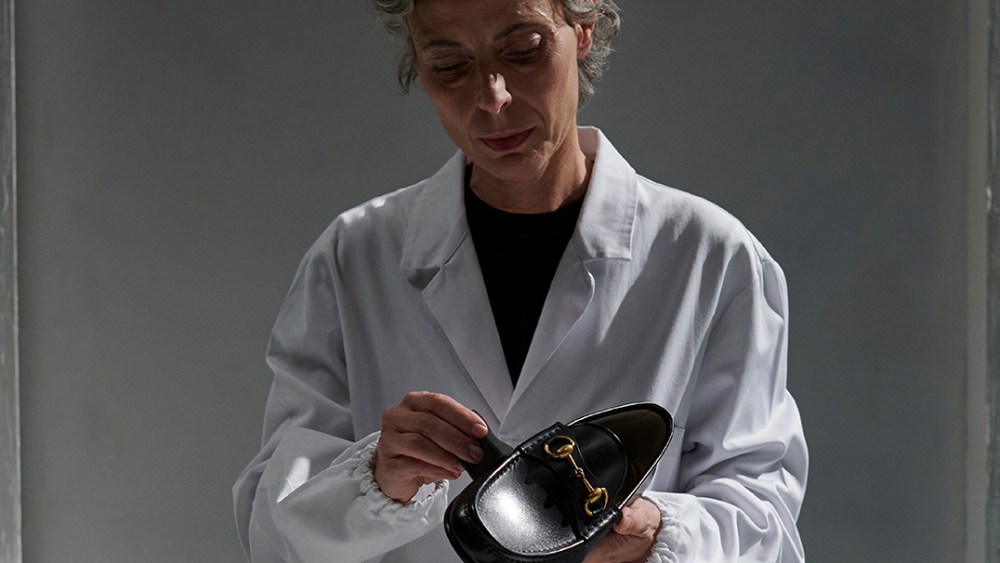
An artisan working on a Gucci bag.
Planet highlights included a 20 percent reduction of absolute GHG emissions year-over-year combining scopes 1, 2, and 3, achieving a 45 percent reduction compared to the 2022 baseline. In terms of materials, Gucci employed 100 percent responsibly sourced precious metals, 90 percent organic or recycled cotton, 96 percent recycled viscose or from responsibly managed sources, and 92 percent organic, recycled or responsibly sourced wool and cashmere.
Gucci listed 99 percent overall traceability across key raw materials, including 100 percent traceability for leather and precious skins and 77 percent traceability for cellulose-based fibers and maintained 100 percent renewable energy use in line with the RE100 guidelines, while expanding LEED-certified sites to 163.
Its circularity program Gucci-Up recovered 485 tons of leftover leather and textiles with 32 tons metal scraps regenerated, and Gucci Scrap-less saving 715,000 liters of water and 68,000 kWh of energy while avoiding 9 tons of chemicals. As it invested in regenerative farming projects for wool, silk, cotton, and denim-specific cotton, Gucci launched a regenerative leather project.
Gucci follows the sustainability targets set at the group level by parent Kering and its framework to achieve them. This includes the Kering Standards for raw materials and manufacturing that act as a guide for suppliers to ensure compliance with the group’s environmental and social requirements.
