

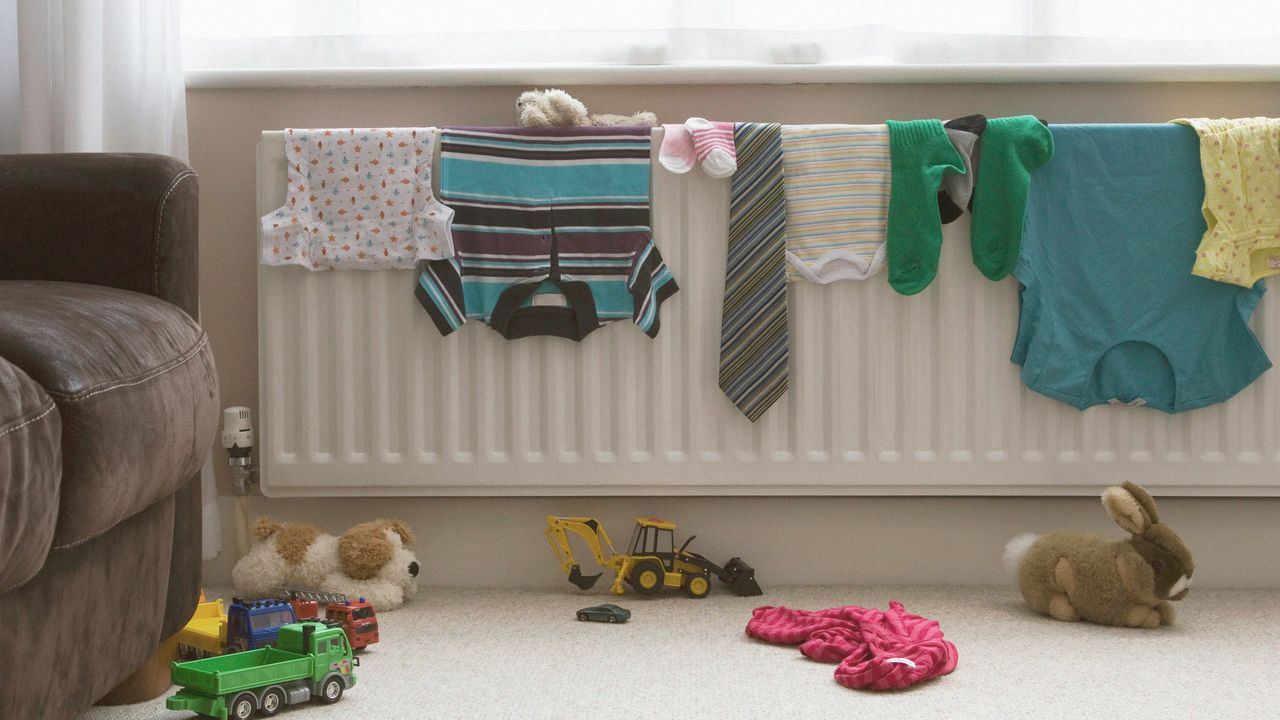
The baby monitor, propped up on the salad bowl, crackles in the background. I’ve finally managed to get our six-month-old to sleep and have come downstairs hoping to relax, but my husband and his parents are bickering again. They have too much stuff, he informs them, and who the hell still has their heat on in May? Half the stuff, his mum reminds him, is ours.
This is true—our moving boxes are still stacked up in the living room, our baby paraphernalia strewn through the house. His dad looks up from his fish—our third fish dinner in as many days, my pescatarianism proving something of a challenge—and tells me, not for the first time, that protein is important. I fear we may stray, yet again, into a discussion of French cooking.
This isn’t how I expected early motherhood to be. When we moved in with my husband’s parents, I was six months pregnant, and it was meant to be a stopgap—a temporary arrangement, but one that became suddenly open-ended two weeks before our son’s birth, when our move to a new apartment fell through. Ten months later, we were still there, all of us crammed into a terraced house in a North London suburb.
“Why don’t you go and watch some TV?” my mother-in-law says. Relieved to be excused, we traipse off to the living room like teenagers, shutting the door behind us. A second later, it opens again. “You forgot this,” she says. It’s the baby monitor. “I think he’s woken up.”
Before deciding to become a mother, I had gone round and round all the arguments—the loss of autonomy it would bring, the depletion of mental space and time alone. So it was fitting that, when I did become a mother, I did so in a house where every shut door seemed to open again a second later.
As a writer, I have always fiercely guarded my solitude, needing an almost comic degree of silence to write. In my 20s, I devoured Rachel Cusk’s A Life’s Work, profoundly affected by her unflinching examination of the tension between personal identity and motherhood. I loved Doris Lessing’s novels, and was fascinated by the fact she’d moved to London alone to become a writer, leaving her two small children behind in Zimbabwe; I feared that for me, too, there would be a direct choice between a life where I was free to create and a life where I had children. Despite this, I always secretly knew that I wanted a family.
It was a conflict that remained with me throughout my pregnancy. At one point, I took a series of slightly more “out-there” prenatal yoga classes (the instructor told us that women were more likely to go into labor under a full moon, such was the strength of our connection to lunar cycles). As we lay in Savasana at the end, the instructor would intone about “the new woman who emerges” from childbirth, telling us that “the woman you were before is gone forever.” Needless to say, I did not find this relaxing.
I’d grown up in a quiet and ordered household full of books, music, and creativity, but with everything in its place. My sisters and I were obsessive readers and would often eat meals in silence, books open in front of us. Toys were put away at the end of each day, three school uniforms hung in a row ready for the morning. Even now, if I leave an apple in my parents’ fruit bowl or a comb in their bathroom, I’ll find the items waiting by the front door, ready for me to take home.
