

There’s a certain cadence to a Yohji Yamamoto show that has the models not so much walking as ambling. While the women certainly take their time, this is even more pronounced with the men, who stroll with the opposite of urgency, yet nonetheless know they need to reach the end of the runway and then head back.
Go figure, with the heat dome still hovering over Paris, most of us are now moving around like this; and it was none other than Yohji-san who used one of his collections several seasons ago as a warning that the planet is burning. Backstage and “too hot,” he confirmed his premonition with characteristic charm: “I’m right!”
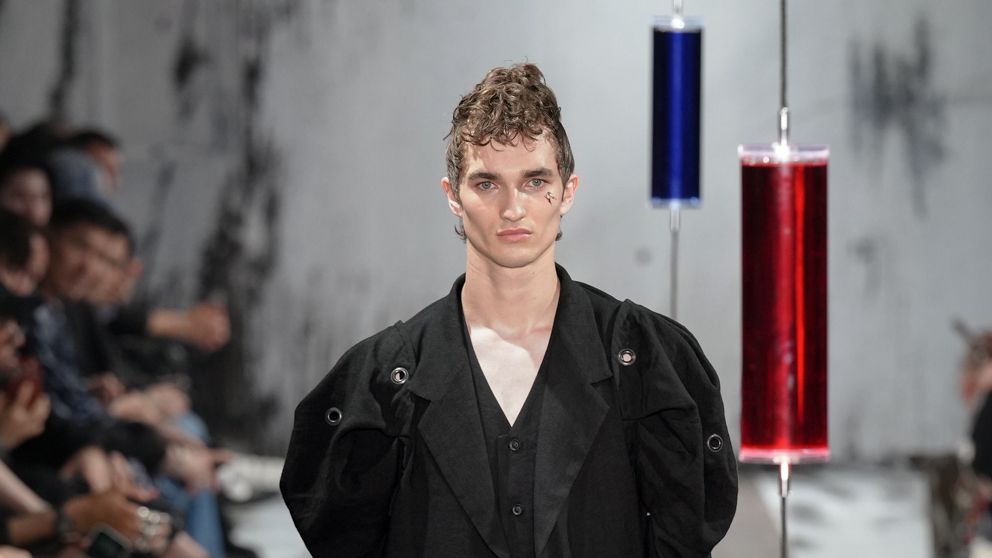
Thus, it made sense that much of this collection revisited his penchant for deconstructed and reconstructed layers, only in airier weights. Outer pieces were punctured with large eyelets, perhaps for the dual purpose of ornamentation and ventilation. Various shoe styles, whether high-tops or lace-up boots, boasted cutouts or mesh panels, ostensibly to keep feet cool, as well.
But the main design development today revolved around the architecture of shoulders and sleeves, which Yamamoto seemed to have studied with great curiosity. There were softened lanterns, sloped padded extensions and deflated gigots, along with peaked edges that recalled armor. Excess fabric that resulted in ripples of light and shadow looked like Fragonard’s depictions of bunchy sleeves. Altogether, they lent a historical bent, without compromising wearability.
As the show progressed, what emerged was a quasi-formula of loose coats that hit below the knee worn with a shirt or vest and long shorts, although there were iterations throughout, whether in grayscale prints, dramatic red devoré burnout merging with these prints; and even shirts in delicate lace. Sections of surfaces were embellished with buttons and fine red threads hung from tops that were equal parts arty and ominous. For a brief moment, the looks made a lighter turn with what looked to be beige cotton with fringed edges and then shifted once again to long, frayed knits that shimmered with silver and copper threads.
If the collection veered feminine, the designer challenged that these distinctions no longer really hold. Except for the fact that the final look was modeled by Rui Harui, who designs the jewelry for Yohji Yamamoto while running her own brand, Riefe. Mysterious in a floppy hat and an eye mask, she swung the chains that adorned her cobwebby coat as an idle gesture (that, or she was putting a hex on all of us).
After this, the models—many bearing temporarily inked birds and butterflies on their cheeks and necks—took one last stroll with their coats removed and slung over their shoulders. Whether this was part of the original plan or a flourish in sync with these scorching days, the carefully calibrated looks were not thrown off balance. And while there’s no way to know whether 2027 will prove even more extreme, here’s guessing that Yamamoto—who perseveres thanks to this creative output—will already be thinking lighter still.
