

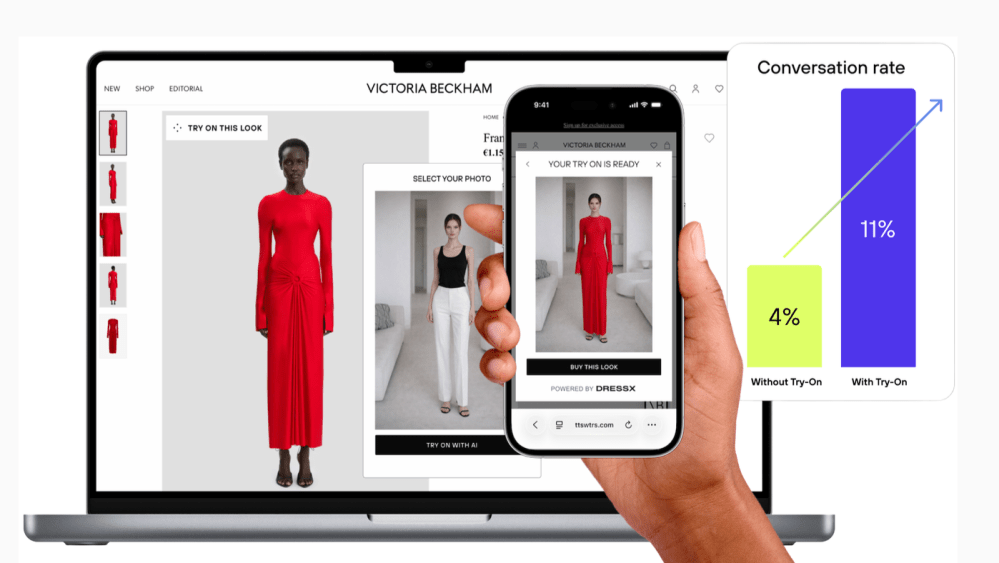
New consumer research reveals that artificial intelligence is making a difference in how people shop for apparel. For brands, that difference means a better shopping experience for their customers and higher conversion rates.
DressX, the Los Angeles-based AI solutions provider that helps fashion brands improve the shopping experience, published a new market intelligence report that found there’s a massive performance gap between digital try-on users and traditional shoppers.
The study tracked 1.2 million e-commerce shoppers across 216 countries, and it showed that virtual try-on technology, such as DressX’s AI Try-On, fundamentally alters consumer behavior, turning passive browsers into highly active buyers.
The report comes at a time when online apparel retail is facing a severe structural challenge as global revenue growth slows and return rates climb as high as 40 percent. High customer acquisition costs are further squeezing profitability. But the authors of the report said digital try-on technology can help.
Consumers who use a digital mirror tool are three times more likely to add items to their carts. They also exhibit a 50 percent increase in final purchase conversions compared to those relying on static images. Confidence drives these sales. This is especially true for premium merchandise priced over $1,000, where buyers face the highest financial risk, the authors of the report said, adding that full-body rendering has emerged as the clear consumer preference, capturing 80 percent of user engagement over basic AI twins.
“AI try-on is different because it puts the shopper inside the product experience,” the report stated. “Instead of only looking at a model or a product image, shoppers can see how a piece looks on their own body. This brings online shopping closer to the most important moment in physical retail: looking in the mirror.”
Beyond driving immediate sales, the technology functions as a powerful tool for customer retention.
A whopping 44 percent of virtual try-on users remain active 30 days after their initial visit. Meanwhile, the non-user retention rate plummets to just 1 percent. This engagement heavily anchors to smartphones, with mobile devices driving 70 percent of try-on interactions and accounting for more than four out of five revenue dollars.

On the DressX agent, one in four try-ons is a shoe.
Brands that team up with DressX are praising the technology. “Victoria Beckham has partnered with DressX to introduce an AI-powered virtual try-on tool, offering customers an innovative and interactive way to engage with the brand’s collections online,” said Kate Hurrell, head of e-commerce at Victoria Beckham. “The technology allows clients to visualize fit, silhouette and styling before making a purchase, bringing the boutique experience closer to digital platforms and enabling more confident shopping decisions.”
As fashion houses such as Victoria Beckham integrate these tools into their core digital infrastructure, the report’s authors said virtual try-ons are quickly transitioning from a novel gimmick into an absolute commercial necessity.
“Try-on is no longer just a consumer-facing visual trick,” said Daria Shapovalova, chief executive officer and founder of DressX. “It’s becoming part of the infrastructure behind how fashion is marketed and sold. As this behavior becomes native, brands increasingly begin to optimize their merchandising, content, and distribution strategies around try-on as a core touchpoint in the customer journey.”
